
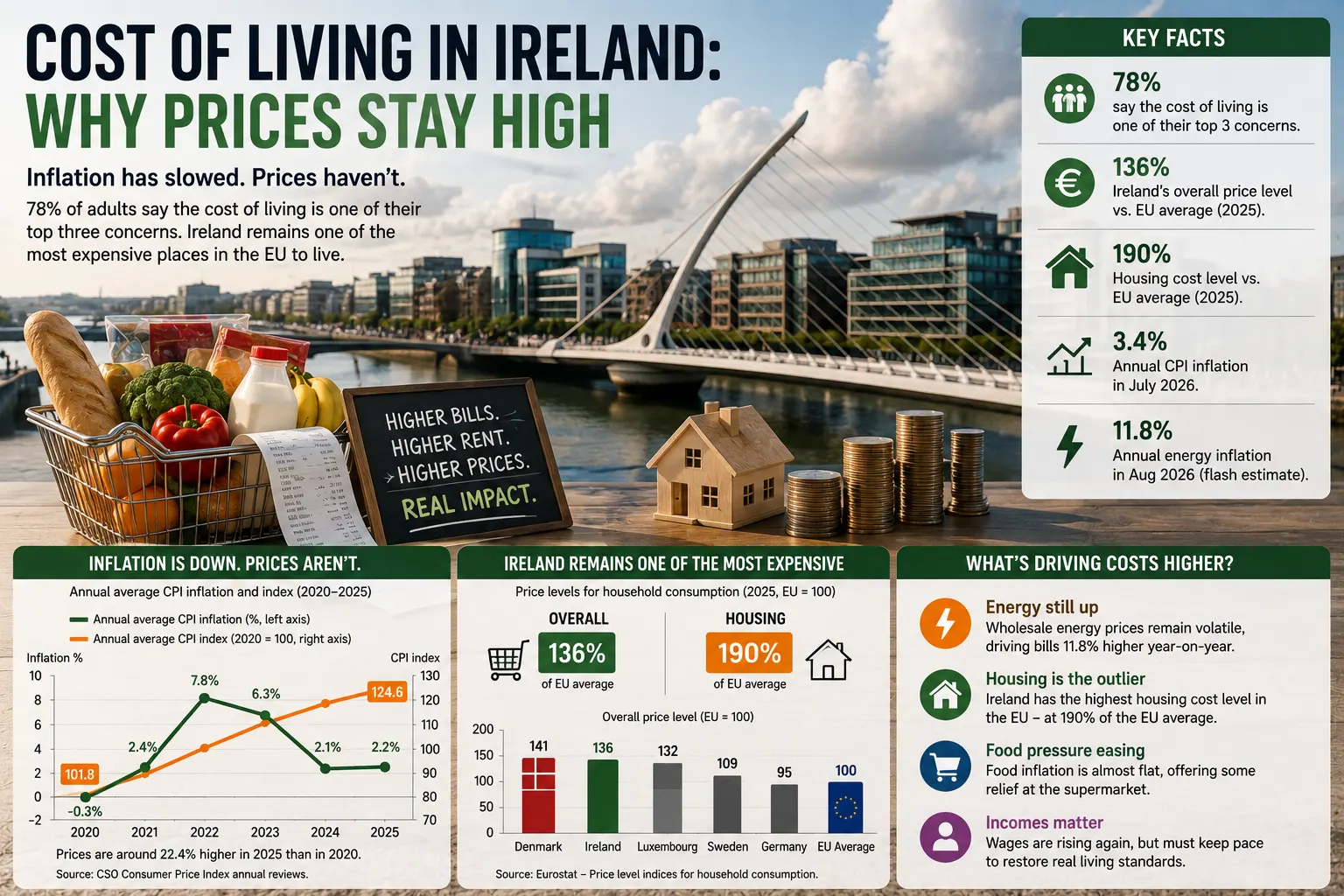
Seventy-eight per cent of adults questioned in PTSB’s latest Reflecting Ireland research placed the cost of living among their three biggest concerns. That anxiety persists even though the double-digit energy shocks of the early 2020s have passed and average earnings are again rising. The explanation is fundamental: inflation may have slowed from its peak, but the prices created by several years of inflation have not gone back down. Ireland entered the latest global energy shock already carrying one of the highest household price levels in Europe, an exceptionally expensive housing market and a heavy dependence on imported energy.
The scale of the problem is visible in European comparisons. Eurostat estimates that the overall price level for household consumption in Ireland was 136% of the EU average in 2025, making it the second-highest in the European Union after Denmark. Housing costs were estimated at 190% of the EU average, the highest level recorded among member states. These figures do not adjust for differences in wages or incomes, so they do not by themselves measure affordability. They do demonstrate, however, that an Irish household begins from a considerably higher nominal cost base than households in most of Europe.
The current inflation figures add another layer. Ireland’s Consumer Price Index was 3.4% higher in July 2026 than a year earlier. The preliminary Harmonised Index of Consumer Prices for August also showed annual inflation of 3.4%, with energy prices estimated to be 11.8% higher than in August 2025. Food inflation, by contrast, was almost flat in that flash estimate. The present cost-of-living problem is therefore no longer simply a story of everything suddenly becoming more expensive at the same speed. Different components of the household budget are now moving in very different directions.
78%: share of respondents in PTSB’s 2026 research who selected the cost of living among their three biggest concerns.
136% of the EU average: Ireland’s overall household-consumption price level in 2025.
190% of the EU average: Ireland’s housing-cost price level in 2025.
3.4%: annual Irish CPI inflation in July 2026.
11.8%: estimated annual energy inflation in the August 2026 HICP flash estimate.
The Most Important Distinction Is Between Inflation and the Price Level
A large part of the public debate becomes confusing because inflation and prices are often treated as if they were the same thing. Inflation measures how quickly prices are changing. The price level measures how expensive those goods and services have already become. If a household bill rises from €100 to €120 and subsequently increases by only 2%, inflation has fallen sharply, but the bill has not returned to €100. It has risen to €122.40.
This is approximately what happened across the Irish economy after 2020. The CSO’s annual-average Consumer Price Index increased by 2.4% in 2021, 7.8% in 2022, 6.3% in 2023, 2.1% in 2024 and 2.2% in 2025. On the CSO’s consistent index series, the annual-average CPI stood at 101.8 in 2020 and 124.6 in 2025. That represents an increase of about 22.4% in the overall consumer price level in only five years.
The effect on household psychology is powerful. A person whose weekly supermarket shop, rent, electricity bill, insurance premium and restaurant bill rose significantly during 2021–2023 does not experience relief merely because those costs later rise more slowly. Unless income has increased by a comparable amount, purchasing power remains lower.
This also explains why official statements that inflation has moderated can seem disconnected from daily life. Economically, both statements can be correct: inflation can be considerably lower than at its peak while households continue paying prices that are permanently much higher than before the inflation shock.
How Ireland’s Consumer Price Level Was Reset After 2020
| Year | Annual average CPI inflation | Annual average CPI index |
|---|---|---|
| 2020 | -0.3% | 101.8 |
| 2021 | +2.4% | 104.2 |
| 2022 | +7.8% | 112.3 |
| 2023 | +6.3% | 119.4 |
| 2024 | +2.1% | 121.9 |
| 2025 | +2.2% | 124.6 |
Source: Central Statistics Office Consumer Price Index annual reviews. The change from the 2020 to 2025 index is approximately 22.4%.
The First Shock Came From a Global Economy Emerging From the Pandemic
The transformation began before Russia’s full-scale invasion of Ukraine. During the pandemic, production was disrupted around the world while households changed what they bought. Demand shifted from services towards goods, shipping networks became congested and shortages emerged in semiconductors, building materials and other components. Governments and central banks simultaneously supported incomes and financial conditions on an unprecedented scale.
When economies reopened, demand recovered faster than parts of the supply system could respond. Freight costs, commodities and manufactured inputs became more expensive. Businesses that had absorbed temporary increases eventually began passing some of them to consumers.
Ireland was particularly exposed because it is a small, highly open economy. A large proportion of the goods, fuels and industrial inputs used in the country cross international supply chains. Being an island does not automatically explain high prices, but transport, distribution and the absence of the economies of scale available in much larger consumer markets can add to costs in some sectors.
The second and much larger shock arrived through energy. Russia’s invasion of Ukraine in 2022 transformed European gas and electricity markets. Irish energy products rose by an extraordinary 41.2% on average during 2022. Housing, water, electricity, gas and other fuels increased by 20.6% on an annual-average basis, while transport costs increased by 13.9%.
Those increases did not remain confined to household energy bills. Energy is embedded in almost everything an economy produces. Farmers use diesel and fertiliser. Food processors use electricity and gas. Supermarkets refrigerate products. Hauliers require fuel. Hotels heat rooms. Manufacturers operate machinery. Once energy becomes more expensive, the shock spreads through transport, food, construction and services.
Ireland’s Dependence on Imported Energy Makes Global Shocks Domestic Problems
The vulnerability has not disappeared. SEAI estimates that Ireland remained 78.2% dependent on imported energy in 2025, compared with the latest available EU average of 57.3%. Ireland imported all of its oil and coal requirements and more than 82% of its natural gas. Fossil fuels still accounted for the majority of the country’s energy requirement even as renewable generation continued to expand.
This matters enormously for household costs because international events can quickly affect Irish consumers. Ireland does not set the world price of oil or natural gas. When geopolitical disruption increases those prices, the effect can reach petrol stations, heating-oil deliveries, wholesale electricity markets and eventually the prices businesses charge for goods and services.
The renewed Middle East conflict in 2026 has demonstrated the mechanism again. The Central Bank of Ireland substantially increased its inflation forecast in June because of higher oil and gas assumptions. It projected energy inflation of 9.6% for 2026 and warned that prolonged disruption could produce a significantly more adverse inflation outcome.
The August HICP flash estimate suggests that this renewed energy pressure is already visible, with energy prices estimated to be 11.8% higher than a year earlier. The distinction from 2022 is scale: this is not currently a repeat of the 41% annual-average energy shock experienced during that year, but it illustrates why Ireland remains unusually exposed to events far beyond its borders.
Electricity Reveals the Structural Problem Particularly Clearly
Eurostat reported that Ireland had the highest household electricity price in the European Union in the second half of 2025, at €40.42 per 100 kilowatt-hours compared with an EU average of €28.96. The comparison was affected by the timing of Irish Government electricity credits, which had reduced measured consumer prices in earlier periods, so the year-on-year increase should not be interpreted purely as a change in underlying generation costs. Even with that qualification, electricity remains a significant element of Ireland’s high cost base.
The reasons extend beyond a single supplier or policy. Ireland’s electricity system has historically relied heavily on natural gas, much of it imported. The island has limited interconnection compared with continental electricity markets, while rapid population growth, electrification and industrial demand require substantial additional generating and network capacity.
Data centres add to that demand but should not be treated as the sole explanation for high household electricity prices. CSO data show that data centres accounted for 23% of metered electricity consumption in 2025, up from 5% in 2015. That expansion increases the importance of generation and grid investment, but household bills are shaped by wholesale energy prices, network charges, supplier costs, taxes, levies, Government supports and the overall structure of the electricity system.
The next phase will require considerable investment. The Commission for Regulation of Utilities has approved transmission and distribution charges for 2026/27 that are expected to add approximately €41.25 over a year for a typical domestic customer, although the PSO levy will fall. Network expenditure is intended to support new housing, renewable generation, security of supply and higher electricity demand. It creates a difficult timing problem: investment can increase regulated costs today while being necessary to build a system capable of reducing fossil-fuel dependence and accommodating cheaper renewable power in the future.
Housing Is the Largest Domestic Structural Cost Problem
If energy explains much of the external shock, housing explains why Ireland’s cost-of-living problem is so persistent domestically. Eurostat’s estimate that Irish housing costs were 190% of the EU average in 2025 is unusually stark. Housing affects households directly through rent or mortgage payments and indirectly through the wages and business costs required to operate in expensive cities.
The roots stretch back to the financial crisis. Ireland entered the 2008 crash after a construction boom. Development collapsed, builders left the industry, construction firms failed, finance became scarce and residential output fell dramatically. Housing demand eventually recovered faster than the sector’s ability to rebuild capacity.
Economic growth then accelerated. Employment increased, household formation resumed and Ireland attracted both returning Irish citizens and workers from abroad. Population growth added legitimate demand for homes, schools, transport, electricity, water and healthcare. The problem was not population growth in isolation; it was the inability of housing and infrastructure supply to expand quickly enough alongside that growth.
The latest CSO estimates put the population at 5.526 million in April 2026, an increase of 66,900 in a year. Net migration accounted for 48,100 of the increase, while births exceeded deaths by about 18,800. Migration is simultaneously a source of housing demand and an important source of workers for construction, healthcare, hospitality, technology and other sectors. Describing it simply as the cause of high housing costs therefore misses the underlying supply constraint.
Housing Supply Is Growing — but the Backlog Is Large
There has been genuine improvement in construction. Ireland completed 36,284 new dwellings in 2025, 20.4% more than in 2024 and the highest annual total since the current CSO series began in 2011. Apartment completions rose particularly strongly. More than half of all completions were in Dublin and the Mid-East region.
That progress does not mean the shortage has disappeared. Years of underbuilding created an accumulated deficit, while population and employment continued to grow. Housing supply must therefore satisfy new annual demand and reduce an existing shortage at the same time.
Construction also depends on much more than planning permission. Sites require water and wastewater capacity, electricity connections, roads, public transport, skilled labour and finance. Apartment developments in particular can involve large upfront capital requirements and long periods between land acquisition and final sale or rental.
Interest rates added another difficulty after 2022. Higher financing costs affect developers and prospective buyers simultaneously. A project that appeared financially viable at very low borrowing costs can become more difficult to finance when interest rates rise, while households can afford smaller mortgages at the same monthly payment.
The Government’s current housing plan aims to deliver 300,000 homes by the end of 2030, including substantial social and affordable provision, alongside additional investment in water, energy and transport infrastructure. That is an official policy target rather than a guaranteed outcome. The effect on affordability will depend on actual completions, where homes are built, the type of housing delivered and whether output grows faster than underlying demand.
Renters Experience the Housing Crisis Differently From Existing Homeowners
The national standardised average rent for a new tenancy reached €1,755 a month in the fourth quarter of 2025, according to the RTB-ESRI Rent Index. That was 5% higher than a year earlier. Existing tenancies averaged €1,503, 4.4% higher, leaving a significant gap between households already established in the rental sector and those entering a new tenancy.
This produces very different experiences of the same economy. An owner who bought a home years ago and has a small mortgage may have relatively limited exposure to current housing prices. A renter seeking a new home in Dublin, Cork or another high-demand area can face a much larger monthly housing burden. A young household attempting to save a deposit while paying market rent faces both costs simultaneously.
PTSB’s survey captures this generational anxiety. Housing prices ranked second only to the general cost of living among the issues respondents considered most important, and 52% of respondents under 35 believed they might never be able to buy a home. That is a survey of expectations rather than a forecast of actual homeownership, but it demonstrates how affordability is influencing confidence among younger adults.
House purchase prices continue to rise as well. The national Residential Property Price Index increased by 5.6% in the year to June 2026. Prices outside Dublin increased by 6.4%, compared with 4.6% in Dublin, showing that affordability pressure is no longer confined to the capital. The median dwelling transaction price over the preceding twelve months was €396,000, ranging from €198,000 in Longford to more than €682,000 in Dún Laoghaire-Rathdown.
High Housing Costs Spread Into the Rest of the Economy
Housing is not merely one item in the consumer basket. It influences the cost of producing many other services. Employers recruiting nurses, teachers, restaurant staff, engineers, construction workers and other employees must compete in labour markets where workers need enough income to pay local rents or mortgages.
When housing costs rise faster than incomes, workers have a rational incentive to seek higher wages. Businesses then face higher labour costs. Some can absorb them through lower profits or productivity improvements, while others pass part of the increase to consumers through higher prices.
Commercial property costs can create a similar channel. Restaurants, shops, childcare providers and other businesses pay rents, energy bills, insurance and wages before selling anything to a customer. A country in which several of those inputs are expensive will generally also have expensive local services.
This is one reason solving housing supply matters beyond homebuyers and tenants. Greater availability of reasonably priced housing can improve labour mobility, reduce recruitment pressures and moderate one of the costs embedded throughout the wider service economy.
Food Inflation Has Slowed, but Grocery Prices Still Carry the Earlier Shock
Food provides another example of the difference between inflation and the price level. The August 2026 flash HICP estimate suggested that food prices were only 0.1% higher than a year earlier and had fallen slightly during the month. That is very different from 2023, when food and non-alcoholic beverages increased by 9.8% on an annual-average basis.
Consumers nevertheless continue to compare present supermarket bills with what they remember paying before that surge. Stable food prices in 2026 do not reverse the increases already accumulated in 2022 and 2023.
Detailed European comparisons also show that Irish food starts from a relatively high level. CSO analysis for 2024 found that food prices were about 12% above the EU average, while non-alcoholic beverages were approximately 40% above the EU average. The differences vary widely by product category, and taxation has a particularly large effect on alcohol and tobacco.
Ireland’s large domestic agricultural sector does not insulate supermarket prices from international costs. Farms purchase energy, fertiliser, machinery and animal feed. Food must be processed, packaged, refrigerated, transported and sold through stores that themselves carry labour, electricity, property and insurance costs. A domestically produced food item can therefore contain several imported or internationally priced inputs before reaching the consumer.
Competition between supermarkets can influence margins and promotional pricing, but it cannot eliminate upstream cost increases. The resulting retail price reflects the entire chain rather than the cost of the agricultural commodity alone.
Fuel Prices Combine Global Oil Markets With Domestic Taxation
Petrol and diesel have a similarly complex structure. Ireland imports all of its oil requirements, making pump prices highly sensitive to global crude and refined-product markets. Currency movements, refining margins, distribution costs and geopolitical disruption therefore affect Irish motorists before domestic taxation is considered.
Taxes and levies also form a substantial and visible component of fuel prices. Government can change that component, and it has repeatedly used temporary excise reductions, postponed tax increases and other interventions during periods of exceptional energy pressure. Those measures cushion the consumer price but do not remove the underlying dependence on international oil.
In July 2026, the CSO’s national average prices were approximately €1.77 per litre for petrol and €1.76 for diesel. Both were higher than a year earlier, although subsequent movements in global energy markets mean a monthly statistical observation can quickly become outdated.
The burden varies geographically. Households in Dublin and other large urban areas may have access to rail, buses, cycling infrastructure or shorter journeys. Rural households often have fewer alternatives to private cars and can travel greater distances for work, education, healthcare and shopping. A rise in petrol or diesel therefore has a larger practical effect on some households even when everyone sees the same pump price.
Insurance Is Rising — but Not All Insurance
Insurance is another category where broad descriptions can hide important differences. The CSO reported that insurance and financial services prices were 5.5% higher in July 2026 than a year earlier, while insurance itself increased by 5.7%. Yet the individual components moved in opposite directions.
Health insurance was 9% more expensive than a year earlier. By contrast, motor-car insurance prices were 3.9% lower and dwelling insurance was 3% lower. The present complaint that “insurance is becoming more expensive” is therefore most accurate for health insurance rather than every form of cover.
Health-insurance premiums are influenced by medical treatment costs, claims, utilisation, the age profile of insured members, technology and the prices charged by healthcare providers. Those pressures interact with a broader Irish healthcare system in which access and waiting times remain major public concerns. In the same PTSB survey, access to affordable healthcare was the third most frequently selected national concern.
The distinction matters for policy. Measures that reduce motor-insurance claims costs do little to solve medical inflation, just as reforms to private healthcare funding do not necessarily affect home insurance. Treating “insurance costs” as a single problem can therefore lead to the wrong diagnosis.
Services Have Become the More Persistent Part of Inflation
The composition of inflation has changed since the peak of the energy crisis. In July 2026, services prices were 4.1% higher than a year earlier while goods prices increased by 2.5%. That pattern matters because services tend to be more dependent on domestic wages, rents and operating costs than globally traded manufactured goods.
A television or mobile phone can be manufactured in a huge international factory and sold into millions of markets. A haircut, childcare place, restaurant meal, plumbing repair or hotel room must largely be provided locally. Productivity improvements can reduce some service costs, but many services still require substantial amounts of human labour for every customer.
Ireland is a high-wage economy by European standards. That supports household income and living standards, but it also makes labour-intensive services expensive. Higher wages are not a defect in themselves; the problem arises when housing, energy and other essential costs rise so rapidly that wage gains do not translate into proportionately better purchasing power.
Average weekly earnings reached €1,046.88 in the second quarter of 2026, 3.9% higher than a year earlier. On average, that rate was slightly above July CPI inflation. But an average does not describe every household. Earnings growth differs by occupation and sector, while a renter signing a new lease can experience a much larger increase in personal costs than a homeowner with no mortgage.
Why Higher Average Wages Do Not Make Everyone Feel Better Off
There are three reasons national wage growth can coexist with widespread financial pressure. The first is the accumulated price increase since 2020. A 4% wage increase this year may preserve purchasing power against current inflation, but it does not automatically compensate for every price increase accumulated during the previous five years.
The second is distribution. Workers do not all receive the national average increase. Pensioners, students, unemployed people and households dependent on fixed or partially indexed incomes face different circumstances. Two people earning identical salaries can also have very different disposable incomes if one bought a home ten years ago and the other is paying a new-market rent.
The third is that essential expenses cannot easily be avoided. Households can postpone buying furniture or electronics, but they cannot simply stop paying rent, heating a home, buying basic food or travelling to work. Inflation concentrated in necessities can therefore create more distress than the same statistical inflation rate concentrated in discretionary products.
The Central Bank’s current forecast illustrates the problem. It expects nominal compensation per employee to increase by about 4% in 2026, yet projects real gross disposable income per household to decline by around 1% this year because higher prices, particularly energy, erode purchasing power. Modest real-income growth of about 0.7% a year is projected for 2027 and 2028.
Where Ireland’s Cost Pressure Is Most Visible
| Indicator | Latest reference period | Measure |
|---|---|---|
| Overall consumer prices | July 2026 | +3.4% year on year |
| Housing, energy and utilities | July 2026 | +7.7% |
| Private rents | July 2026 | +4.5% |
| New-tenancy rent | Q4 2025 | €1,755 per month |
| Residential property prices | June 2026 | +5.6% |
| Health insurance | July 2026 | +9.0% |
| Services prices | July 2026 | +4.1% |
Source: Central Statistics Office and RTB-ESRI Rent Index. Measures use different statistical series and reference periods and should not be added together.
Ireland’s High GDP Does Not Mean Every Household Is Rich
Ireland presents another statistical complication. Conventional GDP per person is extraordinarily high because the accounts include the activities, intellectual property and international profits of large multinational companies headquartered or operating through Ireland. GDP is essential for measuring economic production, but in Ireland it can provide a misleading impression of the resources available to the typical household.
That is why institutions including the Central Bank frequently focus on modified domestic demand and modified gross national income when assessing the domestic economy. These measures attempt to reduce some of the distortions created by multinational balance sheets.
A country can therefore appear extremely wealthy in international GDP rankings while households still struggle with rent, childcare, healthcare or electricity. There is no contradiction. Corporate production and household disposable income are different concepts.
This also helps explain public frustration with comparisons suggesting that Ireland should easily be able to afford high prices because wages or GDP are high. Affordability depends on the relationship between each household’s disposable income and the costs it actually faces, not on a national GDP statistic.
The Cost Burden Is Unequal Across Generations and Regions
The national cost-of-living debate often treats “the household” as a single economic unit, but there are several very different Irelands. A mortgage-free homeowner in a rural county, a family renting a new apartment in Dublin, a young worker sharing accommodation in Cork and an older person living alone face different combinations of costs.
Urban renters generally face the highest housing payments, particularly in Dublin and surrounding counties. Yet house-price growth has recently been stronger outside Dublin, showing how affordability pressure has spread geographically. Smaller towns that once offered a substantial discount can experience rapid price increases when demand rises faster than supply.
Rural households typically benefit from lower housing costs than Dublin households but can face greater dependence on cars, heating oil and longer journeys. Energy and fuel shocks can therefore have a disproportionately large effect on their budgets. Limited public transport can make cutting fuel consumption difficult.
Age also matters. Older owner-occupiers may have little or no housing debt but can be more exposed to heating and healthcare costs. Younger adults can face rent, deposits, childcare and the challenge of saving for a home simultaneously. Families with children often experience a broad basket of costs that includes housing, transport, food, childcare and education-related expenditure.
CSO poverty data underline the importance of tenure. In the Survey on Income and Living Conditions 2025, people in rented or rent-free accommodation had a substantially higher at-risk-of-poverty rate than those in owner-occupied housing. The survey also found that Government cost-of-living measures reduced the estimated national at-risk-of-poverty rate from what would otherwise have been 14.9% to 12.6%.
Government Can Cushion Prices More Easily Than It Can Change Their Causes
Successive Irish governments have responded to cost pressures with electricity credits, welfare payments, fuel-tax changes and other temporary measures. These interventions can have significant distributional effects. The CSO poverty analysis provides evidence that recent cost-of-living supports materially reduced measured poverty risk.
But temporary transfers and tax reductions operate differently from structural reform. An electricity credit can reduce this winter’s bill; it does not build a power station or interconnector. A rent support can help a household make a payment; it does not create another apartment. A fuel-duty reduction can lower the pump price; it does not reduce Ireland’s dependence on imported oil.
This distinction explains a recurring policy dilemma. During a severe shock, temporary support can prevent hardship and protect consumption. If broad subsidies are maintained indefinitely, however, they become expensive for the Exchequer and can support overall demand without increasing the supply of the goods and services whose prices are causing the problem.
Long-term affordability therefore depends more on capacity: homes, electricity generation, grids, transport, childcare, healthcare staffing and productive businesses. Those investments take years and can themselves be expensive while they are being built.
Taxes Matter, but They Do Not Explain Ireland’s Entire Price Gap
Taxation is an important component of several highly visible prices. Excise duty and carbon taxation affect petrol, diesel, heating fuels, alcohol and tobacco. VAT applies to many goods and services. Levies form part of energy bills. Changes to these rates can therefore make a noticeable difference to household expenditure.
But the conclusion that Ireland is expensive simply because it has high taxes does not fit the full evidence. Housing costs are exceptionally high because of supply and demand, land and construction economics, infrastructure constraints and financing. Food prices reflect processing, distribution, energy and labour as well as taxation. Services depend heavily on wages and commercial costs.
Electricity provides a particularly useful example. Government credits temporarily reduced measured household electricity prices, meaning State intervention actually pulled the consumer price down in some periods. Their expiration then made later comparisons appear much higher. Tax and subsidy policy can therefore move measured prices in both directions.
The more useful question is not whether tax contributes to a price but whether changing that tax would solve the underlying constraint. Sometimes it can provide meaningful short-term relief. Often the structural problem would remain.
A High-Cost Economy Can Begin Reinforcing Itself
The most important long-term risk is a feedback loop. Housing, energy and transport become expensive. Employees require higher nominal incomes to maintain living standards. Businesses face higher wage bills and pass part of those costs into service prices. Government and public-sector employers also encounter stronger wage demands. Higher service prices then reinforce the household perception that living costs remain elevated.
Economists describe part of this mechanism as second-round inflation. It should not be confused with workers causing the original inflation shock. Employees seeking higher wages after their purchasing power has fallen are responding to earlier price increases. The issue is whether that adjustment eventually becomes persistent enough for wages and prices to reinforce one another.
The Central Bank reported in June that there was not yet widespread evidence of such second-round effects becoming entrenched, but it identified the risk as significant. Services inflation is expected to remain above 3% throughout its current forecast horizon, even after energy inflation moderates.
Productivity is the most sustainable way to escape that tension. If workers produce more value per hour, firms can pay higher wages without increasing prices proportionately. Housing supply, infrastructure, technology, training and efficient public services therefore have a direct relationship with long-term affordability.
High Costs Can Become a Competitiveness Problem
Ireland’s economy has major advantages: a skilled workforce, access to the EU single market, a large multinational sector, a strong export base and relatively favourable demographics compared with many European countries. A persistently high domestic cost base can nevertheless weaken some of those advantages.
Recruitment becomes harder if workers cannot find affordable housing near employment. Businesses may need to pay higher salaries simply to compensate for rent rather than improved productivity. Restaurants, hotels, retailers and small service companies can face difficulty passing higher costs to consumers without losing demand.
The effects differ between sectors. A highly profitable multinational exporting pharmaceuticals or software may be able to absorb Irish wage and property costs relatively easily. A local café, nursing home, childcare provider or small manufacturer operates with very different margins.
Public services face the same housing market as private employers. Hospitals and schools may technically have vacancies but still struggle to recruit in expensive regions if potential employees cannot find accommodation. Housing affordability therefore becomes part of healthcare, education and infrastructure policy even though those systems appear separate in government accounts.
The Housing Shortage Can Also Influence Migration Decisions
Ireland has historically relied on mobility in both directions. Workers arrive when employment expands, while Irish workers can move abroad when domestic opportunities weaken or the relative attraction of living elsewhere improves. Housing changes that calculation because a higher salary does not necessarily create a higher standard of living if accommodation consumes much of the gain.
The April 2026 population estimates show both large immigration and substantial emigration: 110,600 people arrived and 62,500 departed during the preceding twelve months. Among those leaving were Irish citizens as well as migrants of other nationalities. These flows cannot be attributed solely to housing because education, family, employment, lifestyle and international opportunities also matter.
Persistently poor affordability could nevertheless become a structural recruitment risk if skilled workers conclude that their disposable income is higher elsewhere. The same applies to Irish citizens considering whether to return from abroad.
This is one reason housing cannot be treated simply as a social-policy issue. It is increasingly part of national economic capacity.
Ireland Is Trying to Build Its Way Out of Two Constraints at Once
The response now requires simultaneous expansion of housing and energy infrastructure. New homes need electricity and water connections. New electricity infrastructure needs planning, capital and skilled construction workers. Electrification of cars and heating increases power demand while the country is simultaneously attempting to replace imported fossil fuels with renewable generation.
These objectives compete for some of the same scarce resources: engineers, builders, land, grid connections, public investment and planning capacity. A rapidly growing economy can therefore encounter bottlenecks even when money is available.
The Government’s housing plan and the regulated investment programme for electricity networks both attempt to increase capacity over several years. Their success cannot be judged solely by spending commitments. The economically relevant outcome is how many additional homes, megawatts, connections and transport options are actually delivered.
There is also an unavoidable timing problem. Infrastructure investment often costs households and taxpayers before its benefits appear. Grid expenditure can raise regulated charges before additional renewable energy comes online. Construction activity can increase demand for labour before new housing reduces accommodation shortages. Structural repair can therefore initially coexist with continuing high prices.
Renewable Energy Offers a Long-Term Hedge Against Imported Fuel Prices
Increasing wind, solar, storage and interconnection is not merely a climate policy. For an economy importing virtually all of its oil and most of its gas, it is also a strategy for reducing exposure to international fossil-fuel prices.
Renewable energy accounted for 15.9% of Ireland’s overall energy requirement in 2025, while renewable sources supplied a substantially larger share of electricity. Wind remains Ireland’s dominant indigenous renewable resource. Further electrification could gradually shift transport and heating away from imported oil and gas.
That does not guarantee permanently cheap electricity. Renewable systems require grids, storage, backup capacity and market reform, while financing costs affect new projects. Ireland will also remain connected to European and global energy markets.
The strategic benefit is a reduction in exposure rather than complete isolation. Every kilowatt-hour generated from domestic wind or solar reduces the amount of imported fuel required elsewhere in the system. Over time, that can make household and business costs less sensitive to geopolitical shocks such as those experienced in 2022 and 2026.
Falling Inflation Will Probably Mean Slower Price Increases, Not Cheaper Living
The Central Bank’s baseline forecast provides the clearest guide to the likely near-term future. It expects HICP inflation of 3.5% in 2026, slowing to 2.9% in 2027 and 2.0% in 2028. The ESRI’s summer forecast is somewhat higher for the first two years, at 3.7% CPI inflation in 2026 and 3.1% in 2027. Forecasts differ because they use different assumptions and inflation measures, but both point in the same broad direction: inflation moderates rather than turning into sustained deflation.
That distinction means the general price level is likely to continue increasing. A return to 2% inflation would be economically welcome, but it would mean a €100 basket becoming approximately €102 the following year, not returning to the €80 or €85 it might have cost several years earlier.
Individual prices can certainly fall. Energy prices can retreat, supermarket products can become cheaper and competition can reduce particular service costs. But broad, sustained deflation across the whole economy is neither the central forecast nor normally the objective of monetary policy because persistent deflation can weaken wages, investment and employment.
For households, the route back to affordability therefore depends primarily on income rising faster than prices and on structural costs — especially housing and energy — taking a smaller share of disposable income.
Central Bank Baseline: Inflation Is Expected to Slow, Not Reverse
| Year | HICP inflation | Real household disposable income |
|---|---|---|
| 2026 | 3.5% | -1.0% |
| 2027 | 2.9% | +0.7% |
| 2028 | 2.0% | +0.7% |
Source: Central Bank of Ireland Quarterly Bulletin Q2 2026. Forecasts are subject to substantial uncertainty, particularly around international energy prices.
The Most Likely Scenario to 2030 Is a High-Price Economy With Gradually Improving Affordability
The most plausible scenario is neither a dramatic cost collapse nor continuously accelerating inflation. If the international energy situation stabilises, inflation should gradually fall towards the 2% region while nominal wages continue increasing. Under that combination, household purchasing power can slowly recover even though the absolute level of prices remains high.
Housing is likely to remain the decisive domestic variable. If annual completions rise materially and remain high for several years, the gap between population demand and supply can begin to narrow. That would not necessarily produce falling house prices nationally. A more realistic successful outcome would be slower rent and property-price growth, greater availability and incomes gradually catching up.
Failure to raise housing supply would produce the opposite outcome. Continued population and employment growth would compete for an insufficient stock of homes, keeping rents and purchase prices high even after general inflation normalises. Wage pressure would continue and some employers would struggle to recruit.
Energy presents a similar fork. Continued investment in renewable generation, grids, efficiency, storage and interconnection can reduce exposure to imported fossil fuels. Delays would leave Ireland vulnerable to repeated international oil and gas shocks.
Services are likely to remain comparatively expensive under either scenario because Ireland is a high-income economy and many services are labour intensive. The central question is whether productivity and wages rise quickly enough to make those prices affordable.
A Worse Scenario Would Begin With Another Prolonged Energy Shock
The greatest near-term risk comes from geopolitics. The Central Bank has explicitly modelled a more severe energy scenario in which inflation could approach 5% in 2027. That is not its baseline forecast, but it demonstrates the vulnerability created by imported fossil fuels.
A prolonged oil and gas shock would affect more than electricity and petrol. Transport, agriculture, manufacturing, food processing and hospitality would again experience higher input costs. Employees would seek compensation for another decline in real income, increasing the possibility of second-round service inflation.
Government could again use excise reductions, transfers or energy supports, but repeated large interventions would carry fiscal costs. If the underlying imported fuel remains expensive, the State can redistribute that cost between households and taxpayers but cannot make it disappear.
A simultaneous housing shortage would magnify the damage because households would have less room in their budgets to absorb higher energy costs. The combination of structural domestic scarcity and an external commodity shock is therefore considerably more dangerous than either problem separately.
A Better Scenario Requires Supply to Grow Faster Than Demand
The more favourable path does not require Ireland to become one of Europe’s cheapest economies. High-income countries commonly have relatively high service prices. What matters for living standards is whether incomes, productivity and public services justify that price level.
In housing, this would mean sustained construction sufficient to meet new demand and gradually reduce the existing shortage. In energy, it would mean increasing domestic renewable output and grid capacity faster than electricity demand grows. In transport, it would mean giving more households realistic alternatives to imported petrol and diesel.
For businesses, greater productivity would make higher wages sustainable without equivalent price increases. For public services, better capacity could reduce the private costs households incur when public provision is difficult to access.
None of these changes can be delivered through a single Budget. They depend on infrastructure, skills, construction capacity, regulation and investment extending across several political cycles. This is why the cost-of-living debate is ultimately about the productive capacity of the economy rather than simply this month’s inflation figure.
Ireland’s Cost Problem Has Changed — and Policy Must Change With It
The first phase of the cost-of-living crisis was dominated by a global inflation shock. Pandemic disruption, energy markets and the war in Ukraine pushed prices upward at a speed households had not experienced for decades. Government support was appropriately focused on preventing an exceptional temporary shock from overwhelming household budgets.
The present phase is different. Some global pressures remain — most notably energy — but Ireland now faces a high-price structure that contains deeply domestic elements. Housing supply is inadequate relative to demand. Electricity infrastructure requires major investment. Labour-intensive services remain expensive. Healthcare costs are placing pressure on insurance premiums. Population and economic growth are testing infrastructure that takes years to expand.
The 78% of people telling PTSB that the cost of living is among their biggest concerns are therefore responding to more than one year of inflation. They are experiencing the accumulated result of several economic cycles at once.
There is positive evidence as well. Housing completions reached a series high in 2025. Renewable generation is expanding. Earnings are increasing. Government cost-of-living measures have measurably reduced poverty risk. Inflation is expected eventually to moderate if international energy markets stabilise.
But the central expectation should be realistic: Ireland is unlikely simply to return to the prices of 2019 or 2020. The roughly 22% increase in the annual-average CPI between 2020 and 2025 has largely reset the nominal cost base. The challenge now is to make incomes and supply catch up with that higher level.
That makes housing construction, energy security, infrastructure and productivity more important than waiting for prices to reverse. If Ireland succeeds in expanding those capacities, the country can remain relatively expensive while becoming more affordable to the people who live in it. If supply continues to lag behind a growing economy and population, even low headline inflation will not remove the pressure felt in household budgets.
The future of Ireland’s cost of living will therefore be determined less by whether inflation falls from 3.4% to 2% than by something more fundamental: whether ordinary household incomes can begin rising faster than the unavoidable costs of having a home, heating it, travelling to work and accessing essential services.
Sources
PTSB — Reflecting Ireland Housing and Homeownership 2026
Central Statistics Office — Consumer Price Index July 2026
Central Statistics Office — Flash Estimate for the Harmonised Index of Consumer Prices August 2026
Central Statistics Office — Consumer Price Index December 2025 and Annual Review
Eurostat — Household Consumption Price Levels Across the EU in 2025
Eurostat — EU Household Electricity Prices in 2025
Sustainable Energy Authority of Ireland — Ireland’s Energy Supply and Security of Supply 2025
ESRI and Residential Tenancies Board — RTB Rent Index Q4 2025
Central Statistics Office — New Dwelling Completions Q4 2025
Central Statistics Office — Residential Property Price Index June 2026
Central Statistics Office — Population and Migration Estimates April 2026
Central Statistics Office — Earnings and Labour Costs Q2 2026
Central Statistics Office — Survey on Income and Living Conditions 2025
Commission for Regulation of Utilities — 2026/27 Electricity Network Charges and PSO Levy
Central Bank of Ireland — Quarterly Bulletin Q2 2026
Department of Housing — Delivering Homes, Building Communities 2025–2030
Source & Transparency
This article is published by Ireland Newspaper for editorial and informational purposes.
Published: 3 September 2026 · Updated: 3 September 2026

Newsroom Ireland Newspaper
Ireland Newspaper editorial team prepares daily news coverage for readers in Ireland and abroad.




Market data, financial news and economy content on Ireland Newspaper are provided for editorial and informational purposes only. They do not constitute financial advice, investment advice, trading advice or a recommendation to buy, sell or hold any financial product. Always verify live prices and consult a qualified professional before making financial decisions.