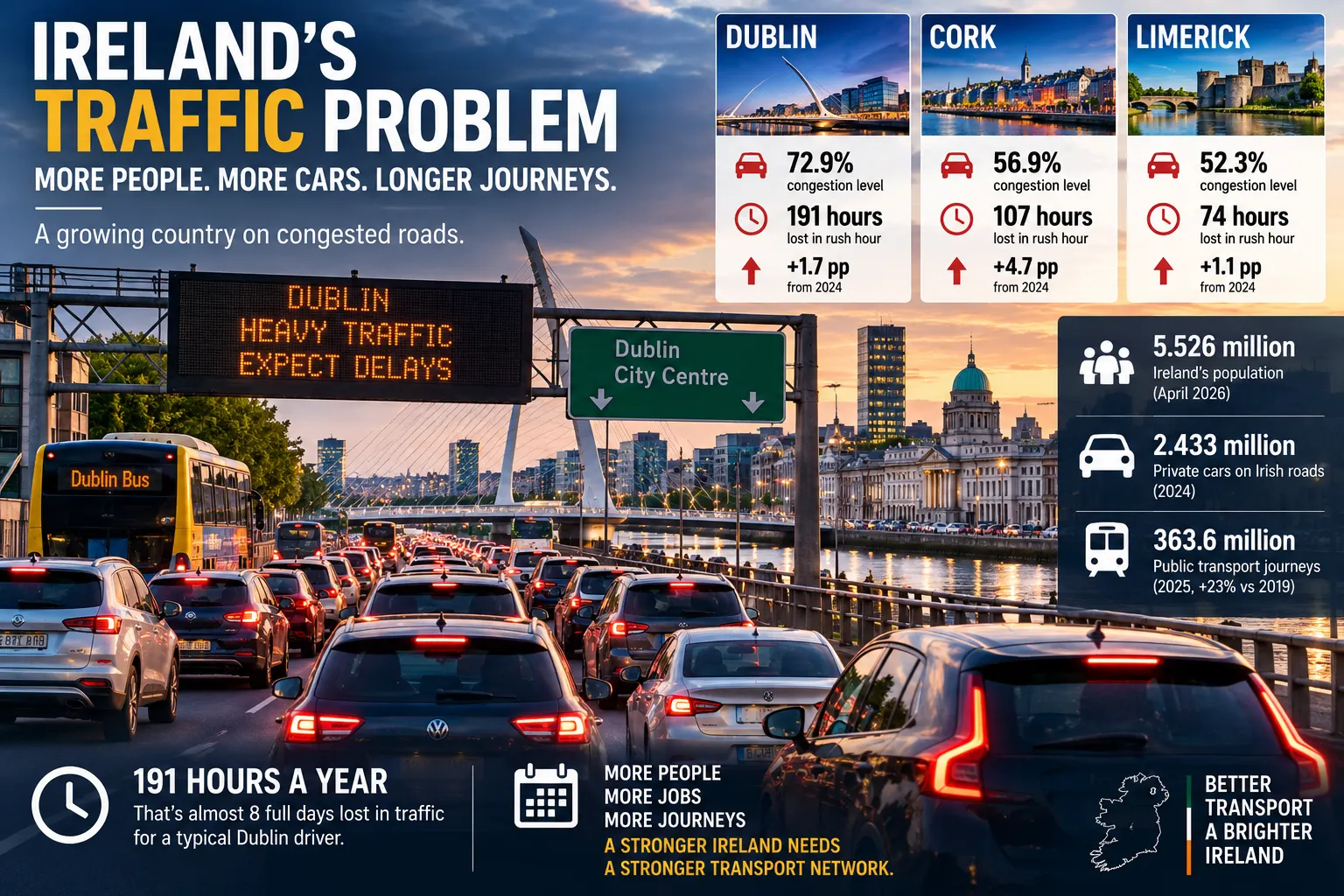
Ireland’s traffic problem can be measured in hours. TomTom estimates that a typical Dublin driver travelling during rush hour lost 191 hours to congestion in 2025, equivalent to almost eight full days. Cork drivers lost 107 hours and those in Limerick 74. At the same time, Ireland’s population has reached an estimated 5.526 million, almost one million more people than were counted in the 2011 census. The central problem is therefore not that Ireland has stopped investing in transport; it is that population, employment, housing and car ownership have expanded while the infrastructure capable of moving large numbers of people efficiently is only gradually catching up.
Dublin’s average congestion level reached 72.9% in TomTom’s 2025 Traffic Index, 1.7 percentage points higher than in 2024. Cork rose much more sharply, by 4.7 percentage points to 56.9%, while Limerick increased to 52.3%. Dublin ranked third among the cities in TomTom’s worldwide 2025 ranking by this measure, behind Mexico City and Bengaluru.
The number should be understood correctly. A congestion level of 72.9% does not mean that Dublin’s roads are blocked for 72.9% of the day. TomTom calculates the measure by comparing actual travel times with those recorded when traffic is flowing freely. A 72.9% congestion level therefore means that journeys across the measured road network took, on average, about 72.9% longer than their free-flow benchmark because of excess traffic.
Irish congestion in 2025
Dublin: 72.9% congestion level and 191 rush-hour hours lost.
Cork: 56.9% and 107 hours lost.
Limerick: 52.3% and 74 hours lost.
Ireland’s estimated population in April 2026: 5,525,600.
Private cars under current licence in 2024: 2.433 million.
Public transport journeys in 2025: 363.6 million, 23% above 2019.
Dublin’s Rush Hour Has Become a Different Transport System
The difference between normal road conditions and peak periods is particularly striking in Dublin. Across all times of the day, TomTom calculated an average 10-kilometre journey at 34 minutes and 29 seconds in 2025. During the morning rush hour the same distance averaged 43 minutes and 48 seconds, while during the evening peak it took 45 minutes and seven seconds.
Average rush-hour speeds were only 13.7 km/h in the morning and 13.3 km/h in the evening. On Dublin’s worst traffic day of 2025, 11 December, the average congestion level reached 122%, rising to 225% at 5pm. Such figures illustrate why small disruptions can have disproportionate effects when the network is already operating close to capacity.
Cork’s absolute travel times were lower but its deterioration was faster. An average 10-kilometre journey took 23 minutes and ten seconds, rising to around 28 and a half minutes in both morning and evening rush hours. Rush-hour speeds averaged close to 21 km/h. Limerick remained faster than either Dublin or Cork but still recorded a 52.3% congestion level and 74 hours of annual rush-hour delay.
Traffic Pressure in Ireland’s Three Cities Measured by TomTom
| City | Congestion level | Rush-hour time lost | Change from 2024 |
|---|---|---|---|
| Dublin | 72.9% | 191 hours | +1.7 pp |
| Cork | 56.9% | 107 hours | +4.7 pp |
| Limerick | 52.3% | 74 hours | +1.1 pp |
Source: TomTom Traffic Index 2025. Congestion level measures additional travel time relative to free-flow conditions.
Ireland Added Nearly a Million People in Fifteen Years
Traffic cannot be separated from Ireland’s demographic transformation. The 2011 census recorded 4,588,252 people. By 2022 the census population had risen to 5,149,139, and the CSO’s latest annual estimate puts the usually resident population at 5,525,600 in April 2026. Because census counts and annual population estimates use somewhat different population concepts, they are not perfectly interchangeable, but the direction and scale of change are unmistakable.
In the twelve months to April 2026 alone, the population increased by 66,900. Net migration contributed 48,100 of that increase and natural population growth approximately 18,800. More people require more homes, workplaces, schools, shops, healthcare and journeys, and many of these additional trips occur on infrastructure whose basic layout was designed for a substantially smaller country.
Dublin has absorbed a particularly large share of the growth. The CSO estimates its population at 1,597,700 in April 2026, representing 28.9% of the State. Dublin’s share of the national population has itself increased, from 27.6% in 2011. The capital is therefore experiencing both national population growth and a continuing concentration of people and economic activity.
The problem is not confined to Dublin. The revised National Planning Framework now plans for a national population of approximately 6.1 million to 6.3 million by 2040. That means today’s traffic pressure cannot reasonably be treated as a temporary peak that will disappear when one or two road projects are completed. Ireland is planning for hundreds of thousands of additional residents and the journeys that accompany them.
Ireland’s Population Growth
| Year | Population | Measure |
|---|---|---|
| 2011 | 4,588,252 | Census |
| 2016 | 4,761,865 | Census |
| 2022 | 5,149,139 | Census |
| 2026 | 5,525,600 | Annual estimate |
Source: Central Statistics Office. The 2026 annual estimate and census figures use different population concepts and should therefore be read as a broad long-term comparison.
More People Have Also Meant Many More Cars
Ireland’s motor-vehicle fleet has expanded alongside the population. In 2015 there were approximately 1.985 million private cars under current licence. By 2019 the figure had reached 2.175 million, and by 2024 it stood at 2.433 million. That is an increase of almost 450,000 private cars in nine years.
The total licensed vehicle fleet, including goods and other vehicles, reached 3.143 million in 2024. It increased by 4.7% in just one year. This matters because roads do not respond to population growth alone; what determines congestion is how many trips people make, where they travel, at what time and which mode they use.
The pandemic initially interrupted established traffic patterns through lockdowns and widespread home working. It did not permanently reverse motorised travel demand. Transport Infrastructure Ireland told the Oireachtas in May 2026 that traffic volumes increased across the national road network during 2025, with M50 traffic rising by another 2%. Since the end of the pandemic, M50 volumes have increased by approximately 10%.
This helps explain why congestion can worsen despite hybrid working. Remote work removed millions of commuting journeys compared with a scenario in which everybody returned to an office five days a week, but population, employment and vehicle ownership continued to grow. Working from home has acted as a pressure-relief valve rather than eliminating the underlying demand.
Growth of Ireland’s Private Car Fleet
| Year | Private cars | All licensed vehicles |
|---|---|---|
| 2015 | 1.985 million | 2.570 million |
| 2019 | 2.175 million | 2.806 million |
| 2022 | 2.256 million | 2.919 million |
| 2024 | 2.433 million | 3.143 million |
Source: Central Statistics Office, Environmental Indicators Ireland 2025.
Ireland’s Housing Crisis Is Also a Transport Problem
One of the most important causes of congestion lies outside transport policy itself. Employment is concentrated in Dublin and the other large urban centres, but many workers cannot afford or cannot find suitable housing close to those jobs. The resulting compromise is familiar across Ireland: a household moves farther from the employment centre to obtain housing and absorbs the difference through a longer commute.
Research by the Economic and Social Research Institute has found measurable evidence of this relationship. Analysing commuting flows between 2011 and 2016, researchers estimated that a 10% increase in rents in employment centres was associated with an increase of up to 0.6 minutes in average one-way commuting times nationally. The effect on any individual journey may appear modest, but across hundreds of thousands of workers the spatial relationship between housing and employment becomes highly significant.
The CSO’s more recent data show how the geography has developed. Between 2016 and 2022, satellite urban towns grew by 12.2%, faster than the 8.4% increase recorded across the State under the same classification. These are precisely the kinds of settlements from which large numbers of workers travel towards nearby cities.
In 2022, 16.4% of workers commuting to Dublin city and suburbs lived in satellite urban towns, while another 9.1% came from rural areas. Cork displayed an even stronger rural commuting relationship: almost a quarter of workers travelling to Cork city and suburbs came from rural areas. The transport consequence is obvious. The farther homes are dispersed from concentrated employment, the harder it becomes to provide every origin with a frequent direct public-transport service.
The Longest Commutes Form a Ring Around Dublin
The pattern becomes even clearer when journey times are examined by county. In Census 2022, 19% of commuters in Meath travelled for an hour or more to reach work. The proportion was 18% in Wicklow and 17% in Kildare. Laois also exceeded 17%, while Fingal was close to 15%.
These are not random geographic outliers. They form much of Dublin’s wider labour and housing market. When homes within the capital become scarce or expensive, households can move into neighbouring counties while retaining jobs in Dublin. That may solve the household’s housing problem while adding a recurring transport requirement that can last for decades.
The effect reaches beyond the M50. Long-distance commuters converge on motorways, rail stations, park-and-ride facilities and arterial bus corridors at the same times. Congestion can therefore begin far outside the city centre before being concentrated onto a relatively small number of approaches to Dublin.
Average national figures hide these pressures. A worker living near an independent regional town may have a relatively short journey, while a household in a commuter settlement can spend well over an hour each way. Traffic is therefore partly an expression of where Ireland has placed housing relative to economic opportunity.
Car Dependence Changes Dramatically Once a Person Leaves the City
The difference between urban and peripheral Ireland is equally striking. In 2022, 44.8% of workers living in cities drove a car to work. In rural areas with high urban influence, the corresponding proportion was 73%. Outside the cities, fewer than 2% of workers cycled to work, and in the three rural classifications cycling was only around 0.5% to 0.6%.
For the State as a whole, approximately 1.28 million commuters used a car as driver or passenger in Census 2022, representing 63% of commuters. Around 240,000 walked or cycled and approximately 180,000 used public transport. The number of people driving to work was still about 1.2 million despite a substantial increase in working from home.
This is why national policies that simply urge people to abandon their cars cannot solve the problem. For many rural and outer-suburban residents the car is not merely a preference; it is the only transport mode capable of connecting home, employment, childcare, shopping and other obligations within a workable timetable.
Government transport policy now explicitly recognises these so-called captive car users. Demand-management measures are therefore intended to focus first on urban areas where viable alternatives already exist or are being built. The equity principle is important: reducing car traffic is politically and practically easier where people are genuinely able to choose something else.
Public Transport Is Booming — and Traffic Is Still Getting Worse
One of the strongest arguments against the idea that Irish congestion is caused simply by an unwillingness to use public transport is the remarkable growth in passenger numbers. In 2025, subsidised public-transport services carried approximately 363.6 million passenger journeys. That was 5.8% more than in 2024 and 23%, or around 69 million journeys, above the pre-pandemic 2019 total.
Dublin Bus alone carried around 164 million passengers during 2025. BusConnects network changes, expanded services, reduced fares, new rail capacity and Connecting Ireland services have all added options. Demand for public transport is demonstrably strong.
But passenger growth and traffic congestion can rise simultaneously because they are serving a growing overall travel market. If the number of journeys demanded by a city rises faster than public transport can absorb them, roads can become more congested even while record numbers use buses and trains.
There is a second complication: buses are themselves vulnerable to road congestion. Where they do not have continuous priority, a bus carrying dozens of passengers can become trapped in the same queue as private vehicles. Traffic therefore damages the reliability and attractiveness of one of the principal alternatives needed to reduce traffic.
This creates a feedback loop. Congestion slows buses; unreliable buses encourage some travellers to retain cars; additional cars worsen congestion; and worsening congestion further reduces bus reliability. Continuous bus lanes and junction priority are therefore not simply public-transport projects. They are measures designed to change the carrying capacity of limited urban road space.
Why Billions of Euro of Investment Have Not Yet Solved the Problem
The Government’s current Transport Sectoral Investment Plan allocates €24.3 billion between 2026 and 2030, including an additional €2 billion specifically supporting MetroLink. Around €9.7 billion is allocated to roads, while significant sums are also planned for rail, buses, active travel and other transport infrastructure. On paper, this is an enormous investment programme.
However, budget allocation and operating capacity are not the same thing. A railway can take many years to move through route selection, environmental assessment, statutory approval, procurement, land acquisition, utility diversion, civil engineering, testing and commissioning. The population using the transport system continues to grow throughout that process.
Many of Ireland’s most important congestion-relieving projects are therefore real but not yet carrying passengers. MetroLink entered procurement for its major civil engineering packages in February 2026. Cork’s proposed Luas has a preferred route but remains in planning. DART+ infrastructure is moving through procurement and enabling works, while the newest DART fleet is expected to begin entering passenger service from the second quarter of 2027 under Iarnród Éireann’s latest programme.
Road expenditure can also be misunderstood. Transport Infrastructure Ireland says approximately 65% of its annual roads budget is used for operation, improvement and maintenance of the national road network. Ireland has an ageing national-road asset valued at around €31 billion. Money spent renewing bridges, pavements, drainage, barriers and other infrastructure is necessary, but it does not necessarily create additional urban capacity or noticeably shorten a commuter’s journey tomorrow morning.
MetroLink Could Change Dublin — but It Cannot Help Today’s Commuter Yet
MetroLink is potentially the most important new public-transport project in Dublin for generations because it introduces a form of capacity largely independent of road congestion. The planned 18.8-kilometre line will run from Swords through Dublin Airport and Ballymun towards the city centre and Charlemont, with 16 new stations.
Its designed capacity is far beyond an ordinary road lane. Project promoters say the system will be capable of carrying around 20,000 passengers per hour in each direction and operating trains as frequently as every 90 seconds at peak times. It would also provide a direct rail connection between Dublin Airport and the city centre.
That combination matters because north Dublin and Fingal contain some of the country’s fastest-growing communities while Dublin Airport is one of the State’s most important employment and transport centres. A segregated metro can move large numbers of people without each additional passenger adding another vehicle to the surface road network.
Yet MetroLink’s ability to relieve traffic today is zero because it is not yet operating. Major civil procurement began in February 2026 and substantial construction still lies ahead. This gap between present-day traffic pressure and future infrastructure is one of the defining features of Ireland’s current transport problem.
DART+ Targets the Commuter Belt Where the Pressure Is Most Obvious
DART+ addresses a different part of the problem. Rather than creating an entirely new corridor, it is designed to expand and electrify existing rail routes linking Dublin with communities towards Maynooth and M3 Parkway, Hazelhatch and Celbridge, Drogheda and the existing coastal network.
The overall programme is designed to double passenger capacity and treble the extent of electrification across the Greater Dublin Area rail network. DART+ West and DART+ South West have secured Railway Orders, while DART+ Coastal North received approval in 2025. Procurement, design and enabling activities are progressing in stages.
The location of these routes is critical. Kildare, Meath and the wider north and west Dublin corridors contain precisely the populations facing some of Ireland’s longest commutes. Higher-frequency rail can remove significant numbers of peak-period car journeys because each train can replace hundreds of individual vehicles travelling along broadly the same corridor.
The programme also demonstrates why transport planning must be coordinated with housing. If large numbers of future homes are placed within walking, cycling or feeder-bus distance of high-capacity stations, the rail investment can shape travel behaviour for decades. If development continues mainly in locations poorly connected to those stations, much of the new population will still need cars.
BusConnects May Matter Before MetroLink Does
Dublin cannot wait for one metro line to solve a metropolitan transport problem affecting nearly 1.6 million residents. BusConnects is therefore designed to improve the network at a much broader geographic scale through service redesign, electric buses, better interchanges and a series of Core Bus Corridors providing bus priority and cycling infrastructure.
The network redesign is already being introduced in stages, including new spines. Physical corridor construction has moved more slowly. As of 2026, the Liffey Valley to City Centre and Ballymun/Finglas to City Centre schemes had moved into detailed construction-stage activity, with site investigations and preparation ahead of the main works.
The underlying concept is straightforward. A city street has finite width. If a lane carries private cars with an average occupancy close to one or two people, its passenger-carrying capacity is limited. A bus lane can move substantially more people through the same corridor when services are frequent enough. The benefit therefore comes not from making every vehicle travel faster but from increasing the number of people who can move through a constrained urban space.
Construction itself can temporarily worsen congestion, which creates another political difficulty. The period in which bus corridors, rail works and utility diversions are being built may be precisely the period in which citizens experience disruption without yet receiving the finished benefit.
Cork’s Traffic Problem Is Growing Faster Than Its Mass Transit
Cork’s 4.7-percentage-point deterioration in TomTom’s 2025 congestion measure deserves particular attention because the city’s transport transformation remains incomplete. Unlike Dublin, Cork currently has no light-rail system. Its bus network carries the largest share of public-transport demand, while the existing commuter railway has significant potential but does not yet operate at the frequencies envisaged for the future.
The Cork Area Commuter Rail Programme is beginning to change this. Phase 1 includes a new platform at Kent Station, twin-tracking between Glounthaune and Midleton and a major signalling and communications upgrade. Track laying on the twin-track project is largely complete, while the overall Phase 1 programme is scheduled to be fully completed in 2027 once signalling works are finished.
Phase 2 is more ambitious. It proposes eight new stations, a new depot, full electrification and a new fleet capable ultimately of supporting services as frequent as every ten minutes on the Mallow, Midleton and Cobh corridors. A Railway Order application is expected around the end of 2026.
Luas Cork would add another layer by linking Ballincollig to Mahon through central Cork and Kent Station. The preferred route contains up to 27 stops and envisages six-minute services. But the preferred-route consultation only closed in June 2026, meaning the project remains at a much earlier stage than the immediate traffic problem it is intended eventually to address.
BusConnects Cork is also still moving towards statutory approval. Its three proposed corridor schemes are designed to provide extensive bus priority and cycling facilities, with the wider programme envisaging around 90 kilometres of bus lanes or bus-priority measures. Planning applications are expected to begin on a phased basis during 2026.
Some New Roads Are Necessary — but Their Purpose Matters
Cork also demonstrates why the roads-versus-public-transport debate is often too simplistic. The M28 Cork to Ringaskiddy motorway is under construction, with the main project currently targeted for completion in summer 2028. It is intended to improve access to Ringaskiddy and the Port of Cork, remove pressure from existing roads and provide more reliable journeys for freight and commuters.
Such projects can produce substantial benefits when they remove strategic freight from unsuitable local roads, bypass settlements, address safety problems or eliminate severe network bottlenecks. The same applies to projects such as the Adare Bypass and other targeted national-road improvements.
But a new motorway serving a port cannot substitute for urban public transport. Nor can adding road capacity indefinitely resolve congestion where the ultimate destinations are dense city centres with finite street space and parking. The correct question is therefore not whether Ireland needs roads or public transport; it is which mode is best suited to each journey and which investment produces the greatest movement of people and goods for the available space.
Transport modelling internationally has repeatedly demonstrated another complication: new road capacity can generate or redirect additional traffic over time. Faster journeys make some previously unattractive trips viable, alter route choices and can influence where homes and businesses locate. The result can be that part of an initial congestion benefit is gradually absorbed by new demand.
Limerick Has a Strategy, but Much of the Transformation Remains Ahead
Limerick’s 52.3% congestion level is lower than Dublin’s and Cork’s, but the city’s dispersed employment and settlement geography creates its own transport challenge. Major employment locations include the city centre, University of Limerick, Raheen and other suburban areas, while the wider metropolitan economy extends towards Shannon.
The Limerick Shannon Metropolitan Area Transport Strategy envisages a major expansion of bus priority, including around 85 kilometres of bus lanes and priority measures, higher-frequency cross-city and orbital routes, park-and-ride facilities and rail improvements. The principle is important because a radial system designed only to bring everybody into the centre cannot efficiently serve a metropolitan area in which many jobs are elsewhere.
Implementation, however, remains at a much earlier stage than the strategy’s long-term vision. In August 2026 the NTA and Limerick City and County Council opened consultation on a draft Limerick City Centre Transport Plan, with submissions remaining open into October. The immediate reality is therefore similar to Cork and Dublin: congestion is measurable today while a substantial share of the planned alternative capacity remains future infrastructure.
Why Building More Roads Alone Cannot Solve City-Centre Congestion
An urban road system has a physical limit. The number of lanes entering Dublin, Cork or Limerick cannot continue increasing indefinitely without demolishing buildings, consuming public space or creating larger bottlenecks where expanded roads converge on ordinary streets. A city centre is fundamentally different from an inter-urban corridor.
Road expansion can be highly effective where a discrete bottleneck is constraining an otherwise adequate network. It is much less effective as the sole response to continually rising metropolitan travel demand. If every additional resident and worker requires an additional car journey at the same time of day, even very large road investments eventually encounter the same capacity problem again.
The Department of Transport’s own congestion modelling reaches essentially this conclusion. Planned transport investment slows the projected increase in congestion costs, but infrastructure on its own does not eliminate them. Additional shifts towards sustainable modes or reductions in transport demand are required if congestion growth is to be contained.
This is why the current national strategy combines three ideas: avoid unnecessary journeys or shorten them through better planning; shift feasible trips towards public transport, walking and cycling; and improve the remaining motorised journeys through cleaner vehicles and more efficient networks. No single component is sufficient by itself.
Even Electric Cars Do Not Solve the Space Problem
The electrification of Ireland’s car fleet is important for emissions, local air pollution and energy security, but it should not be confused with a congestion policy. An electric car occupies essentially the same road space as a petrol or diesel car and contributes to the same queue when demand exceeds road capacity.
That distinction will become increasingly important as Ireland decarbonises. A transport system could theoretically replace a large share of petrol cars with electric vehicles and substantially cut tailpipe emissions while leaving rush-hour journey times almost unchanged. Electrification addresses the energy source of mobility; modal shift and spatial planning address the quantity and geography of traffic.
SEAI’s provisional figures show why both challenges matter. Transport emissions fell by 1.6% in 2025, but the agency estimates that transport still exceeded its 2021–2025 sectoral emissions ceiling by 8%, or approximately 4.3 million tonnes of carbon-dioxide equivalent. Reducing emissions therefore requires both cleaner vehicles and changes in overall travel activity.
Short Car Journeys Are a Major Opportunity
Not every congested journey is a long-distance commute. Government figures indicate that 57% of journeys shorter than two kilometres are still made by car. Some of those trips involve disability, childcare, heavy loads or other circumstances that make driving necessary, but the figure also indicates a large pool of journeys that could potentially be shifted where safe infrastructure exists.
The NTA’s 2025 Walking and Cycling Index estimates that walking, wheeling and cycling already replace as many as 660,000 non-leisure car trips each day across Ireland’s five largest metropolitan areas. The estimate is modelled rather than a literal count of 660,000 cars disappearing from the road, but it demonstrates the scale at which active travel can influence demand.
In Dublin alone, the index estimates up to 510,000 such car trips are avoided daily. That matters because a person who walks a one-kilometre school or shopping journey leaves road capacity available for somebody whose journey cannot realistically be made without a vehicle.
Active travel is therefore not an attempt to make every commuter cycle from Meath to Dublin. Its greatest congestion benefit often comes from replacing the shortest local car trips, especially school journeys and trips within urban areas. Removing many small journeys from local streets can improve the operation of buses and essential traffic farther up the network.
Traffic Has a Large Economic Cost Even When Nothing Physically Breaks
Congestion is economically unusual because much of its cost is invisible. A road can remain fully operational, every vehicle can eventually reach its destination, and yet the economy can lose substantial value through accumulated delay. Employees arrive later, delivery vehicles complete fewer jobs, buses require additional operating time, tradespeople spend billable hours travelling and companies have to allow larger buffers around every movement.
The Department of Transport estimated the economic cost of congestion in the Greater Dublin Area at €336 million in 2022. Without sufficient changes in the transport system and travel behaviour, it projected that figure could approach €1.5 billion a year by 2040, expressed in the study’s price basis. Nationally, congestion costs have been projected at around €2 billion by that point.
Those projections are not forecasts that must inevitably occur. They are modelling exercises based on assumptions about population, economic activity, infrastructure and transport demand. The same research finds that major public-transport investment slows the growth of congestion costs and that lower transport demand, including greater working from home, can reduce them further.
Studies of Cork, Galway and Waterford reach a similar conclusion: population and economic growth increase congestion, substantial transport projects mitigate that increase, and changes in travel behaviour can materially improve the result. In other words, Ireland cannot build its way out of congestion with infrastructure alone, but neither can it manage demand successfully without giving people credible alternatives.
The Social Cost Is Measured in Family Time as Well as Money
TomTom’s 191 lost rush-hour hours in Dublin are more than a transport statistic. For somebody who experiences that level of delay, the time represents evenings arriving home later, earlier departures in the morning and less flexibility around childcare, education, sport or caring responsibilities. Congestion therefore changes the practical geography of everyday life.
Long journeys can also restrict access to employment. A job that appears attractive on salary alone may become unviable once a two-hour daily commute, fuel, parking and childcare constraints are considered. Employers consequently face a labour-market problem as well as commuters facing a transport problem.
The burden is unevenly distributed. Higher-income households may be able to choose housing closer to employment or pay for alternatives, while lower-income workers can be pushed towards cheaper areas farther away. Shift workers can have particularly limited public-transport choices because services are often less frequent early in the morning, late at night or at weekends.
That is why transport policy cannot be separated from housing, social policy and regional development. The cost of a cheaper house 40 kilometres from a job can reappear as transport expenditure and lost time for years afterwards.
Congestion Also Makes Public Transport More Expensive to Operate
A bus caught in traffic represents more than an inconvenience to its passengers. The operator is paying for a driver, vehicle and energy while covering fewer kilometres per hour. Maintaining the same timetable under slower road conditions can require additional buses and drivers, increasing the cost of providing the service.
This is particularly important at a time when Ireland is attempting simultaneously to expand public transport and manage driver, fleet and infrastructure constraints. Bus priority can therefore create an economic benefit for the transport system itself: faster and more predictable buses can deliver more service from the same vehicles and staff.
Reliability is equally important to passengers. A ten-minute scheduled frequency has less value if several buses become trapped together and then arrive in a group. Protecting public transport from general congestion can therefore be as important as simply adding more buses.
Spatial Planning May Ultimately Matter More Than Another Lane
The cheapest journey to accommodate is one that does not need to travel a long distance in the first place. This is why the revised National Planning Framework places greater emphasis on compact growth and transport-oriented development. Ireland is now planning future housing around existing and planned high-capacity transport corridors rather than treating transport as infrastructure that can always be added after communities are built.
The difference is structural. A dense neighbourhood around a rail station can generate enough passengers to support frequent trains and buses, while many residents can walk or cycle to local services. The same number of homes distributed over a wide rural or peripheral area may generate thousands of separate car journeys because no single public-transport route can efficiently serve them.
Ireland’s future housing programme therefore has the potential either to ease the transport problem or deepen it. The revised planning framework anticipates approximately 50,000 homes a year over the longer term and explicitly links strategic growth around the five cities to transport-oriented development. If the principle is implemented consistently, new housing can increase the customer base for high-capacity public transport rather than automatically increasing traffic.
If housing delivery instead remains disconnected from employment and transport, the opposite can occur. Every new development may solve an immediate shortage of homes while embedding additional car dependence into the transport network for decades.
Which Projects Could Actually Make a Measurable Difference?
No individual scheme can eliminate Irish congestion, but some projects have a much greater potential impact than others because they add high-capacity alternatives on the corridors where demand is greatest. The most important distinction is between schemes that are already being built, those in procurement and those that remain in planning.
Major Projects and What They Could Change
| Project | Current position in 2026 | Main congestion role |
|---|---|---|
| MetroLink | Major civil procurement underway | High-capacity north Dublin and airport corridor |
| DART+ | Approvals, procurement and enabling works progressing | Greater Dublin commuter-belt rail capacity |
| BusConnects Dublin | First Core Bus Corridors moving through construction activity | Faster, more reliable high-capacity buses |
| Cork Commuter Rail | Phase 1 advanced; full phase completion targeted 2027 | Frequent rail on Mallow, Cobh and Midleton corridors |
| Luas Cork | Preferred route selected; planning stage | East-west high-capacity urban transit |
| BusConnects Cork | Preparing statutory applications | Continuous bus priority across major corridors |
| Limerick transport strategy | Phased planning and city-centre consultation | Bus priority, orbital services and rail integration |
| M28 Cork–Ringaskiddy | Under construction | Freight, port access and targeted road relief |
Source: Department of Transport, NTA, TII, MetroLink, BusConnects and Iarnród Éireann project information current in 2026.
The Most Effective Solution Is a Network, Not a Flagship Project
MetroLink can move enormous numbers of people along one corridor, but it cannot serve a worker travelling from every suburb to every industrial estate. DART+ can transform radial rail routes, but passengers still need ways to reach stations. BusConnects can fill many of those gaps, while walking and cycling can handle short local journeys. Roads remain essential for freight, emergency services, rural access and journeys for which public transport is not practical.
The projects become much more powerful when they operate as one network. A commuter who can cycle safely to a suburban station, take a high-frequency train, transfer to MetroLink or a reliable bus and complete the entire journey on integrated ticketing has a realistic alternative to driving. If any one part of that chain is unreliable, the car can remain the rational choice.
Park-and-ride can also play a useful transitional role, particularly at the outer edges of cities. It allows people living in low-density areas that cannot support frequent local services to drive a shorter distance and transfer before entering the most congested part of the network. But park-and-ride must be located carefully; a facility that encourages additional driving through already congested areas can undermine its purpose.
Demand Management Will Become Harder to Avoid
Even after new infrastructure opens, Ireland is unlikely to escape a debate about how scarce road space is allocated. Government’s Moving Together strategy for 2026–2030 explicitly adopts an Avoid-Shift-Improve approach and provides a framework for reducing unnecessary transport demand, shifting journeys to more efficient modes and improving those journeys that remain.
Possible tools can include parking policy, road-space reallocation, freight management, workplace mobility measures, school transport, incentives to travel outside peak periods and, in some circumstances, forms of road-user or congestion charging. Not every option will be appropriate in every city, and a congestion charge should not be treated as an obvious or imminent national policy.
The sequencing is crucial. Charging drivers to enter a city where there is no reliable alternative can disproportionately penalise people who have little control over how they travel. Demand management becomes more defensible once high-quality public transport, park-and-ride and active-travel routes exist.
The goal is also not necessarily to eliminate cars. Urban road networks must continue serving people with disabilities, trades, deliveries, emergency services, taxis, buses and journeys that cannot reasonably move to another mode. Reducing discretionary car traffic where alternatives exist can make the road network work better for motorists who genuinely need it.
Ireland’s Transport Targets Require a Much Larger Change Than Electrification
The National Sustainable Mobility Policy now targets a 50% increase in daily active-travel journeys and a 130% increase in public-transport journeys by 2030, alongside a 20% reduction in total vehicle kilometres travelled. These are ambitious targets because they require not merely cleaner cars but a change in how the country moves.
Public-transport growth since 2019 shows that substantial modal change is possible. Yet rising M50 traffic and the expanding vehicle fleet show that aggregate road demand remains strong. Both trends can coexist in a rapidly growing economy.
The challenge becomes increasingly mathematical. If the population continues towards 6.1 million or more and the number of journeys per person remains broadly stable, total travel demand will keep expanding. Public transport and active travel must therefore absorb not only journeys shifted from existing cars but also a substantial share of new journeys generated by population and employment growth.
Three Realistic Traffic Scenarios for the 2030s
Infrastructure catches up with growth: MetroLink moves through construction, DART+ expands commuter rail, BusConnects corridors deliver reliable bus priority, Cork’s rail system increases frequency and new housing is concentrated around transport corridors. Under this scenario, Ireland could continue growing while slowing or stabilising congestion in the most heavily travelled corridors. Absolute car numbers could remain high, but a larger share of additional journeys would be absorbed by higher-capacity modes.
Population outruns delivery: housing and employment continue expanding while major transport projects suffer further delays or new homes are built mainly in car-dependent locations. Under this scenario, public-transport patronage can continue setting records while congestion still deteriorates. Dublin’s commuter belt would expand farther, Cork’s road pressure would intensify and cities would face increasing pressure for emergency traffic-management measures.
A mixed transition: some major projects are delivered, hybrid working remains significant, electric vehicles become dominant and cities introduce stronger bus priority, active travel and parking management, but housing geography continues producing substantial car demand. This is arguably the most plausible medium-term outcome. Congestion would improve on some corridors and remain severe on others rather than disappearing nationally.
Why Ireland Is Stuck Today
Ireland’s present congestion is the accumulated result of several developments that make sense individually but conflict when combined. The country created jobs and attracted population. Households sought affordable homes wherever they could find them. Car ownership gave people access to jobs across wider distances. Roads connected expanding suburbs and commuter towns. Public transport investment increased, but many of its largest capacity projects required years of planning before construction could begin.
No single institution or policy created that pattern. It emerged from housing costs, land use, economic concentration, demographic growth, transport investment cycles and millions of individual household decisions. The result is a transport system carrying far more demand than it did a decade ago while still relying heavily on road-based travel.
The paradox is that Ireland is now investing heavily in almost every proposed solution at once. Public transport is carrying record passenger numbers. MetroLink has entered procurement. DART+ is progressing. BusConnects corridors are beginning physical delivery. Cork’s commuter railway is being expanded. Luas Cork has reached preferred-route stage. Major roads are under construction, and active-travel infrastructure is receiving sustained investment.
But transport infrastructure has a long memory. Today’s commute is shaped by homes constructed years ago, jobs located decades ago and projects that were delayed or not yet conceived when those settlements developed. The benefits of decisions taken in 2026 will therefore be felt gradually rather than immediately.
The Real Test Is Whether Housing and Transport Are Planned Together From Now On
If Ireland adds another half-million or more people while repeating the same spatial pattern, congestion will remain extraordinarily difficult to control regardless of how many electric cars are purchased. High-capacity public transport works best when enough homes and jobs are located close to its stations and corridors. Roads work best when they are not required to carry every type of journey at the same time.
That makes the future housing programme inseparable from the transport programme. A home constructed beside a frequent rail or bus corridor creates a fundamentally different long-term transport demand from an otherwise identical home built where every adult requires a car. The difference compounds across thousands of dwellings and decades of journeys.
For Dublin, the largest gains are likely to come from MetroLink, DART+, continuous bus priority and denser development around those networks. For Cork, commuter rail, BusConnects and eventually Luas Cork can create the high-capacity alternatives the growing metropolitan area currently lacks. For Limerick, faster buses, orbital connections, better rail integration and land-use coordination may be more important than trying to force every journey through the traditional city centre.
Targeted road schemes will still be necessary, especially for freight, bypasses, safety and strategic regional connectivity. But the evidence from Ireland’s own congestion studies points towards a broader conclusion: road building, public transport, active travel and demand management only work sustainably when spatial planning reduces the need for ever longer car journeys in the first place.
Dublin’s 191 lost hours are therefore not merely a warning about insufficient road capacity. They are the visible outcome of a country that has grown faster than the spatial and transport systems supporting that growth. Ireland now has the investment plans and many of the projects needed to change that trajectory. Whether traffic becomes better or worse during the next decade will depend less on announcing additional schemes than on delivering the existing ones quickly enough — and ensuring that the next generation of homes, jobs and communities is built around them.
Sources
TomTom — Ireland Traffic Index 2025
TomTom — Traffic Index Methodology
Central Statistics Office — Population and Migration Estimates April 2026
Central Statistics Office — Census 2022 Employment, Occupations and Commuting
Central Statistics Office — Urban and Rural Life in Ireland 2025: Commuting
Central Statistics Office — Environmental Indicators Ireland 2025: Transport
Economic and Social Research Institute — Do Rising Rents Lead to Longer Commutes?
National Transport Authority — Public Transport Patronage and Fares Determination 2026
Department of Transport — The Economic Cost of Congestion in the Greater Dublin Area 2022–2040
Department of Transport — Moving Together 2026–2030
Department of Transport — €24.3 Billion Sectoral Investment Plan for Transport 2026–2030
MetroLink — Major Design and Build Civil Contracts Procurement
BusConnects — Dublin Core Bus Corridor Construction Update
Iarnród Éireann — Cork Area Commuter Rail Programme
National Transport Authority — Luas Cork
Sustainable Energy Authority of Ireland — National Energy Balance 2025
Source & Transparency
This article is published by Ireland Newspaper for editorial and informational purposes.
Published: 4 September 2026 · Updated: 4 September 2026

Newsroom Ireland Newspaper
Ireland Newspaper editorial team prepares daily news coverage for readers in Ireland and abroad.