
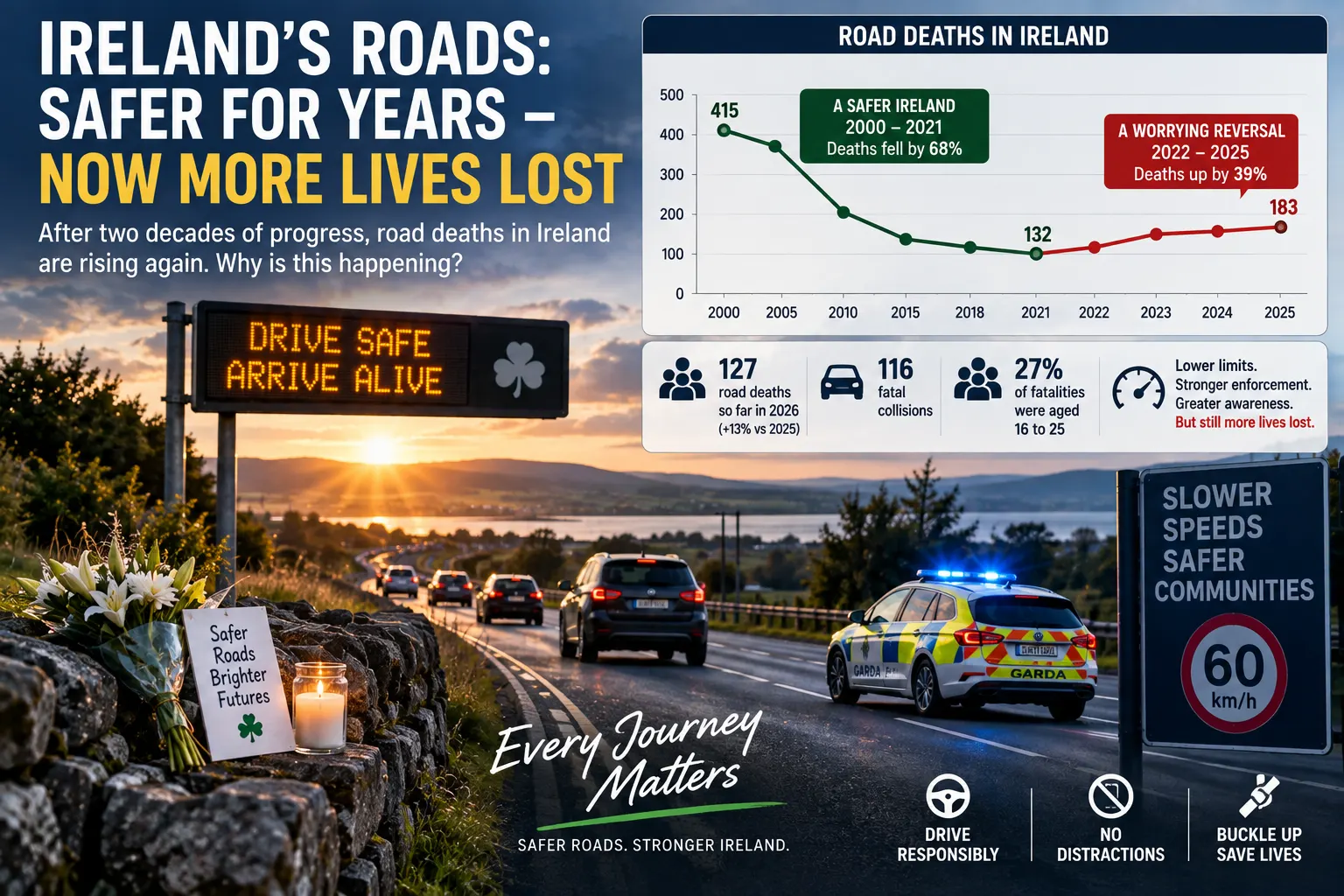
Ireland spent much of the first two decades of this century becoming dramatically safer on the road. Annual deaths fell from 415 in 2000 to 132 in 2021, transforming a country that had once recorded more than 400 fatalities a year. That progress has now gone into reverse. By 3 September 2026, An Garda Síochána had provisionally recorded 127 fatalities in 116 fatal collisions, compared with 112 deaths in 107 collisions at the same point in 2025.
The increase is especially striking because it has occurred while Ireland is doing many of the things normally expected to improve road safety. Default limits on many rural local roads were cut from 80 km/h to 60 km/h in February 2025, lower urban limits are being introduced, Garda roads-policing activity has intensified, safety campaigns have expanded and a national strategy is supposed to halve deaths and serious injuries by 2030. Yet the fatality count is moving in the wrong direction.
That does not mean those measures have failed, nor does it establish that any one behaviour is responsible for the 2026 increase. Fatal-collision investigations take time, the current figures are provisional and the circumstances of individual crashes vary considerably. The more useful question is why a safer legal framework has not yet produced a sustained improvement in outcomes. The answer lies in the difference between introducing a safety measure and changing the conditions, behaviour and infrastructure that ultimately determine whether a collision occurs and whether somebody survives it.
Road safety in 2026 so far
- 127 people had been provisionally recorded as killed by 3 September 2026.
- That was 15 more deaths than at the same point in 2025, an increase of about 13%.
- Fatal collisions increased from 107 to 116 over the same comparison period.
- Drivers accounted for 48 deaths, passengers 26, pedestrians 21, motorcyclists 18, pedal cyclists 10 and e-scooter or e-bike users four.
- An RSA mid-year analysis found that 27% of public-road fatalities up to 26 July were people aged 16 to 25.
Ireland Has Been Here Before — but the Long-Term Direction Had Been Much Better
Road deaths do not move in a straight line. Ireland recorded 472 deaths in 1997, 415 in 2000 and 396 in 2005 before a much stronger downward trend developed. Government road-safety assessments attribute that longer improvement to a combination of measures rather than one intervention: the National Car Test, penalty points, safety cameras, stronger Garda enforcement, mandatory alcohol testing, safer road infrastructure, vehicle improvements and sustained education campaigns all formed part of successive strategies.
By 2010 the annual toll had fallen to 212. It reached 162 in 2015, 134 in 2018 and 132 in 2021. The scale of that decline matters because it demonstrates that rising traffic volumes or economic activity do not automatically have to produce more fatalities. Ireland managed for many years to increase mobility while reducing road deaths, which is why the deterioration since 2021 cannot be explained simply by saying that there are more people and vehicles on the road.
Ireland’s Long Decline in Road Deaths — and the Recent Reversal
| Year | Road deaths |
|---|---|
| 2000 | 415 |
| 2005 | 396 |
| 2010 | 212 |
| 2015 | 162 |
| 2018 | 134 |
| 2021 | 132 |
| 2022 | 152 |
| 2023 | 179 |
| 2024 | 171 |
| 2025 | 183 |
Source: Road Safety Authority, Road Deaths in Ireland 1959 to 2025, published February 2026. Figures from 2022 onwards are provisional and may be revised.
The turning point is visible after 2021. The latest RSA historical series puts deaths at 152 in 2022, 179 in 2023, 171 in 2024 and a provisional 183 in 2025. That leaves the 2025 figure about 39% above the exceptionally low 2021 level. The provisional 2026 figures do not yet constitute a full-year total, but being 15 deaths ahead of the comparable 2025 point means the hoped-for reversal has not yet materialised.
There is an important statistical caution. Garda and RSA figures can differ because the Garda operational series may include fatalities in public places that do not meet the RSA definition of a collision on a public road, while provisional cases can also be revised as investigations progress. For that reason, year-to-date Garda figures are best used for the current trend and the latest RSA historical series for long-term comparison rather than treating every provisional publication as directly interchangeable.
Lowering a Limit Is Not the Same as Lowering Every Vehicle’s Speed
Speed is one of the clearest mechanisms through which an ordinary driving error can become a fatal collision. Higher speed increases stopping distance, reduces the time available to react and raises the forces involved when a vehicle strikes another vehicle, a roadside object, a pedestrian, cyclist or motorcyclist. International evidence used by the RSA estimates that excessive or inappropriate speed is involved directly in roughly 10% to 15% of all collisions and around 30% of fatal collisions.
Ireland has therefore changed its legal framework. Since 7 February 2025, the default limit on many rural local roads has been 60 km/h rather than 80 km/h. Urban authorities are now reviewing and introducing 30 km/h limits in built-up areas, with the national rollout still continuing. The Government’s broader speed-limit programme also envisages lower limits on national secondary roads.
The timing is crucial when assessing the 2026 fatality figures. The entire package has not been operating nationwide for several years; parts of it are still being implemented. A death occurring in 2026 therefore cannot be treated as evidence that a mature, fully implemented lower-speed system has failed. Ireland is still in the transition between the old network of limits and the system envisaged by the 2023 Speed Limit Review.
Compliance is the harder part. In the RSA’s 2025 Free Speed Survey, 38% of vehicles observed on 30 km/h roads were exceeding the limit, as were 43% on 50 km/h roads and 50% on the surveyed 60 km/h roads. Non-compliance was lower on the faster road classes — 28% on 80 km/h roads, 25% on 100 km/h roads and 15% on motorways — although the consequences of excessive or inappropriate speed can be much greater where the underlying speeds are high.
Those figures also require careful interpretation. The survey covered selected sites and was not designed simply as a before-and-after test of every rural local road affected by the February 2025 change. A separate post-intervention attitudes survey in October 2025 found that 69% of motorists said they drove within the new 60 km/h limit, but only 34% believed other drivers were doing so. Self-reported compliance is not the same thing as measured speed, but the gap shows how changing a sign can be easier than changing a road culture.
A Safe System approach goes further still. If a road is wide, visually open and engineered in a way that encourages higher speeds, a lower number on a sign may have less influence than a street or road whose design naturally produces the intended speed. Effective speed policy therefore involves a combination of limits, enforcement, road geometry, junction design, traffic calming where appropriate and clear public understanding of why the limit has changed.
The Most Serious Risk Remains Concentrated on Faster Roads
The geography of fatal collisions helps explain why the national total can remain high even while urban speed reform advances. In the RSA’s review covering the first 26 days of July 2026, 57% of public-road fatalities had occurred on roads carrying speed limits of at least 80 km/h. Historically, high-speed rural roads have accounted for a disproportionate share of deaths, even though serious injuries and vulnerable-road-user collisions also present major problems in towns and cities.
That does not prove that road condition caused those fatalities. The distinction between road condition and road design is important. A damaged surface, poor drainage or defective markings may be relevant to an individual crash, but the provisional national fatality totals do not demonstrate that maintenance defects are the principal explanation for the 2026 increase. The stronger structural evidence concerns the environment in which a mistake occurs: operating speed, bends, junctions, available sight distance, roadside obstacles, recovery space and the degree to which the road protects people when something goes wrong.
Transport Infrastructure Ireland’s road-safety framework explicitly treats infrastructure as part of collision prevention and injury reduction. Its network assessments combine historical collision records with infrastructure-based risk indicators, while safety inspections and audits are intended to identify locations where design changes can reduce either the likelihood or severity of crashes. The principle is straightforward: drivers will sometimes make mistakes, but a safe network should be designed so that a momentary mistake is less likely to become a fatal one.
This has particular significance outside the major cities. Rural journeys frequently involve roads with higher operating speeds and, depending on the route, less physical separation between opposing traffic or between vehicles and roadside hazards. A bend, junction or loss of control at 80 or 100 km/h presents a fundamentally different energy problem from a comparable error at 30 km/h. That is why reducing the death toll cannot be achieved through enforcement alone; engineering investment has to be targeted at sections where collision history and road characteristics indicate the greatest risk.
Alcohol and Drugs Have Not Disappeared From the Road-Safety Problem
Ireland’s progress against drink-driving was one of the important components of the earlier fall in road deaths, but impaired driving remains a persistent risk. During the first half of 2026, Gardaí made more than 4,600 arrests for drink or drug driving, equivalent to roughly one arrest an hour. The number is significant, but it should not be read as a direct measure of how impairment itself changed from one year to another because detection levels depend on the amount, location and intensity of enforcement as well as offending behaviour.
Separate RSA and Garda analysis covering surviving drivers involved in fatal or serious-injury collisions from 2021 to 2025 found that 63% were tested for alcohol. Seven per cent of those tested returned a positive result. Among the positive cases, men and younger adults were heavily represented, and more than half of the associated collisions occurred between 8pm and 4am or at weekends.
Even these figures should not be turned into a simplistic causal claim. A positive alcohol test establishes the presence of alcohol; it does not by itself establish that alcohol caused a particular collision. But the concentration around high-risk times, combined with thousands of annual intoxicated-driving arrests, shows why drink- and drug-driving enforcement remains necessary even after decades of campaigns and tougher laws. Mandatory drug testing following serious collisions has strengthened the evidence base, but the deterrent effect still depends on drivers believing that detection is a realistic possibility.
Phones Create a Different Kind of Risk: Seconds of Missing Information
Mobile-phone distraction is more difficult to see in fatality statistics because distraction can disappear in the seconds before a collision and may be harder to establish than alcohol concentration or vehicle speed. Yet observational research shows that the behaviour remains present. The RSA’s 2024 observational survey found about 6% of drivers using a handheld mobile device, an improvement from the previous year but still a substantial number when applied across millions of journeys.
Self-reported surveys have pointed to an additional concern among younger motorists. RSA research published in 2024 found that 40% of drivers under 35 said they at least sometimes checked notifications, social media or messages while driving. Observational and self-reported studies measure different things and cannot be directly combined, but both show why distraction remains part of the risk picture.
Enforcement has become more intensive. Garda figures for the first half of 2026 included more than 14,500 fixed-charge notices relating to mobile-phone use. Again, a larger number of detections can mean more offending, more policing or a combination of the two. What matters for safety is whether the underlying behaviour declines, particularly on roads where a few seconds of inattention can put a vehicle across a centre line, through a junction or into the path of a vulnerable road user.
Seat-Belt Use Is High — but the Remaining Non-Compliance Carries Enormous Consequences
Seat belts illustrate another feature of road safety: very high national compliance can coexist with a serious problem among a relatively small high-risk minority. The RSA’s 2024 observational survey found belt-wearing rates of 97% among drivers and 96% among both front and rear passengers. Those are strong figures by ordinary behavioural standards.
Yet collision data show that non-use remains disproportionately important among people who die in cars. RSA analysis for 2020 to 2024 found that 17% of car users killed were not wearing a seat belt. The relevant policy challenge is therefore not to persuade an entire population that belts matter; most people already use them. It is to reach the much smaller group that still travels unrestrained, often in precisely the circumstances where other risks such as speed or impairment may also be present.
This overlap is central to understanding fatal collisions. Road-safety factors do not occur independently like separate categories in a spreadsheet. Speed can combine with intoxication, distraction can combine with a failure to wear a belt, or an inexperienced rider can encounter a driver who fails to observe at a junction. The severity of the outcome is often determined by several layers of risk failing at the same time.
Young People Are Overrepresented, but Age Alone Is Not an Explanation
In the RSA’s mid-year 2026 public-road review, 27% of those killed were aged between 16 and 25. That is a striking share, but it describes all road-user types in that age group, not simply young car drivers. It would therefore be wrong to interpret the figure as evidence that young drivers caused more than a quarter of road deaths.
Younger drivers and riders nevertheless face a recognised combination of risk factors. Experience is still developing, peer and social influences can matter, and some dangerous behaviours occur more frequently in younger groups. Ireland already applies tighter penalty-point thresholds to learner and novice drivers and requires structured training for new drivers, but licensing rules cannot eliminate the risk created by individual decisions after a licence has been obtained.
Nor should the discussion imply that older road users are unimportant. Fatality patterns include drivers and passengers across the age spectrum, while ageing can introduce different vulnerabilities related to physical resilience, eyesight, medication or the complexity of particular traffic environments. Effective road-safety policy therefore needs age-specific interventions without reducing a national problem to a stereotype about one generation.
Motorcyclists Face a Level of Physical Vulnerability Cars Cannot Replicate
Motorcycling presents a different risk profile because the protective structure surrounding a car occupant largely does not exist. Garda figures show that 18 motorcyclists had died by 3 September 2026. The longer-term trend is also concerning: the RSA recorded 117 motorcyclist deaths and 954 serious injuries during 2021 to 2025, with motorcyclists accounting for 14% of all fatalities in that period.
The provisional 2025 total of 30 motorcyclist deaths was the highest since 2007. The latest spotlight analysis found that almost two-thirds of motorcyclist fatalities involved another vehicle and one-quarter occurred at junctions. Among serious-injury collisions involving multiple vehicles, failure to observe was the most frequently recorded action for both motorcyclists and the other driver.
That evidence argues against treating motorcycle safety simply as a question of how riders behave. Rider speed, training, visibility and protective equipment matter, but so do whether other drivers detect an approaching motorcycle, whether junction sight lines are adequate and whether road design allows recovery from an error. The Safe System principle of shared responsibility is particularly relevant because the physical consequences of somebody else’s mistake can be disproportionately severe for a rider.
Cycling Reveals a Different Weak Point: Urban Junctions and Serious Injuries
Ten pedal cyclists had been provisionally recorded among the 2026 fatalities by 3 September. Fatality numbers alone, however, substantially understate the wider burden of cycling injuries. The RSA’s 2021–2025 cyclist analysis found that 52% of recorded serious cyclist injuries occurred in Dublin and almost half occurred at junctions. Most seriously injured cyclists in multi-vehicle collisions were struck in incidents involving a car or light goods vehicle.
Hospital data add another dimension. A separate RSA study found 3,305 pedal cyclists were admitted to hospital following road-traffic collisions between 2020 and 2024, a much larger number than the serious injuries recorded in Garda collision data over a similar period. The difference reflects issues including collisions that are never reported to Gardaí and differences in how injuries are classified.
For cyclists, pedestrians and children, lower urban speeds can materially reduce impact severity, but speed control is only one layer. Protected cycling infrastructure, safer junction layouts, crossing facilities, visibility and separation from faster or heavier traffic can remove conflicts before a driver’s or cyclist’s reaction becomes the final line of defence. That is especially important as Ireland encourages more walking and cycling for everyday travel.
Who Had Died on Irish Roads by 3 September 2026
| Road user | Fatalities |
|---|---|
| Drivers | 48 |
| Passengers | 26 |
| Pedestrians | 21 |
| Motorcyclists | 18 |
| Pedal cyclists | 10 |
| E-scooter/e-bike users | 4 |
Source: An Garda Síochána, provisional figures current to 3 September 2026.
The distribution reinforces an important point: there is no single “road death problem”. Car drivers remain the largest individual category, but passengers, pedestrians, motorcyclists, cyclists and newer forms of mobility together account for a large share of the total. Each group encounters different forms of exposure and vulnerability, and a policy focused too narrowly on one category risks missing the interactions that produce serious collisions.
Why More Enforcement Can Coexist With More Deaths
At first sight, the 2026 figures create another paradox. Gardaí issued more than 119,000 fixed-charge notices for speeding during the first half of the year, more than 14,500 for mobile-phone offences and arrested more than 4,600 people for drink or drug driving. If enforcement is so extensive, why have deaths not fallen?
One answer is statistical. Enforcement figures count detected offences, not the total amount of dangerous behaviour in the road network. More detections may be the result of greater enforcement activity, more violations or both, so an increase in notices cannot automatically be interpreted either as worsening behaviour or as proof that enforcement is succeeding.
A second answer is geographical. Ireland has a very large road network, much of it rural, and conventional roadside enforcement cannot be present everywhere at once. A driver may encounter a highly visible operation on one journey and no direct enforcement on dozens of others. The deterrent effect therefore depends not only on the number of detections but on how widespread and predictable the perceived possibility of detection becomes.
This is one reason the Government published Ireland’s first National Safety Camera Strategy in 2026, providing a framework for a wider combination of fixed, average-speed and other camera-based enforcement. Technology can extend coverage well beyond the places where Garda officers happen to be positioned. But a strategy published in April cannot reasonably be expected to have transformed the national network by September; its effect will depend on deployment, site selection, processing capacity and whether it changes behaviour at the locations that contribute most to fatal and serious collisions.
A third answer is that enforcement acts on only part of the system. Gardaí can prosecute a driver for speeding, impairment, phone use or not wearing a belt, but enforcement does not redesign a hazardous junction, create recovery space beside a high-speed road or physically separate a cyclist from heavy traffic. Road policing is indispensable, but its effectiveness is greatest when the road, vehicle, legal and behavioural parts of the system reinforce one another.
Campaigns Can Change Attitudes, but Attitudes Are Not the Final Measure
Ireland has a long history of high-profile road-safety advertising, and public communication was one of the measures credited with the earlier decline in fatalities. Campaigns can make risks memorable, establish social norms and support new laws. They can be particularly important when rules change, as happened with the new rural speed limit.
But the relevant outcome is not whether people remember an advertisement. It is whether average speeds fall, fewer people drive after drinking or taking drugs, phones stay out of drivers’ hands, belts are worn and collisions become less severe. An awareness campaign should therefore be treated as one component of a safety intervention rather than evidence that the underlying behaviour has changed.
The post-intervention rural-speed research illustrates the distinction. Public support for the 60 km/h limit remained strong, but understanding of the rule was not universal and self-reported behaviour differed sharply from perceptions of how other motorists drove. That suggests communication has to continue after a law takes effect and be combined with road design and credible enforcement that make the new norm visible in everyday travel.
Growing Traffic Exposure Adds Risk — but Cannot Explain the Reversal on Its Own
Population growth, employment, tourism, freight movement and economic activity all influence how much travel takes place. More journeys create more opportunities for collisions even if the risk attached to each individual kilometre does not change. The official review of the first phase of the current Road Safety Strategy identified population growth and increased economic activity as part of the context in which Ireland missed its interim road-safety targets.
Exposure is therefore an influence factor, but not an adequate explanation by itself. Ireland’s own historical record shows that deaths can fall substantially while the economy and transport system expand. If additional mobility is accompanied by safer vehicles, safer roads, lower effective speeds, better enforcement and safer behaviour, risk per journey can decline sufficiently to offset increased exposure.
The important policy question is consequently not whether Ireland can stop people travelling. It is whether the safety of each journey improves quickly enough to compensate for a larger and busier country. That places greater importance on measuring kilometres travelled, actual speeds and serious-injury risk rather than relying solely on annual fatality totals.
Serious Injuries Show Why Fatalities Alone Are an Incomplete Measure
Deaths receive the greatest public attention, but the national strategy deliberately gives equal prominence to serious injuries. For survivors and their families, a collision can result in permanent neurological damage, loss of mobility, lengthy rehabilitation, inability to work and lifelong care needs. The economic effects extend into emergency medicine, hospital treatment, rehabilitation, social protection, lost earnings and unpaid family care.
Measurement itself remains a challenge. RSA research comparing hospital and Garda information found 11,241 road casualties were admitted to hospital between 2020 and 2024, compared with 7,465 serious injuries recorded in Garda data during the period. The two figures use different definitions and should not be treated as equivalent measures, but the disparity demonstrates why linking health and collision data matters if Ireland is to understand the full burden of road trauma.
Better data also improve prevention. Knowing that a collision occurred is useful; knowing whether it involved speed, intoxication, distraction, road geometry, visibility, vehicle type, junction design or another factor is considerably more useful. Faster and more complete data sharing between Gardaí, the RSA, hospitals, local authorities and road operators can help move investment from broad assumptions towards demonstrably high-risk locations and behaviours.
The 2030 Target Is Becoming Harder, Not Easier
Ireland’s Road Safety Strategy 2021–2030 was built around a baseline of 144 annual deaths and 1,259 serious injuries. The objective is to reach no more than 72 deaths and 630 serious injuries a year by 2030, before progressing towards the longer-term Vision Zero objective of eliminating road deaths and serious injuries by 2050.
The first phase of the strategy was supposed to put Ireland on that path, but its interim targets were not achieved. The latest historical series records 171 fatalities in 2024 against an interim ambition of no more than 122. The subsequent provisional figure of 183 for 2025 widened rather than closed the distance to the final target.
Measured against 2025’s provisional 183 deaths, reaching 72 would now require a reduction of roughly three-fifths. That is substantially more demanding than the original 50% reduction from the strategy’s baseline. The target itself has not become more severe; the deterioration since the strategy began has made the remaining journey steeper.
The Phase 2 Action Plan for 2025–2027 responds with 12 primary actions and 77 supporting actions across the Safe System. Responsibility also extends beyond the RSA: the Department of Transport now has an enhanced coordinating role, while Gardaí, Transport Infrastructure Ireland, the National Transport Authority, local authorities and other bodies each control different parts of the system. That distribution of responsibility is unavoidable, but it makes execution and accountability particularly important.
What Would Have to Change for Ireland to Get Back on Course?
The first requirement is to complete the speed reforms and then measure what vehicles are actually doing. The critical indicator is not how many signs have changed but whether mean and high-end speeds fall on the roads where death and serious injury are concentrated. Where compliance remains poor, enforcement, average-speed cameras, road design and targeted engineering should be used together rather than expecting repeated advertising to carry the full burden.
The second is to make high-risk enforcement more difficult to avoid. Drink- and drug-driving enforcement is most valuable when it covers the times and places where impaired driving is most likely, while mobile-phone and seat-belt enforcement needs sufficient visibility to alter the perceived probability of being caught. Expanded camera technology can strengthen speed enforcement, but deployment should be based on collision risk and measurable safety outcomes rather than simply maximising the number of offences detected.
The third is sustained investment in roads that protect people when mistakes occur. On high-speed rural routes that can mean treating dangerous junctions, improving sight lines, addressing collision-prone bends, managing roadside hazards, installing appropriate barriers and changing layouts where collision analysis identifies a persistent problem. Maintenance remains essential, but a smooth road is not necessarily a safe road if its geometry, operating speed and roadside environment make an inevitable human error disproportionately lethal.
Fourth, vulnerable road users require infrastructure designed around their exposure rather than around the protection available to occupants of modern cars. Lower urban speeds, protected cycle routes, safer junctions, pedestrian crossings and routes to schools should function as a coherent network. For motorcyclists, engineering and awareness need to address both rider behaviour and the repeated problem of motorcycles not being observed by other road users.
Fifth, policy has to become more targeted without becoming simplistic. Young road users are overrepresented in the current fatality figures, but broad messages directed at every young person are less useful than identifying the specific combinations of inexperience, speeding, impairment, distraction, night driving or vehicle type associated with severe outcomes. The same principle applies to older drivers, commercial traffic, motorcyclists and other groups: intervention should follow evidence rather than stereotypes.
Finally, Ireland needs to judge programmes by results rather than activity. Numbers of campaigns, enforcement operations, new signs, kilometres of infrastructure and published action plans are important measures of implementation, but the ultimate indicators are lower actual speeds, lower prevalence of dangerous behaviours, fewer high-risk conflicts, fewer serious injuries and fewer deaths. Regular publication of those intermediate safety indicators would make it easier to identify quickly which interventions are changing behaviour and which require adjustment.
The Lesson From Ireland’s Own History
The rise in road deaths does not have a single culprit. The evidence instead points to a system in which persistent dangerous behaviours interact with high-speed environments, vulnerable road users, uneven compliance, growing travel exposure and infrastructure that cannot always prevent a mistake from becoming catastrophic. The individual causes of the 2026 fatalities will continue to emerge through investigations, and it would be premature to assign the year-to-date increase to any one factor before those cases are complete.
Nor is the present deterioration evidence that lower speed limits, safety campaigns or increased enforcement are pointless. Some measures are relatively new, some are still being rolled out, and none can remove every source of risk in isolation. The more important finding is that legislation and campaigns have to translate into measurable changes on the road — lower actual speeds, less impaired and distracted driving, safer junctions and roadsides, greater protection for people outside cars and a credible expectation that serious offences will be detected.
Ireland has already demonstrated that a road-death toll once measured above 400 a year can be reduced to close to 130. That historical achievement makes the recent reversal more concerning, but it also shows that improvement is possible. Reaching 72 deaths or fewer by 2030 will now require a much faster reduction than originally envisaged, and the remaining years leave little room for measures whose benefits exist mainly on paper.
The decisive test will therefore not be whether Ireland announces another road-safety initiative. It will be whether the combined system makes an ordinary human mistake less likely to happen, and far less likely to cost a life when it does.
Sources
An Garda Síochána — Roads Policing Statistics for Traffic Fatalities for 2026
Road Safety Authority — Road Traffic Collision Data and Fatality Reports
Road Safety Authority — Safe Speeds Research and Free Speed Surveys
Road Safety Authority — Safe Road Use Research
Department of Transport — About the Slower Speeds Campaign
Road Safety Authority — Government Road Safety Strategy 2021–2030
Department of Transport — Road Safety Strategy Phase 2 Action Plan 2025–2027
An Garda Síochána — Roads Policing and Enforcement Update, July 2026
Road Safety Authority and An Garda Síochána — Impaired Driving Analysis, May 2026
Road Safety Authority — Motorcyclist Spotlight Report 2021–2025
Road Safety Authority — Cyclist Spotlight Report 2021–2025
Transport Infrastructure Ireland — Road Infrastructure Safety Management
Source & Transparency
This article is published by Ireland Newspaper for editorial and informational purposes.
Published: 4 September 2026 · Updated: 4 September 2026

Newsroom Ireland Newspaper
Ireland Newspaper editorial team prepares daily news coverage for readers in Ireland and abroad.