
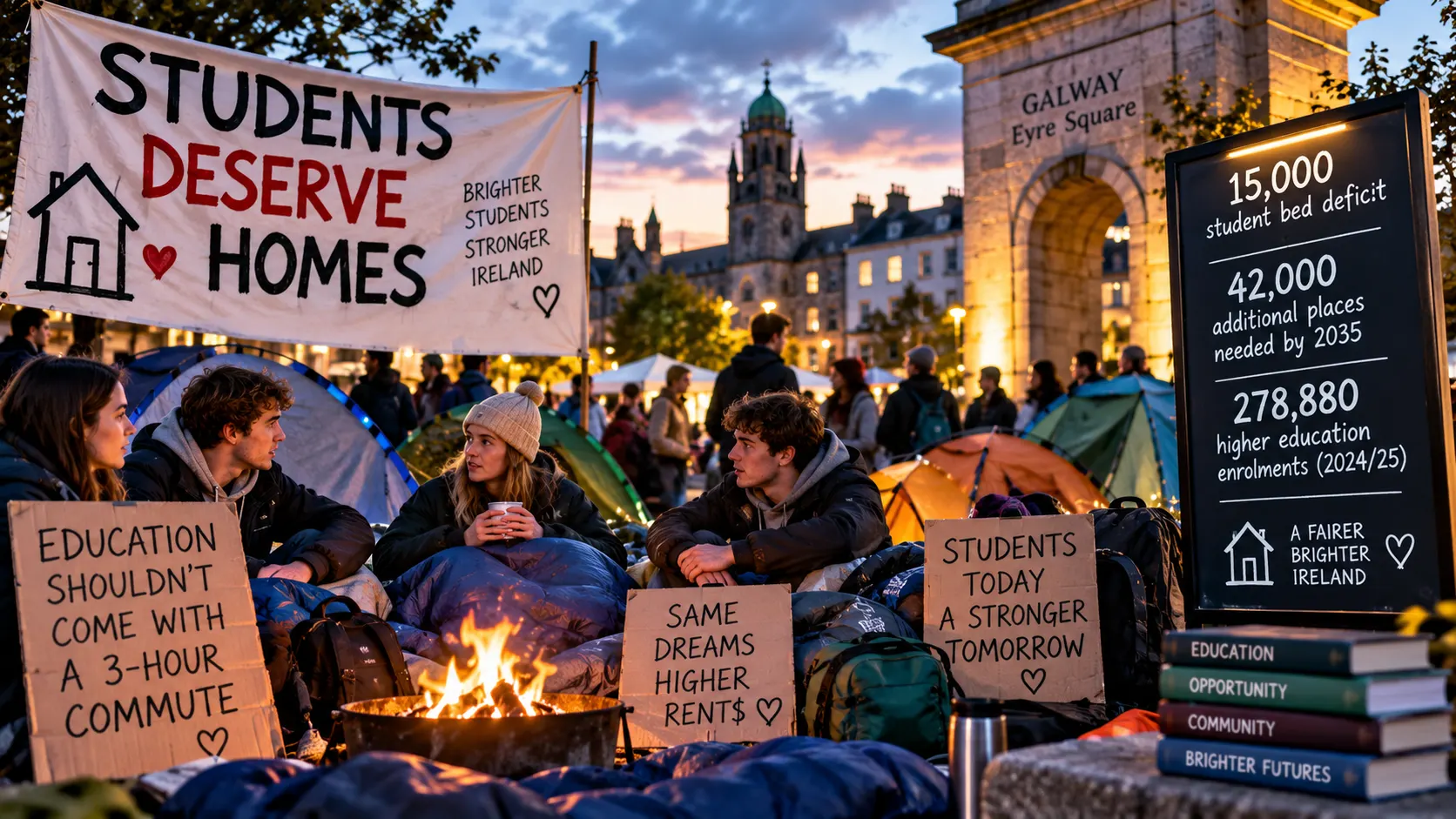
On 1 September, students carried sleeping bags and tents into Galway’s Eyre Square to make a problem normally hidden in bedrooms, buses and family homes impossible to ignore. University of Galway Students’ Union organised an overnight protest as another academic year began with students still searching for accommodation. Representatives warned that some were facing exceptionally long daily journeys, couches and hostels, while others could ultimately have to defer college places. The protest was local, but the shortage it highlighted is national.
The Government’s National Student Accommodation Strategy 2026–2035 estimates an existing shortfall of approximately 15,000 student beds and plans around a requirement for 42,000 additional places by 2035, including that current deficit. The number is not simply a forecast of how many new university residences must be built: the strategy expects accommodation to come from public and private purpose-built student housing, university-linked developments and rooms in private homes. Even so, the scale of the requirement shows that student housing is no longer a secondary welfare issue. It has become part of the physical infrastructure required to operate a growing higher-education system.
Ireland’s student accommodation challenge
- The Government estimates an existing deficit of about 15,000 student beds.
- Approximately 42,000 additional student places are expected to be required by 2035, including the existing shortfall.
- Higher-education enrolment reached 278,880 in 2024/25, the latest complete HEA data available.
- Total enrolment increased 4.9% in one year and 57.1% compared with 2007/08 on a comparable institutional basis.
- The Government’s June 2026 projections indicate demand for full-time higher education could rise by up to 19% before peaking around 2034.
- Government-supported projects under the Short-Term Activation Programme cover roughly 1,000 additional purpose-built beds, with 30% designated for target groups at discounted rents.
- The new strategy regards total daily commuting of more than three hours as excessive when assessing accommodation need.
Ireland Was Warned About the Shortage More Than a Decade Ago
The present crisis did not begin in 2026. An influential Higher Education Authority analysis published in 2015 estimated student accommodation demand at 57,104 bed spaces in 2014 and projected it to rise above 68,000 by 2024. At the time, suitable supply was estimated at fewer than 31,300 spaces, producing unmet demand of around 25,000.
Those historical estimates cannot be compared directly with today’s 15,000-bed deficit because methodologies, definitions, accommodation patterns and the higher-education system itself have changed. Their significance is nevertheless clear: Ireland knew well before the current housing emergency had reached its present scale that higher student participation would require a much larger accommodation system.
The first National Student Accommodation Strategy followed in 2017. It set a target of 7,000 additional purpose-built student bed spaces by the end of 2019 and 21,000 additional spaces by 2024. The strategy was explicitly intended not only to house students but to remove some of their demand from the wider private rental market.
Early progress appeared encouraging. By the third quarter of 2019, more than 8,200 bed spaces had been completed, more than 5,200 were under construction and thousands more had planning permission. But the experience since then illustrates one of the central lessons of Irish housing policy: a pipeline is not the same thing as completed accommodation.
Student Numbers Kept Growing While the Housing System Struggled to Keep Up
Higher education expanded dramatically during the same period. The latest complete HEA figures show 278,880 enrolments across publicly funded higher-education institutions in 2024/25, 4.9% more than a year earlier. On the HEA’s comparable series, enrolment has increased by 57.1% since 2007/08.
More than three quarters of those students were studying full-time. Undergraduate enrolment reached 212,345, while postgraduate enrolment increased 7.6% in a single year to 66,535. The pressure is therefore not simply caused by larger first-year classes; it comes from expansion across several levels and types of higher education.
International participation has also grown. There were 44,535 students domiciled outside Ireland in 2024/25, 10.2% more than the previous year. International students accounted for about 16% of enrolments, with non-EU students forming the majority of that group.
Internationalisation is one influence on accommodation demand, but it would be inaccurate to describe it as the central cause of the shortage. The Department’s latest long-term projections point to another major demographic wave from within Ireland itself. Larger birth cohorts recorded between 2007 and 2012 are now moving through secondary education towards college age, while postgraduate and international participation are also expected to contribute to future growth.
Why Building Permission Did Not Automatically Produce Affordable Rooms
The student housing problem is sometimes described as a planning problem and sometimes as a construction problem. In reality, both interact with finance. A developer can obtain permission and still decide that construction is not commercially viable; a university can own suitable land but lack the borrowing capacity or capital funding required to develop it.
The Government itself acknowledged this when it created the Short-Term Activation Programme. The programme targeted purpose-built accommodation projects that already had planning permission but had stalled because construction costs made them unviable. The existence of those projects demonstrates why measuring planning approvals alone can overstate future supply.
The wider Irish planning system can add uncertainty to large urban projects through design requirements, appeals, infrastructure needs and long development periods. Larger apartment-style developments tend to face more complex planning and financing processes than small housing schemes. Student accommodation is particularly exposed because projects require substantial upfront capital while rents must remain low enough for students to pay.
Construction inflation amplified those difficulties after the pandemic. Materials, labour, professional fees, financing and site-related costs all influence total development cost, while higher interest rates increased the expense of funding projects. A bed can therefore be badly needed socially while still failing the financial test required to begin construction.
Ireland Has Also Had an Expensive Student-Housing Design Model
Government construction studies found that Irish purpose-built student accommodation could be comparatively expensive to deliver. The subsequent Design Guide for State Sponsored Student Accommodation, published in 2025, identified elements including generous space standards, specifications and scope of works as areas where costs could be reduced without abandoning quality or safety.
The new design approach therefore allows more efficient layouts, including different arrangements for shared bathrooms and kitchen, dining and living space. Standardisation is intended to make projects easier to design repeatedly, support modern construction methods and reduce the amount of expensive floor area required per student.
This illustrates an important distinction between reducing construction cost and reducing quality. A student bedroom does not need to reproduce a private apartment. If accommodation can share expensive facilities intelligently, each project may provide more beds for the same capital investment.
There are limits to that approach. Students still need privacy, accessibility, adequate communal areas, energy-efficient buildings and safe accommodation. Cost reduction therefore cannot solve the shortage by simply making rooms smaller indefinitely; it has to come from design efficiency, procurement, construction methods and financing as well.
For Years, Universities Had Limited Ways to Finance the Scale Required
Another structural problem was the funding model. The State did not historically treat student residences in the same way as mainstream higher-education teaching infrastructure. In November 2022, Government approved a new policy to provide direct State assistance to stimulate construction by public higher-education institutions, described by the Department as the first time such State support would be provided for building student accommodation.
That marked a significant change. Before it, universities depended more heavily on their own finances, borrowing arrangements and commercially sustainable projects, while much of the expansion outside campuses depended on private developers. Technological universities faced particular difficulties because they generally lacked the established accommodation estates and financing routes of older universities.
Government subsequently introduced several financing mechanisms. A €434 million European Investment Bank and Housing Finance Agency initiative announced in 2023 was designed to support the potential delivery of more than 2,700 student beds. In 2024, the State committed around €100 million to activate approximately 1,000 beds at institutions including UCD, DCU and Maynooth University.
The current strategy broadens that intervention. But it also acknowledges implicitly that the State will not finance the entire 42,000-place requirement itself. Private capital, institutional land, rent-a-room accommodation and new contractual structures will all be needed.
The Wider Housing Crisis Removed the Traditional Safety Valve
Purpose-built accommodation has never housed every student who leaves home for college. Students have traditionally rented ordinary houses and apartments, shared with other students or lived in rooms provided by homeowners. That model works only when the wider rental market contains enough spare capacity.
Ireland’s general housing shortage has progressively removed that buffer. Students looking for an ordinary rental property are competing with workers, couples and families for the same limited stock. A shortage of student accommodation therefore cannot be separated cleanly from the national housing problem.
RTB data illustrate the price environment in which this competition occurs. In the fourth quarter of 2025, the standardised average rent for a new tenancy in Dublin City was €2,191 per month. Galway City averaged €1,834, Limerick City €1,814 and Cork City €1,756.
Those figures describe whole registered private tenancies, not the price of an individual student room, and should not be interpreted as student accommodation rates. Their relevance is that they show the market from which students often try to assemble shared housing when university or purpose-built accommodation is unavailable.
The Wider Rental Market Students Compete In
| City | Average new-tenancy rent | Period |
|---|---|---|
| Dublin City | €2,191 | Q4 2025 |
| Galway City | €1,834 | Q4 2025 |
| Limerick City | €1,814 | Q4 2025 |
| Cork City | €1,756 | Q4 2025 |
Source: Residential Tenancies Board and Economic and Social Research Institute. Figures are standardised average rents for whole new private tenancies, not student-room prices.
Galway Shows Why Location Matters as Much as the National Total
Student accommodation cannot be moved around Ireland like a national stockpile. A vacant room in one county does little for a student with morning lectures in another. Demand is concentrated around campuses, transport routes and the country’s largest university cities.
The Galway sleep-out illustrates this geographical problem. RTÉ reported on 1 September that student representatives were warning of students facing hours of commuting and possible deferral because they had not secured suitable accommodation. The University of Galway Students’ Union said some students were relying on hostels or friends’ couches while searching for something more permanent.
New private purpose-built accommodation has been added in Galway, but availability and affordability are separate questions. A bed priced beyond a student’s budget technically increases supply without necessarily resolving that student’s housing problem. This is why the new national strategy contains separate pillars for viability and affordability.
The same distinction applies to Dublin, Cork and other centres. A city can contain substantial student accommodation and still experience acute shortages if enrolment is large, rents are high and available beds are concentrated in higher-priced developments.
Long Commutes Have Become Part of the Accommodation System
When students cannot move close to college, the housing shortage becomes a transport problem. The 2026 strategy explicitly treats daily commuting of more than three hours in total as excessive and incorporates those journeys into assessments of accommodation demand.
This is important because living at home does not necessarily mean a student has adequate accommodation for education. A family home 80 or 100 kilometres from campus technically provides a bed, but using it may require an exhausting journey several days each week.
HEA geographic data show how uneven that burden can be. Based on students’ family-home addresses rather than their term-time residences, the median distance to an institution was 108 kilometres for students from Leitrim, 93 kilometres for Longford and 91 kilometres for both Monaghan and Kilkenny. For students whose family home was in Dublin, the median was only eight kilometres.
Those figures are not actual commuting distances for every student because many people move during term. They nevertheless reveal the geography behind the accommodation question: students from some counties have much less realistic access to higher education while remaining at home.
Distance From Family Home to Higher-Education Institution
| Home county | Median distance | What it indicates |
|---|---|---|
| Leitrim | 108 km | Very high relocation pressure |
| Longford | 93 km | High relocation pressure |
| Monaghan | 91 km | High relocation pressure |
| Kilkenny | 91 km | High relocation pressure |
| Cork | 17 km | Much shorter median distance |
| Limerick | 15 km | Much shorter median distance |
| Dublin | 8 km | Shortest among these examples |
Source: Higher Education Authority socioeconomic geographic profile. Distances use family-home addresses and are not measurements of actual daily commuting.
Housing Can Turn a College Offer Into a Financial Decision for the Entire Family
The financial burden extends well beyond rent. Moving away for college can involve deposits, utilities, food, transport, laundry and repeated travel home. When accommodation is scarce, students and parents may also have to make decisions quickly because waiting for a cheaper option carries the risk that nothing will remain.
The latest completed Eurostudent study, based on 2022 survey data, already found accommodation to be the largest single student expense, representing about 35% of average expenditure. One third of respondents reported serious or very serious financial problems. The figures predate the 2026 academic year and should not be treated as current rent measurements, but they demonstrate that financial strain was established well before the present intake.
The same survey found 45% of students living with parents or other relatives during term time. Among full-time undergraduates the proportion was 53%. Remaining at home can substantially reduce accommodation costs, but whether it is practical depends heavily on where a family lives.
As a result, parental income can indirectly influence the geographic range of universities available to a young person. A family able to finance an expensive room can treat a distant college offer differently from a household already struggling with living costs. Housing scarcity therefore risks turning a formally national admissions system into a more financially constrained set of choices.
This Is Why Student Housing Is Also an Education-Access Issue
Ireland’s National Access Plan aims for a higher-education population that reflects the country’s social mix and identifies socioeconomically disadvantaged students, Traveller and Roma students and students with disabilities as priority groups. Accommodation can reinforce barriers experienced by those groups even where tuition and entry requirements have been addressed.
The State has increasingly recognised this connection. Under the Short-Term Activation Programme, 30% of beds in supported projects are to be reserved at discounted rents for students from target groups. The 2026 accommodation strategy also points to SUSI non-adjacent maintenance grants, the 1916 Bursary, Student Accommodation Assistance and the Student Assistance Fund as part of an annual support package worth €176 million.
From September 2026, non-adjacent SUSI maintenance payments were also increased for eligible students living or travelling away from home. Financial support can narrow the affordability gap, but it cannot create a room where none exists. Demand-side subsidies therefore work best when accompanied by additional supply.
The opposite can also occur in a severely constrained market: increasing students’ ability to pay without increasing the number of beds may leave more people competing for the same stock. That is one reason the new strategy attempts to address affordability and construction simultaneously.
Housing Shortages Change the Student Experience Even When Nobody Drops Out
The consequences should not be measured only by whether a student eventually enrols. A three-hour daily commute consumes time that could otherwise be used for study, sleep, employment, societies, sport or friendships. Students who arrive immediately before lectures and leave immediately afterwards experience university differently from those living close to campus.
Long commuting can also make part-time work more difficult to organise. Yet paid employment may be exactly what a student needs to meet accommodation and living costs. The resulting trade-off can become circular: expensive housing increases the need to work, while distance and commuting reduce the time available to do so.
Universities also feel the effect. Accommodation shortages can undermine recruitment from distant regions, complicate international admissions, reduce participation in campus life and increase demand for welfare and emergency financial support. Institutions may offer an academic place without being able to ensure that the student can realistically live within reach of it.
For families, the uncertainty begins before the academic year. Accommodation searches increasingly become part of the decision about whether a particular course is affordable at all rather than an administrative detail after a place has been accepted.
Why Private Student Accommodation Has Not Solved the Problem by Itself
Private purpose-built student accommodation has delivered significant additional capacity, particularly in Dublin and other major cities. It also has advantages over ordinary rented houses: accommodation is designed around academic life, usually located near campuses or transport and does not remove a conventional family dwelling from the rental market.
Its weakness is financial viability. Developers face land, construction and finance costs while the eventual product must be rented to customers with limited incomes. Where the rent needed to finance the development is too high for many students, the market can produce accommodation without producing enough affordable accommodation.
That tension became more visible as interest rates and construction costs increased. Some schemes with permission could no longer proceed on their original financial assumptions. The Government’s decision to subsidise stalled university projects is direct evidence that planning approval alone could not close the viability gap.
The new strategy therefore tries to reduce risk for developers rather than relying solely on higher rents. Standardised designs, State-owned land, site servicing and institutional commitments to fill rooms are intended to make projects financeable at lower risk.
The New Strategy Uses University Land in a Different Way
One of the most consequential elements of the 2026 strategy is the proposed use of State-owned land on higher-education campuses. Institutions can make sites available under fixed-term licence arrangements to private developers, with the land and buildings ultimately returning to the institution.
This approach can remove or reduce one major development cost: acquiring an expensive urban site. It can also place accommodation close to the students who need it and reduce competition for privately owned residential land elsewhere in the city.
The strategy also introduces nomination agreements. Under this model, an institution commits to nominate students for a specified number of rooms in privately operated accommodation. That gives the developer greater certainty that the building will be occupied, which can make financing easier to secure.
Nomination agreements transfer some risk back towards the institution, however. If an institution guarantees access to rooms, the contractual structure has to deal with occupancy risk, pricing and long-term affordability. The model can unlock construction, but the details determine whether it ultimately provides good value for students and the State.
Dublin, Cork and Galway Are First in the New Delivery Programme
The Higher Education Sector Student Accommodation Programme is the main institutional delivery mechanism under the strategy. It expands the earlier technological-sector programme to include traditional universities and is being supported by the Higher Education Authority and National Development Finance Agency.
The first phase concentrates on Dublin, Cork and Galway, where demand pressure is particularly acute. Preliminary business cases are being advanced in 2026 before later procurement and construction stages.
This is meaningful progress, but a preliminary business case is not a completed residence. Large projects still require design, approvals, financing, procurement and construction. Students entering first year in 2026 therefore cannot assume that the long-term strategy will solve their immediate accommodation search.
That gap between policy launch and physical delivery explains much of the frustration visible each September. Housing programmes operate over years; university admissions operate annually.
Current Construction Is Rising, but the Scale Required Is Much Larger
The supply pipeline has begun to strengthen again. CSO figures based on information from the HEA recorded 568 newly completed student bed spaces during 2025. Department figures reported at the end of August indicated a further 419 beds had been completed so far in 2026, while the number of student beds on sites under construction had risen to 3,136 by the end of July.
Those figures demonstrate activity, but they also put the 42,000-place requirement into perspective. A simple arithmetic average of 42,000 additional places across ten years would equal roughly 4,200 places a year. That is not an official annual construction target because the strategy includes rent-a-room spaces and delivery will not occur evenly, but it illustrates the necessary scale.
Construction therefore has to accelerate substantially if the deficit is to close while demand continues growing. Completing only enough beds to match annual enrolment growth would leave the existing shortage in place. The system has to expand faster than demand for a sustained period.
That is a different challenge from merely preventing the situation becoming worse.
Rent-a-Room Can Add Beds Quickly — With Different Legal Protections
Building a university residence takes years. A room in an existing house can become available almost immediately. For that reason, rent-a-room or digs accommodation remains a major part of the Government’s strategy.
Revenue’s Rent-a-Room Relief allows qualifying homeowners to receive up to €14,000 a year in gross income from renting rooms in their principal residence without income tax on that amount, provided the relevant conditions are met. The relief can apply to student accommodation during an academic year or term.
Digs can work particularly well for students seeking a lower-cost room from Monday to Friday or for homeowners who do not want to become conventional landlords. They can also distribute accommodation beyond large commercial student complexes.
But the legal relationship is different. Where the homeowner lives in the property, the student normally occupies under a licence rather than a residential tenancy. Digs are outside the RTB registration system and do not carry the same protections as a standard private tenancy or registered student-specific accommodation.
The Government has published a voluntary regulatory framework and sample licence agreement to improve clarity. Students should nevertheless understand the distinction before paying a deposit or moving in.
Student-Specific Accommodation Now Has Stronger Rental Protections
Purpose-built student-specific accommodation falls within the Residential Tenancies Board’s remit even where the student occupies under a licence rather than a conventional lease. Providers must register the accommodation and students can use RTB dispute-resolution mechanisms.
Current rules also limit what providers can demand upfront. A student generally cannot be required to pay more than one month’s rent in advance to secure the accommodation, while the deposit is also limited to the equivalent of one month’s rent. An exception applies in particular circumstances where rent and tuition are paid to the same education provider.
Since legislative changes introduced in 2024, providers generally cannot require a student to enter a student-specific accommodation agreement lasting more than 41 weeks unless the student asks for a longer arrangement. The rule is intended to stop students being forced to pay for summer months they do not require.
National rent-control rules introduced from 1 March 2026 also cover student-specific accommodation, although different provisions apply to certain newly constructed schemes. Students should therefore check the exact RTB rules that apply to their accommodation rather than assuming every student residence is regulated identically.
A Student Guide to the Main Accommodation Types
Know What You Are Renting
| Accommodation type | RTB protection | Important point |
|---|---|---|
| Purpose-built student accommodation | Yes | Must be registered; special student rules apply |
| Ordinary private tenancy | Yes | Standard residential tenancy rules apply |
| Digs / room in owner’s home | No | Usually a licence, not a tenancy |
| Short-term accommodation | Generally no | Different protections and often higher costs |
Source: Residential Tenancies Board.
Students searching during the September rush are also particularly exposed to rental fraud. The RTB’s 2026 student campaign advises renters to understand the type of agreement they are entering, obtain written records and avoid transferring money for accommodation they have not properly verified.
The distinction matters because a convincing advertisement does not establish that a property exists or that the person offering it has authority to rent it. Scarcity increases the pressure to act quickly, which can make students more vulnerable to demands for immediate deposits.
The 42,000-Bed Figure Is a Requirement, Not 42,000 Funded Buildings
The central number in the new strategy is easy to misunderstand. The Government has not announced funding for 42,000 newly constructed State-owned bedrooms. The figure represents the scale of accommodation required by 2035, including today’s estimated shortfall and future demand.
Delivery is expected to come from several sources. Publicly supported purpose-built accommodation will form one part, privately financed developments another, while rent-a-room accommodation is expected to contribute additional capacity without new construction.
This diversified model spreads risk and allows faster responses than relying solely on State construction. It also creates an implementation challenge because Government has greater control over a residence it funds directly than over whether a homeowner offers a room or a private developer can finance a project.
The strategy should therefore be judged not by how many prospective sites or planned rooms are announced but by how many usable, affordable places are actually occupied by students each academic year.
Future Demand Will Arrive Before Many Long-Term Projects Are Finished
The official projection of up to 19% growth in higher-education demand before 2034 makes timing critical. The school-leaver cohorts driving part of that increase already exist. This is not a speculative demographic possibility dependent on births that have yet to happen.
Large accommodation projects started in the late 2020s may therefore be opening into a market where demand has already moved higher. If construction merely follows enrolment rather than anticipating it, shortages can persist even while thousands of new rooms are completed.
There is also uncertainty around postgraduate and international participation, economic conditions and the geographic choices students make. The exact number of beds ultimately required in Dublin, Galway, Cork, Limerick or regional campuses will therefore change over time.
That argues for continual regional demand analysis rather than one national target fixed for a decade. A surplus in one location cannot compensate effectively for a shortage beside another campus.
Technological Universities Expose a Regional Gap
The accommodation debate has historically focused on the older universities in Dublin, Cork, Galway and Limerick. The growth of technological universities changes that picture because larger regional institutions increasingly attract students from beyond daily commuting distance while many campuses have relatively little dedicated accommodation.
The Government’s long-term policy specifically identifies technological universities as an area requiring development. Options include purpose-built construction, leasing, acquisition, refurbishment and redevelopment of existing property rather than relying on one model everywhere.
This matters for balanced regional development. A university outside Dublin cannot become a genuinely national institution if students from distant counties cannot find somewhere to live near it. Accommodation is therefore linked not only to education policy but also to the wider objective of strengthening regional cities.
The alternative is a system in which students disproportionately select courses according to commuting distance from the family home. That may be financially rational for the individual household but limits the effective national reach of higher education.
More Student Beds Can Also Help Families Who Have No Connection to a University
The benefits of student accommodation extend beyond students. Every student who moves from an ordinary rented house into dedicated accommodation potentially reduces pressure on the general rental market, although the exact effect depends on household formation and local demand.
This was one of the objectives of the original 2017 strategy and remains central to the 2026 plan. Student housing is therefore not necessarily competing with family housing in policy terms; well-located purpose-built accommodation can reduce the number of students bidding for ordinary homes.
There can still be competition for construction labour, finance and development land. Planning authorities also have to consider whether neighbourhoods are becoming excessively concentrated with one type of accommodation. The relationship is therefore more complex than assuming every student bed automatically creates one family home.
But in a constrained rental system, separating a large portion of student demand into dedicated housing is one of the few ways to reduce competition between fundamentally different types of renter.
Universities Face a Strategic Choice Between Education and Housing
Higher-education institutions are primarily teaching and research organisations, yet accommodation has become increasingly important to their ability to perform those functions. A university expanding enrolment without considering where additional students can live risks creating capacity in lecture theatres that cannot be matched by capacity in the surrounding city.
Building accommodation requires capital and management expertise that might otherwise be used for laboratories, teaching buildings or academic programmes. Private partnerships can reduce that burden but may provide institutions with less direct control over rents.
The new model of using campus land and nomination agreements represents an attempt to divide those responsibilities. Universities contribute land, demand certainty or access to students; private developers provide capital and construction expertise; the State supports viability and affordability where necessary.
Whether that balance works will depend on contracts that have not yet been tested at the scale envisaged in Ireland. The principle has international precedents, but its Irish results will have to be measured in actual rents as well as completed beds.
Affordability May Prove Harder to Solve Than Physical Supply
A physical shortage can theoretically be addressed by construction. An affordability shortage is more difficult because the same factors that make new projects expensive also push the rent required to finance them higher.
State-supported discounted rooms can help priority students, while grants and tax credits can reduce household costs. Standardised design can reduce the capital required per bed. Public land can remove part of the site cost.
But none of those mechanisms individually guarantees cheap accommodation. If construction, finance, maintenance and operating costs remain high, somebody ultimately pays: the student, the institution, the developer, the taxpayer or some combination of them.
The policy question is therefore not simply how many beds Ireland can build, but how many can be provided at rents compatible with student incomes and public spending constraints.
Three Very Different Futures Are Possible by 2035
The first scenario is the one the strategy is designed to produce. Purpose-built construction accelerates, university land is activated, private finance responds to nomination agreements, rent-a-room supply expands and affordability supports keep pace. In that case, today’s 15,000-bed deficit could narrow while the system absorbs the coming demographic peak.
A second, less favourable scenario would see substantial construction but continued affordability problems. Ireland could technically create tens of thousands of new places while lower-income students still commute because the new rooms remain beyond their budgets. That would improve physical supply without fully solving educational access.
The third scenario is a persistent delivery gap. If construction costs, financing, procurement or planning delays prevent the pipeline from scaling fast enough, future student growth would continue spilling into the private rental market. Long commuting, parental financial support and geographic restrictions on college choice would then become an increasingly normal part of higher education.
These are scenarios rather than forecasts. The Government has adopted a strategy and begun several programmes, but the 42,000-place requirement is large enough that implementation over the next few years will matter more than the publication of the plan itself.
The September Scramble Is the Result of a Long Structural Mismatch
It would be convenient to explain the student accommodation shortage through one failed policy or one surge in demand. The evidence points instead to a long interaction of factors. Higher education expanded, Ireland’s wider housing market tightened, construction became more expensive, financing constraints delayed projects and a large part of student housing continued to depend on ordinary rental homes.
The State responded with a strategy in 2017 and thousands of additional rooms followed. But enrolment and housing pressures continued evolving, while some projects that existed on paper did not translate quickly into affordable places. By the time direct State capital support and a dedicated student-accommodation unit became central parts of policy, the shortage was already deeply embedded.
The new 2026–2035 strategy is more interventionist than its predecessor. It combines State funding, private development, campus land, standardised designs, nomination agreements, rent-a-room accommodation and direct financial support for students. That broader toolkit reflects a recognition that the problem cannot be solved by asking the private market to build more rooms in isolation.
For students entering college this September, however, the distinction between an improved strategy and an available room is stark. The Galway sleep-out took place because future beds do not solve this week’s search.
A College Place Is Only Meaningful if the Student Can Reach It
Ireland has spent decades expanding participation in higher education because education can improve employment prospects, productivity and social mobility. Housing has now become an increasingly important condition of that access. A student who academically qualifies for a course but cannot afford to live within practical reach of the campus does not enjoy the same effective choice as someone who lives nearby or whose family can finance accommodation.
That does not mean every student must live beside a university. Better public transport, flexible learning and sensible commuting can all expand access. The Government’s strategy itself recognises transport as part of the solution.
But there is a point at which commuting ceases to be an alternative to accommodation and becomes evidence of its absence. The decision to treat journeys exceeding three hours a day as excessive is an acknowledgement of that boundary.
The test for the coming decade is therefore broader than whether Ireland reaches a numerical bed target. It is whether a student choosing a college in 2030 or 2035 can make that decision primarily on the basis of education rather than on whether their parents happen to live close enough to drive them there.
Sources
Higher Education Authority — Key Facts and Figures 2024/25
Higher Education Authority — Report on Student Accommodation: Demand and Supply
Government of Ireland — National Student Accommodation Strategy and Progress
Higher Education Authority — Geographic Profile of Higher-Education Students
Residential Tenancies Board — RTB/ESRI Rent Index
Residential Tenancies Board — Student Specific Accommodation Rights and Rules
Central Statistics Office — New Dwelling Completions Q4 2025 and Student Bed-Space Data
RTÉ News — Galway Students Sleep Out Over Lack of Accommodation
The Irish Times — Student Accommodation Supply and Construction Pipeline, August 2026
Source & Transparency
This article is published by Ireland Newspaper for editorial and informational purposes.
Published: 5 September 2026 · Updated: 5 September 2026

Newsroom Ireland Newspaper
Ireland Newspaper editorial team prepares daily news coverage for readers in Ireland and abroad.