
Global Markets in 2026: Record Stocks, Expensive Money and a World Learning to Price Risk Again
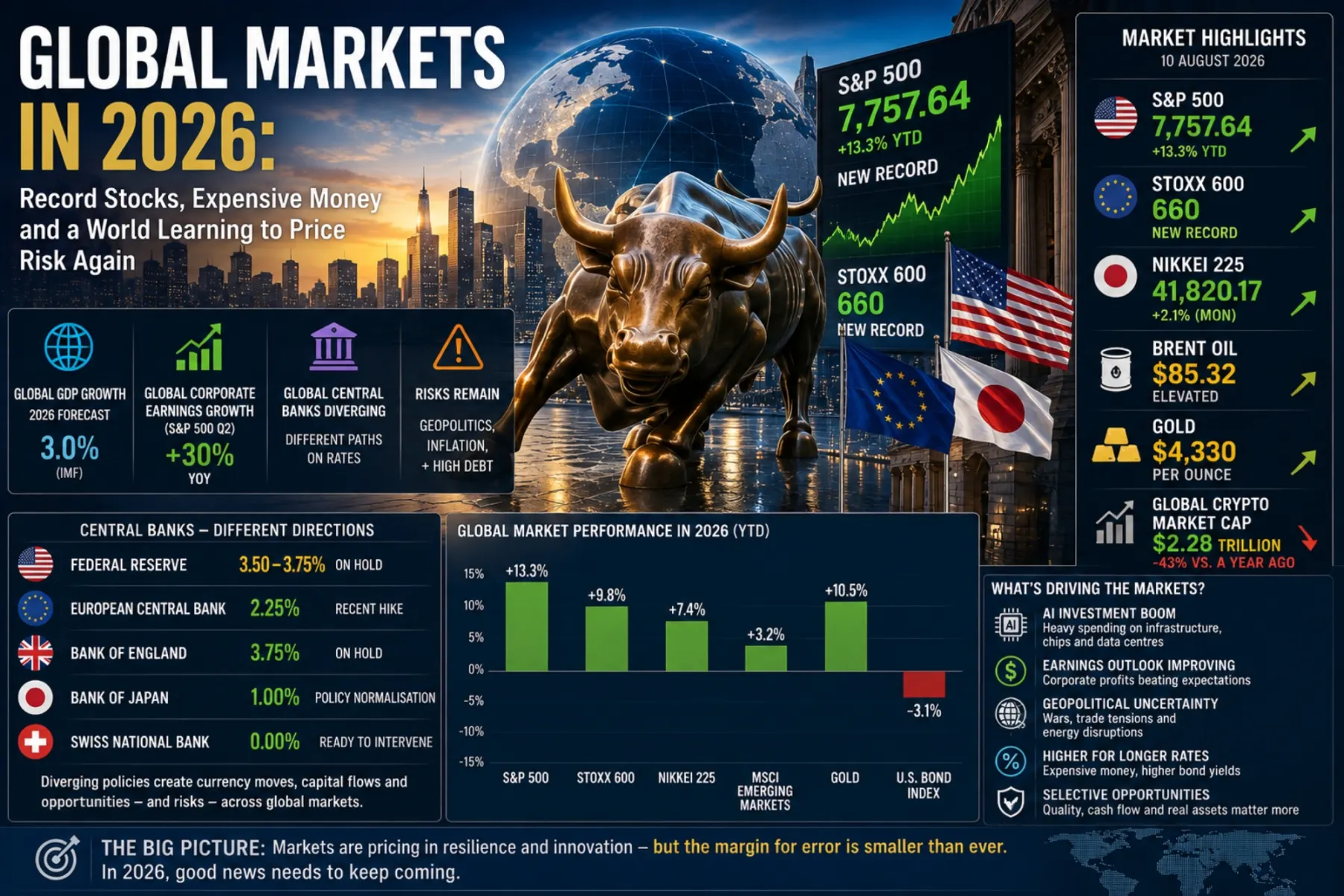
Wall Street and European equities are trading around record territory, Japan has surged, corporate profits are beating expectations and artificial-intelligence investment remains one of the strongest forces in global capital markets. Yet beneath the optimism, bond yields remain high, oil is back near $85, gold trades above $4,300 and global growth is only moderate. The markets of August 2026 are not ignoring risk — they are making an increasingly expensive bet that profits can outrun it.
There is a strange contradiction running through global financial markets in August 2026.
The world does not look particularly calm.
War continues to affect international energy markets. Shipping through the Strait of Hormuz remains restricted. Oil prices are elevated. Government borrowing costs remain high. China’s domestic economy has lost momentum. The United States has just reported unexpectedly weak employment data. Inflation has not disappeared, and the world’s leading central banks are no longer moving together.
Yet stock markets are close to records.
The S&P 500 finished Friday at 7,757.64, after reaching another record close, and has gained about 13.3% since the beginning of the year. Europe’s STOXX 600 also closed at a record on Friday and began Monday around 660 points. Japan’s Nikkei jumped another 2.1% on Monday.
At first glance, that appears contradictory.
It is not.
Financial markets do not price whether the world is comfortable.
They price whether future corporate earnings, interest rates and economic growth are likely to be better or worse than investors currently expect.
And in 2026, corporate profits have repeatedly been stronger than expected.
That is keeping global equities remarkably resilient even while the economic environment around them remains complicated.
The World Economy Is Growing — Just Not Fast
The broader economic backdrop is neither recession nor boom.
The International Monetary Fund’s latest July outlook projects global economic growth of 3.0% in 2026, followed by an acceleration to 3.4% in 2027.
The IMF describes the global picture as highly uneven: conflict and energy costs are weighing on energy-importing economies, while countries integrated into artificial-intelligence and technology supply chains are benefiting from powerful new investment. It also warns that global disinflation has stalled and that renewed geopolitical conflict or a sharp repricing in financial markets remains a significant downside risk.
That is an important starting point.
The stock-market rally is not being powered by an extraordinary global economic expansion comparable with the strongest post-war booms.
It is being powered by something more selective.
Certain companies are growing profits much faster than the economy around them.
Technology investment is enormous.
Large corporations have maintained strong margins.
And investors increasingly believe that artificial intelligence may allow some businesses to grow productivity and revenue substantially even in a world of only moderate GDP growth.
That distinction explains much of what is happening on Wall Street.
Wall Street Is Trading the Earnings Story More Than the Economic Story
US corporate profits have become the strongest defence against concerns about expensive valuations.
With almost 90% of S&P 500 companies having reported second-quarter results, Bank of America calculations cited by Reuters put earnings per share around 30% above the previous year, excluding certain investment gains at Alphabet and Amazon. Roughly three quarters of companies had beaten earnings expectations.
Separate LSEG data show that 85.1% of the 436 S&P 500 companies that had reported by Friday morning beat analyst expectations, considerably above the long-term average of 68%.
That matters more than almost anything else for the present rally.
Investors entered 2026 concerned that enormous spending on artificial intelligence might become financially excessive.
Data centres require billions.
Semiconductors require billions.
Cloud infrastructure requires billions.
Electricity infrastructure requires billions.
The market wanted evidence that this investment would eventually produce revenue.
The second-quarter results have begun providing more of that evidence.
J.P. Morgan specifically pointed towards stronger cloud growth and larger backlogs at companies including Google, Amazon and Microsoft as signs that AI-related capital expenditure is translating into business activity. The bank raised its 2026 S&P 500 earnings estimate to $365 per share and increased its year-end index target from 7,800 to 8,000.
That is a forecast, not a guarantee.
But it captures why investors remain willing to own equities at historically demanding prices.
The S&P 500 Is Now Expensive Enough That Good News Is Required
An index near 7,800 is no longer priced for widespread pessimism.
J.P. Morgan’s revised 8,000 target would represent only about another 3% gain from Friday’s close. At the same time, the bank continues to use a forward valuation assumption of roughly 20 times earnings, reflecting concerns about high interest rates, geopolitical risk and heavy issuance of both debt and equity.
That creates a much harder market environment than the headline records suggest.
When stocks are cheap, mediocre results can be enough to trigger a rally.
When markets are already expensive, companies have to keep delivering.
A company can report excellent profits and still fall if investors expected something better.
That is the defining characteristic of a mature bull market.
Expectations become the risk.
AI Has Become a Global Capital-Spending Cycle
The importance of artificial intelligence extends far beyond the largest US technology companies.
AI requires:
semiconductors;
data centres;
electrical equipment;
cooling systems;
power generation;
grid expansion;
network infrastructure;
construction;
copper;
and enormous quantities of capital.
This is why the investment theme now connects companies that once appeared unrelated.
A semiconductor producer can benefit.
A power-equipment company can benefit.
A European electrical manufacturer can benefit.
A building-products company exposed to data-centre construction can benefit.
Utilities can receive additional demand.
Copper producers can benefit from grid expansion.
The AI boom has therefore become partly an industrial-investment boom.
That helps explain why technology remains powerful while selected industrial, infrastructure and materials companies are participating too.
It also creates a risk: when enormous amounts of capital chase the same investment theme, returns eventually have to justify the expenditure.
Europe Has Quietly Joined the Record-High Club
European equities have attracted less international excitement than Wall Street, yet the continent’s share market has also performed strongly.
The STOXX 600 finished last week at a record high after gaining 1.7% during the week. On Monday morning it was holding close to that level around 660 points.
European earnings have significantly exceeded earlier expectations.
Analysts now expect roughly 21% second-quarter earnings growth for STOXX 600 companies, considerably stronger than forecasts earlier in the reporting season.
The European rally matters because it challenges the simple idea that investors only want American technology.
European banks have benefited from a higher-interest-rate environment.
Industrial groups have gained from infrastructure and defence investment.
Technology suppliers participate in the AI cycle.
Energy companies benefit when oil prices rise.
And many of Europe’s largest listed corporations earn a substantial share of their revenue outside Europe.
Weak European GDP growth therefore does not automatically mean weak European corporate profits.
Europe Still Has a More Difficult Economic Equation
The economic challenge facing Europe is nevertheless more complicated than the stock index implies.
The European Central Bank raised rates in June and left them unchanged in July. Its deposit rate currently stands at 2.25%, with the main refinancing rate at 2.40% and the marginal lending rate at 2.65%.
Europe is simultaneously dealing with moderate growth and renewed energy-related inflation pressure.
That is difficult for a central bank.
If inflation remains high, policy may need to remain restrictive.
If economic activity weakens, higher rates become more painful.
The result is an environment in which European companies can perform well while the wider economy remains less convincing.
Investors therefore need to distinguish the European stock market from the European economy.
They overlap.
They are not the same thing.
Britain Shows the Same Disconnect
The FTSE 100 was around 10,857 on Monday, slightly lower on the day but still at historically elevated levels. British government bond yields remain high, with the UK 10-year yield around 4.95%.
Sterling is trading close to $1.35, around a three-and-a-half-week high.
This produces another interesting market contrast.
UK equities contain many internationally exposed companies whose revenues come from commodities, financial services, pharmaceuticals and overseas markets.
They can perform reasonably well even when domestic British households face pressure from borrowing costs.
Again, the listed corporate economy and household economy do not move in perfect synchronisation.
Japan Has Become One of the World’s Most Extraordinary Markets
Japan’s Nikkei 225 rose more than 2% on Monday to around 66,970.
That is remarkable for a market that spent decades associated with stagnation after the collapse of Japan’s late-1980s asset bubble.
Several forces have changed the investment story.
Japanese companies have improved shareholder returns.
Corporate governance has changed.
Inflation has returned after years of deflation.
Wages have increased.
Global semiconductor and technology investment has supported parts of Japanese industry.
And a weak yen has benefited many exporters.
But the same weak yen has become one of Japan’s greatest economic problems.
The currency fell towards ¥164 per dollar in July before Japanese and US authorities intervened. On Monday it weakened again towards ¥159 per dollar.
The stock-market rally is therefore accompanied by substantial currency and bond-market tension.
Japan Is Attempting Something No Other Major Economy Is Doing
For most advanced economies, the problem since 2022 has been how to bring high inflation down.
Japan entered the period from the opposite direction.
For decades, policymakers tried to create sustainable inflation.
Now inflation pressure has become strong enough that Bank of Japan officials are discussing whether interest rates need to rise more quickly. Reuters reported on Monday that policymakers had highlighted mounting inflation risks that could support another increase as early as September.
Japanese 10-year government bond yields are now around 2.81%.
That would have looked extraordinary only a few years ago.
The global significance is greater than Japan alone.
Japanese investors hold enormous overseas portfolios.
If domestic Japanese bond yields become more attractive, some money currently invested abroad could eventually return home.
That could affect US Treasuries, European bonds and other global assets.
China Is Moving to a Different Market Rhythm
China remains the world’s most important economic market that is not moving in close alignment with the United States and Europe.
The country’s economy grew 4.3% year on year in the second quarter, weaker than expected, as subdued domestic demand and the global energy shock weighed on activity.
Yet Chinese equities have not simply followed the weaker economic narrative.
The CSI 300 gained almost 11% in dollar terms during the first half of the year, while Chinese bonds also performed strongly during the earlier phase of the Middle East conflict.
This creates an unusual diversification argument.
For years, investors treated China mainly as a high-growth market.
In 2026, some investors increasingly view Chinese assets as behaving differently from Western markets.
That does not automatically make them safer.
It makes their correlations different.
In portfolio construction, that distinction can be valuable.
China’s Export Machine Is Stronger Than Its Consumer Economy
The deeper Chinese story is a growing divergence between domestic demand and industrial exports.
China recorded 24% annual export growth in July and a trade surplus of approximately $113 billion, according to data reported by Reuters, even as domestic indicators remained much weaker.
The composition of Chinese exports is also changing.
Electric vehicles.
Batteries.
Solar equipment.
Advanced manufacturing.
Technology hardware.
This has created what some Western policymakers increasingly describe as a second “China shock”.
The economic opportunity for Chinese manufacturers is substantial.
The political risk is equally clear.
Large export surpluses and industrial competition increase the likelihood of tariffs, trade restrictions and local-content requirements abroad.
The next stage of Chinese market performance may therefore depend not only on economic growth but on how much of that growth the rest of the world is willing to absorb.
India Is Still a Growth Market — but Oil Remains Its Weakness
India’s equity market was broadly flat on Monday.
The Nifty 50 stood around 24,584, while the Sensex was approximately 78,542.
The long-term Indian investment case remains based on population, domestic consumption, infrastructure development and expanding corporate activity.
But the current Middle East crisis exposes one of India’s clearest vulnerabilities.
Energy.
India imports substantial quantities of oil.
Higher crude prices therefore affect inflation, the currency, corporate margins and government finances.
That explains why Indian equities can benefit from strong domestic earnings while simultaneously being constrained by developments thousands of kilometres away in the Persian Gulf.
Global markets repeatedly demonstrate this principle:
economic geography is not the same as financial geography.
The Strait of Hormuz Is the Most Important Market Chokepoint Right Now
Oil is currently the clearest bridge between geopolitics and financial markets.
Brent crude was trading close to $85 a barrel on Monday, around 2% higher, because shipping through the Strait of Hormuz remained severely restricted while negotiations over reopening the route continued.
That price remains well below the more than $126 per barrel reached in late April, but it is high enough to influence inflation expectations and corporate costs.
The market reaction to oil is complicated.
Higher crude can help energy producers.
It can hurt airlines.
Transportation companies suffer.
Chemical companies face higher inputs.
Consumers spend more on fuel and less elsewhere.
Energy-importing countries can see trade balances deteriorate.
Central banks may worry about inflation.
A single commodity therefore moves through the entire financial system.
Oil Is Now the Main Threat to the ‘Soft Landing’ Narrative
Investors want an ideal combination:
economic growth remains positive;
corporate earnings increase;
inflation falls;
and central banks eventually become less restrictive.
Oil can disrupt that balance.
If oil falls, headline inflation can ease quickly.
If oil rises sharply, central banks can be forced to keep rates higher even while growth slows.
That is why every development around Hormuz currently matters to stocks, currencies and bonds simultaneously.
The geopolitical headline is about shipping.
The market question is about inflation.
The Federal Reserve Is the Most Important Central Bank Again
The US Federal Reserve kept its target rate at 3.5% to 3.75% on 29 July.
Until last week, investors were assigning a substantial probability to another rate increase.
Then the US labour market produced a surprise.
The economy unexpectedly lost jobs during July and earlier employment gains were revised significantly lower. That caused markets to reduce expectations for a September rate increase.
The S&P 500 reacted positively.
This may appear odd.
Weak employment should normally be bad for companies.
But investors interpreted the data partly through monetary policy.
A softer labour market reduces pressure on the Fed to tighten again.
Lower expected rates can increase the value investors place on future corporate earnings.
This is the strange logic of late-cycle markets:
bad economic news can temporarily become good financial news.
Wednesday’s US Inflation Report Could Reverse That Logic
The next major test comes with July US consumer prices.
Economists surveyed by Reuters expect headline inflation around 3.4% year on year, compared with 3.5% previously.
If inflation comes in below expectations, markets may strengthen their belief that the Fed can remain on hold.
If inflation is unexpectedly high, the rate-hike debate could return immediately.
That would affect:
US stocks;
global bond yields;
the dollar;
gold;
emerging markets;
and technology valuations.
One economic release can now move markets globally because the Federal Reserve remains the most influential source of dollar liquidity.
Bond Markets Are Sending a More Cautious Message Than Stocks
Equity markets are celebrating earnings.
Bond markets remain much less relaxed.
The US 10-year Treasury yield is around 4.67%.
Germany’s 10-year yield is roughly 3.15%.
Britain’s is close to 4.95%.
Japan’s is approximately 2.81%.
These are not low borrowing costs.
High bond yields matter because bonds compete with stocks.
When government debt provides an attractive return, investors need stronger reasons to accept equity risk.
Higher yields also increase:
mortgage costs;
corporate borrowing costs;
government interest expenditure;
property financing costs;
and valuation pressure on long-duration assets.
The fact that equities are near records despite these yields demonstrates how strong earnings optimism currently is.
It also shows where vulnerability could emerge.
If yields rise substantially further, expensive equity valuations become harder to justify.
Government Debt Is Becoming a Market Story of Its Own
The United States is bringing another $125 billion of Treasury issuance to market this week, while the 10-year yield remains around 4.66%–4.67%.
Governments around the world are borrowing heavily for defence, ageing populations, infrastructure, industrial policy and energy investment.
That creates competition for capital.
The traditional assumption that governments can always finance large deficits cheaply has become much less comfortable in a higher-rate world.
Markets increasingly care not only about central banks but about fiscal policy.
If government borrowing expands faster than investor demand for the bonds being issued, yields may need to rise.
That is one of the most important medium-term risks to global asset prices.
Gold Is Telling Investors Something Different Again
Gold is trading around $4,330 per ounce, close to a seven-week high after rising strongly during the previous week.
That price is extraordinary by historical standards.
Gold is benefiting from several overlapping forces:
geopolitical uncertainty;
concerns about inflation;
central-bank demand;
fiscal worries;
and periods of dollar weakness.
But gold also faces a contradiction.
It pays no interest.
When bond yields rise, holding gold becomes relatively more expensive because investors give up the income available from bonds.
That explains why gold can simultaneously benefit from inflation concerns and suffer when those same concerns push interest rates higher.
It is not a simple inflation trade.
It is a confidence trade.
Gold Above $4,000 Is Also a Warning Against Simple Narratives
If stocks are near records and gold is also extremely expensive, one of them must be wrong — or so the argument often goes.
Not necessarily.
Different investors can be pricing different risks.
Equity investors may believe corporate earnings will remain powerful.
Gold investors may believe governments will continue running large deficits or that geopolitical risk will remain elevated.
Bond investors may demand higher yields because inflation remains uncertain.
All three views can coexist.
Markets are not one collective forecast.
They are millions of competing forecasts expressed simultaneously through different assets.
The Dollar Has Weakened — but Remains Central
The US dollar index is close to a two-month low around 99.7 after the weaker employment report reduced expectations for a Fed increase.
The euro is trading around $1.155.
Sterling is near $1.35.
The yen remains much weaker at around 159 per dollar.
A softer dollar can support global markets because many countries and companies borrow in dollars.
It can also improve commodity purchasing power outside the United States.
But currency relationships are increasingly unstable because central banks are moving in different directions.
The Fed is waiting.
The ECB has already raised rates this summer.
Japan may tighten again.
Switzerland is worried about excessive franc strength.
The Bank of England faces its own inflation dilemma.
Currency markets are therefore becoming another source of volatility rather than simply a reflection of stock markets.
Emerging Markets Have Been Surprisingly Resilient
Emerging-market assets have performed more strongly than many investors expected during the energy crisis.
Earlier this year, the MSCI emerging-market equity index reached record levels and had recovered more than 20% from its March lows, while spreads on emerging-market dollar debt returned close to levels seen before the Iran conflict.
The resilience reflects several factors.
Some emerging economies now have stronger foreign-exchange reserves than in previous crises.
Many central banks raised rates earlier than developed economies.
Commodity exporters can benefit from higher energy and metals prices.
And investors are increasingly looking for assets that are not completely dependent on the US technology cycle.
But emerging markets are not one category.
An oil exporter experiences $100 crude very differently from an oil importer.
A country with large dollar debts reacts differently from one with substantial reserves.
Generalising across them can therefore hide more than it reveals.
Bitcoin Is Now Part of the Global Risk Map
Bitcoin was trading around $64,850 on Monday, well below previous highs but still representing a large globally traded asset.
Its relevance to global markets has changed because regulated investment products have connected cryptocurrency more closely to conventional portfolios.
Bitcoin increasingly responds to:
Fed expectations;
global liquidity;
risk appetite;
institutional investment flows;
and movements in technology shares.
That does not make it identical to equities.
It does mean cryptocurrency can no longer reasonably be analysed as a completely separate financial universe.
When global investors reduce leverage, several asset categories can fall together.
The Global Market Is Becoming More Concentrated Around Large Themes
Several powerful investment narratives dominate the current environment.
Artificial intelligence.
Energy security.
Defence.
Electrification.
Data centres.
Infrastructure.
Gold.
Digital assets.
These themes are attracting enormous amounts of capital.
That concentration creates opportunities.
It also creates risk.
When everybody understands the same investment case, much of the future benefit can already be incorporated into today’s price.
A great company can become a poor investment if purchased at too high a valuation.
Conversely, a mediocre economy can contain an attractive market if expectations are low enough.
Investors therefore need to distinguish between a good story and a good price.
The Biggest Bull Case: Profits Keep Winning
The constructive scenario for global markets is straightforward.
US inflation gradually eases.
The Federal Reserve avoids another aggressive tightening cycle.
Oil falls as Middle East shipping conditions improve.
Corporate earnings remain strong.
AI investment continues translating into actual revenue.
European growth remains positive.
China stabilises.
Japan normalises monetary policy without creating financial disorder.
Under those conditions, global equities could continue rising even from high current levels.
The reason would not be optimism alone.
It would be earnings.
Stocks can sustain high valuations much more easily when profits grow into them.
The Most Likely Challenge May Be a Period of Consolidation
Another plausible outcome is less dramatic.
Global equities stop making rapid progress.
Earnings remain solid.
Economic growth remains positive.
But valuations are already high enough that investors become less willing to pay more.
Markets could then spend months moving within broad ranges while profits catch up with prices.
Such a period would not necessarily signal an approaching crash.
It could represent a healthy adjustment after strong gains.
Record highs create psychological pressure because they appear dangerous simply by being high.
The relevant question is not whether an index has reached a record.
It is whether earnings and interest rates justify the valuation.
The Inflation Shock Scenario Remains the Most Immediate Risk
The clearest near-term danger is another surge in energy prices.
If Hormuz restrictions intensify and Brent crude rises sharply again, inflation expectations could increase across energy-importing economies.
The Fed could become more hawkish.
The ECB could remain restrictive.
Bond yields could rise.
Consumer spending could weaken.
Airlines, transport, manufacturing and other energy-sensitive industries would face higher costs.
In that scenario, equity markets would confront both lower future profits and higher discount rates.
That is the combination investors fear most.
The Bond-Market Shock May Be the Underestimated Risk
A second danger requires no war escalation.
Government bond yields could simply rise.
Large fiscal deficits.
Heavy bond issuance.
Persistent inflation.
Reduced central-bank support.
Or concerns about fiscal credibility could all push long-term yields higher.
The stock market has tolerated a US 10-year yield around 4.7%.
It may not be equally comfortable at materially higher levels.
Growth stocks are especially sensitive because much of their valuation depends on profits expected many years into the future.
Higher discount rates reduce the present value of those future profits.
The more expensive the stock, the greater that mathematical sensitivity can become.
AI Could Create the Market’s Greatest Upside — or Its Greatest Disappointment
The artificial-intelligence investment cycle is powerful enough that it deserves to be treated separately from ordinary technology spending.
If AI increases productivity across large parts of the economy, current spending may eventually appear justified.
Companies could generate new products.
Workers could become more productive.
Cloud demand could expand.
Entire industries could be reorganised.
The economic value could be enormous.
But investors should remember that transformative technologies do not automatically make every company associated with them a successful investment.
Railways transformed economies.
Many railway investors still lost money.
The internet transformed civilisation.
Many dot-com companies disappeared.
A technological revolution and an investment bubble can occur at the same time.
They are not mutually exclusive.
China Is the Biggest Structural Unknown
China’s future matters because of its scale.
A stronger Chinese recovery would support:
commodities;
industrial exports;
Asian economies;
European luxury businesses;
capital goods;
and global trade.
A prolonged period of weak domestic demand would create the opposite problem.
Chinese manufacturers would have even greater incentives to export surplus capacity.
That could intensify trade tensions with Europe, the United States and emerging economies attempting to build their own industries.
China’s market outlook therefore cannot be separated from global trade policy.
The world spent decades integrating production.
It is now trying to decide which parts of that integration it still considers strategically acceptable.
Globalisation Is Not Ending — It Is Being Rewired
This may ultimately be the larger story behind global markets in 2026.
Globalisation has not disappeared.
Capital still moves internationally.
Companies still manufacture across borders.
Currencies still trade around the clock.
Energy still moves across oceans.
Technology supply chains still span continents.
But the system is becoming more politically organised.
Governments care more about where semiconductors are produced.
Where batteries come from.
Who controls energy infrastructure.
Where critical minerals are refined.
Whether defence equipment can be produced domestically.
Whether trade dependence creates strategic vulnerability.
Markets must increasingly price politics into economics.
That makes the world less efficient in some areas.
It may make it more resilient in others.
The Most Important Market Signals Right Now
The global picture can be reduced to several indicators worth watching.
The S&P 500 around 7,758 shows how much confidence investors currently place in US earnings and AI.
The STOXX 600 around record territory shows that the rally has broadened beyond America.
The Nikkei near 67,000 shows how dramatically Japan’s financial regime has changed.
Brent crude near $85 measures the continuing geopolitical risk premium around the Middle East.
The US 10-year yield near 4.67% shows that money remains expensive despite record equities.
Gold above $4,300 shows that demand for financial protection remains strong.
And the dollar near a two-month low shows how quickly assumptions about Federal Reserve policy can change after one weak employment report.
Together, these prices tell a more useful story than any one index.
Global Markets Are Optimistic — but Not Carefree
The defining characteristic of August 2026 is therefore not irrational exuberance.
Nor is it fear.
It is tension.
Investors are optimistic about corporate profits.
Cautious about inflation.
Enthusiastic about artificial intelligence.
Concerned about government borrowing.
Hopeful that Middle East energy disruption will ease.
Unsure how quickly the Federal Reserve will move.
Interested in China as a diversifier.
Excited by Japan.
And still willing to pay historically high prices for companies believed capable of delivering exceptional growth.
That combination can continue.
But it requires the pieces to remain in balance.
Oil cannot rise indefinitely without consequences.
Bond yields cannot increase indefinitely without challenging valuations.
AI spending eventually needs to generate returns.
Consumers need enough income to keep buying.
Governments need investors willing to finance their debt.
And geopolitics needs to remain disruptive rather than catastrophic.
The Next Phase Will Be Harder Than the Rally That Came Before It
The easy part of a market recovery is when expectations are depressed.
The harder part begins when stocks reach records and everyone already knows the positive story.
That is where global markets stand now.
The world economy is still expanding.
The IMF expects growth to accelerate next year.
Companies are reporting powerful earnings.
Artificial intelligence is generating a genuine investment boom.
Europe’s markets have strengthened.
Japan has undergone an extraordinary revaluation.
Emerging markets have proven more resilient than expected.
Those are substantial positives.
But the margin for disappointment has narrowed.
The next stage of the global market cycle will probably not be decided simply by whether economic growth continues.
It will be decided by whether growth and profits are strong enough to justify prices that already assume a great deal of success.
For investors, that changes the central question.
During the uncertainty of earlier years, the question was whether markets could survive the shocks.
In August 2026, they clearly have.
The question now is whether record-level markets can continue climbing while money remains expensive, global debt rises, geopolitical risk stays elevated and the world waits to discover whether the largest technology investment cycle in modern history will ultimately deliver everything markets have already priced into it.
That is a much more demanding test.
And it may define the rest of 2026.
Source & Transparency
This article is published by Ireland Newspaper for editorial and informational purposes.
Published: 10 August 2026 · Updated: 10 August 2026

Newsroom Ireland Newspaper
Ireland Newspaper editorial team prepares daily news coverage for readers in Ireland and abroad.




Market data, financial news and economy content on Ireland Newspaper are provided for editorial and informational purposes only. They do not constitute financial advice, investment advice, trading advice or a recommendation to buy, sell or hold any financial product. Always verify live prices and consult a qualified professional before making financial decisions.