
Crypto Regulation in Ireland Has Entered a New Era — But Regulation Does Not Make Crypto Safe
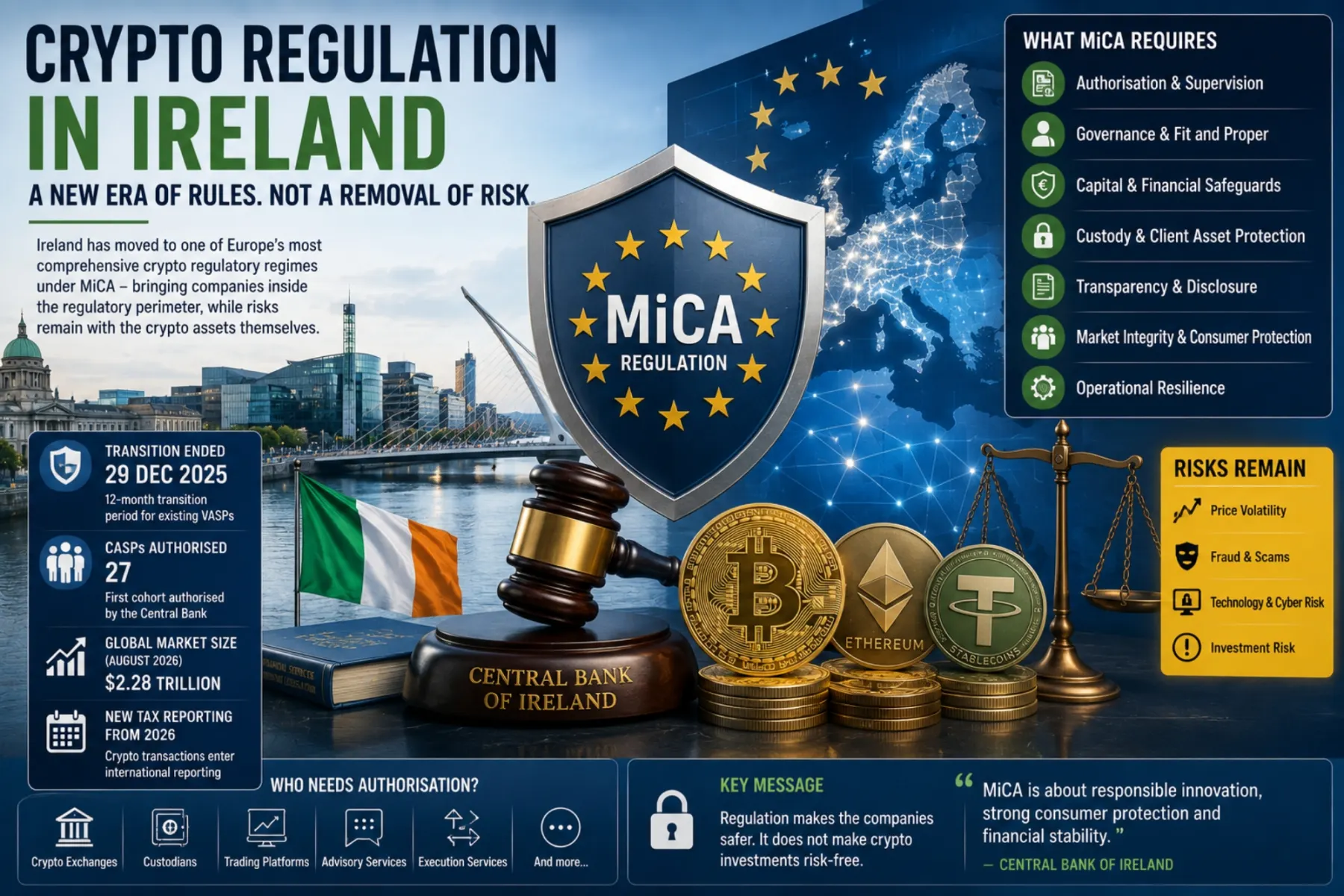
Ireland has moved from an anti-money-laundering registration system to one of Europe’s most comprehensive crypto regulatory regimes. Crypto exchanges, custodians and other service providers now need MiCA authorisation to operate, consumer-protection and operational-resilience rules have tightened, and from 2026 crypto transactions are entering a new international tax-reporting framework. Yet the Central Bank of Ireland continues to stress an important distinction: regulating the companies around crypto does not remove the volatility, fraud, technology and investment risks of the assets themselves.
For years, Ireland’s cryptocurrency market occupied an unusual position.
Crypto companies could operate businesses involving billions of euro in digital assets while much of the underlying activity sat outside the traditional regulatory architecture that governs banks, investment firms and insurers.
That era has largely ended.
As of August 2026, Ireland is operating within the European Union’s Markets in Crypto-Assets Regulation — MiCA, generally referred to in Ireland as MiCAR — creating a common regulatory framework for crypto-asset issuers and service providers across the EU.
The Central Bank of Ireland is Ireland’s national competent authority for the regime and has already authorised a first significant cohort of Crypto-Asset Service Providers, or CASPs. The Bank described 2026 as the point at which the sector was moving from an authorisation exercise into an ongoing supervisory environment.
That change is much more significant than replacing one licence with another.
The old Irish system was primarily concerned with money laundering and terrorist financing.
MiCA goes much further.
Governance.
Capital.
Custody.
Consumer information.
Conflicts of interest.
Market abuse.
Operational resilience.
Complaints.
Management competence.
And the question of whether the Irish entity supposedly running a European crypto business actually has enough people, expertise and decision-making authority in Ireland to do so.
Crypto has moved inside the regulatory perimeter.
But it has not moved outside the risk perimeter.
Before MiCA, Ireland Regulated Crypto Mainly Through Anti-Money-Laundering Law
Ireland’s first significant dedicated crypto regime arrived in April 2021.
Virtual Asset Service Providers — VASPs — established in Ireland were required to register with the Central Bank for anti-money-laundering and counter-terrorist-financing purposes.
They became designated persons under Ireland’s Criminal Justice anti-money-laundering legislation and had obligations including customer due diligence, ongoing transaction monitoring, suspicious-transaction reporting, record keeping and AML controls.
That registration was important.
But it was also limited.
A VASP registration did not amount to the type of broad prudential and consumer-protection authorisation associated with traditional regulated financial firms.
The Central Bank itself has repeatedly emphasised that the previous VASP framework was an AML/CFT regime rather than a comprehensive authorisation system.
That distinction became increasingly difficult to maintain as crypto companies grew larger, products became more complex and consumers could buy digital assets almost instantly through mobile applications.
Europe eventually decided that AML registration alone was not enough.
MiCA Changed the Regulatory Architecture Across Europe
The EU adopted MiCA in 2023 to establish a harmonised framework for crypto-assets and related services that were not already covered by existing EU financial-services legislation.
Stablecoin-related provisions began applying from 30 June 2024, while the broader framework became fully applicable from 30 December 2024.
The purpose was not to endorse cryptocurrency as an investment.
It was to bring previously fragmented activity into a defined regulatory system.
MiCA introduced requirements concerning transparency, disclosure, governance, authorisation, supervision, market integrity and financial stability. It also established specific frameworks for asset-referenced tokens and electronic-money tokens — two categories particularly relevant to stablecoins.
For Ireland, the most visible change concerned the companies through which consumers actually access crypto.
Trading platforms.
Exchanges.
Custodians.
Execution providers.
Advisory businesses.
And other firms providing defined crypto-asset services professionally.
Those businesses increasingly require proper CASP status rather than the much narrower VASP registration used previously.
Ireland Chose a Shorter Transition Than the Maximum Allowed by Europe
MiCA allowed EU Member States to provide existing crypto businesses with a transitional period of up to 18 months.
Ireland did not use the full period.
The Irish transitional arrangement ran for 12 months and ended on 29 December 2025.
Existing VASPs that wanted to continue operating beyond that point needed the appropriate MiCA authorisation.
Across the EU more broadly, the final MiCA transitional periods ended on 1 July 2026.
That means the summer of 2026 marks an important regulatory dividing line.
The Central Bank warned Irish consumers in June that entities providing crypto services to EU consumers after the end of the transition must hold the required MiCA authorisation. It advised consumers to verify providers through the official ESMA register.
For the first time, a consumer in Ireland can therefore ask a relatively straightforward question before transferring money to a crypto platform:
Is this provider actually authorised under MiCA?
A MiCA Licence Is Much Harder to Obtain Than the Old VASP Registration
This is one of the most important changes for the industry.
A company previously registered as a VASP did not automatically qualify as a CASP.
Ireland did not treat VASP registration as equivalent to MiCA authorisation, nor did it use the simplified authorisation procedure available in some circumstances elsewhere.
Applicants have had to go through the full CASP assessment.
The Central Bank examines considerably more than whether the company has an anti-money-laundering policy.
It looks at the business model.
Governance.
Risk management.
Capital.
Operational arrangements.
Customer protection.
Management competence.
Outsourcing.
And whether the company has genuine substance in Ireland.
That changes the meaning of operating an Irish crypto business.
A Dublin company address is no longer sufficient evidence of a meaningful Irish operation.
The Central Bank Wants Real Management in Ireland
The Central Bank has been particularly explicit about what it calls “substance”.
An Irish-authorised CASP is expected to demonstrate genuine autonomy in Ireland and to be led by a locally based executive team and board with sufficient crypto expertise and knowledge of the Irish regulatory environment.
The board must understand the company’s activities and risks.
It must be capable of independent decision-making.
And outsourcing important functions to a global parent company does not remove the Irish entity’s responsibility for them.
That matters because Ireland is a natural location for international financial and technology groups seeking access to the EU market.
The State already hosts major global technology companies, payment businesses, investment managers and international financial institutions.
A crypto business authorised in Ireland may therefore serve customers far beyond Ireland.
But the Central Bank’s position is effectively that European passporting rights must be accompanied by genuine European regulatory responsibility.
MiCA Creates a European Passport
One of MiCA’s major commercial advantages is that an authorised CASP does not necessarily need to build an entirely separate regulatory structure in every EU Member State.
Once authorised, firms can use the MiCA framework to provide permitted crypto services across the Union following the relevant notification process.
The Central Bank requires firms planning cross-border activity to identify the Member States they intend to serve, which services they intend to provide and when those services will begin.
This is strategically important for Ireland.
A company obtaining Irish authorisation is not necessarily targeting a market of little more than five million people.
It may be positioning its Irish entity as a gateway to the European single market.
That makes crypto regulation potentially relevant to Ireland’s broader financial-services strategy.
Ireland Could Become an Important European Crypto Centre
The Central Bank itself has recognised that Ireland could become an important location for CASPs because the country combines an established financial-services industry with a major technology sector and EU membership.
Those advantages are substantial.
Ireland understands cross-border financial regulation.
It already hosts large regulated firms.
There is a substantial compliance workforce.
Major technology operations are established in the country.
And English is the principal language used in business and financial regulation.
But none of that guarantees that Ireland will dominate European crypto.
Other Member States are competing for the same businesses.
The quality, predictability and speed of authorisation matter.
So does regulatory reputation.
Ireland therefore faces a familiar financial-centre challenge: attracting innovative businesses without becoming attractive simply because companies expect lighter supervision.
The Central Bank Does Not Appear Interested in Winning a Race to the Bottom
The Irish regulator’s public statements repeatedly emphasise that authorisation is not intended to be a box-ticking exercise.
It has said firms need clear business models, sufficient resources, credible funding, proper documentation and practical plans for how European operations will function.
That may make authorisation demanding.
It may also make the resulting licence more commercially valuable.
Financial regulation ultimately depends on trust.
If an Irish MiCA authorisation is perceived internationally as rigorous, firms operating under it can benefit from that credibility.
The opposite also applies.
A jurisdiction that attracts crypto companies by performing weak authorisation could eventually inherit the failures of the businesses it admits.
Ireland’s financial history gives the country strong reasons to take that distinction seriously.
Regulation Has Now Moved From Entry Checks to Continuous Supervision
2025 was largely about getting the first CASPs authorised.
2026 is increasingly about supervising them afterwards.
The Central Bank has described this transition directly: from newly authorised companies to an actively supervised crypto sector.
That matters because a licence is only a snapshot.
A company can satisfy regulatory requirements when it applies and then change rapidly.
Transaction volumes can multiply.
New tokens can be added.
Customer demographics can change.
Operations can be outsourced.
Technology systems can become inadequate.
Cyber threats evolve.
Management can change.
Financial conditions can deteriorate.
The regulatory question therefore becomes not merely whether the company was suitable to receive a licence but whether it continues operating safely once it has one.
The Central Bank Is Building a Data-Driven Crypto Supervisory System
The next stage is increasingly quantitative.
The Central Bank announced that it is introducing a quarterly regulatory return for CASPs, designed to provide detailed information about each firm’s financial position and support ongoing supervisory engagement.
That sounds bureaucratic.
It is actually significant.
Regulators cannot supervise fast-moving digital businesses effectively if they depend only on annual accounts and occasional meetings.
Crypto companies can experience dramatic changes in customer balances, trading activity and liquidity within days.
More frequent regulatory reporting gives supervisors a better opportunity to identify problems before they become failures.
This is another way the industry is beginning to resemble traditional finance.
Consumer Protection Became Stronger Again in March 2026
MiCA is not operating alone.
Ireland’s revised Consumer Protection Code took effect on 24 March 2026, and the Central Bank says it applies to activities regulated under MiCA, subject to overlaps and provisions that are not relevant to particular business models.
This adds an Irish consumer-protection layer to the EU crypto framework.
Regulated firms need systems for handling complaints.
They must communicate clearly.
The Central Bank expects disclosures to help customers actually understand what they are buying rather than simply burying risks in lengthy legal documents.
This matters particularly in crypto because products can be technically complex while being extraordinarily easy to purchase.
A consumer can buy an asset they do not understand in seconds.
Regulation therefore increasingly focuses not only on whether information was technically disclosed but on whether the customer could reasonably understand the risk.
But MiCA Does Not Turn Bitcoin Into a Safe Investment
This distinction is essential.
MiCA regulates important parts of the crypto ecosystem.
It does not guarantee crypto prices.
Bitcoin can still fall.
Ether can still fall.
A token can still become nearly worthless.
Markets can remain highly volatile.
Technology can fail.
Fraud can occur.
The Central Bank continues to describe many crypto-assets as highly risky and speculative and warns that they may not be suitable for retail customers.
A regulatory licence therefore means something specific.
It means the provider is operating within a regulatory framework.
It does not mean the regulator believes that every asset available through the provider represents a good investment.
That is no different in principle from conventional markets.
A regulated stockbroker can sell shares that subsequently collapse.
Authorisation supervises the intermediary.
It does not insure the investment outcome.
Crypto Investors Still Have Less Protection Than Traditional Investors
European regulators have been explicit about this limitation.
MiCA provides consumer protections including information requirements and complaints procedures, but the protection remains less extensive than that available for many traditional financial investments.
In particular, crypto-assets do not automatically benefit from investor-compensation arrangements equivalent to those applying to certain conventional investment services.
This is one of the easiest points for consumers to misunderstand.
“Regulated” can sound like “protected”.
They are not synonymous.
A regulated CASP may be required to safeguard client assets and follow conduct rules.
That still does not mean the State will reimburse an investor who buys a token that loses 90% of its value.
Authorised and Unauthorised Providers Now Need to Be Treated Very Differently
The end of the transitional period makes provider status especially important.
The Central Bank has warned that customers using unauthorised CASPs do not receive MiCA protections and has urged consumers to check the official ESMA register.
That has practical consequences for Irish crypto users.
An attractive website is not evidence of authorisation.
An Irish-sounding company name is not evidence of authorisation.
A celebrity photograph is not evidence of authorisation.
A social-media advertisement is not evidence of authorisation.
And the word “regulated” written by the company itself is not evidence of authorisation.
The relevant evidence is whether the provider appears on the appropriate official regulatory register.
Crypto Fraud Has Become More Sophisticated
The Central Bank continues publishing warnings about unauthorised firms and clone businesses that imitate legitimate financial organisations.
Some scams use familiar company names.
Others use online advertisements purporting to be connected to public figures or established institutions.
That is particularly dangerous in crypto because transactions can be difficult or impossible to reverse once assets leave the victim’s wallet.
The underlying technology can settle a transaction perfectly while the economic decision behind it was fraudulent.
That distinction is important.
Blockchain security does not prevent somebody being tricked into voluntarily sending assets to a criminal.
Ireland Has Already Taken Major Enforcement Action in the Crypto Sector
Crypto regulation in Ireland is no longer theoretical.
In November 2025, the Central Bank announced its first enforcement outcome in the sector, imposing a €21.46 million penalty on Coinbase Europe Limited for anti-money-laundering transaction-monitoring failures between 2021 and 2025.
The underlying settlement provided for a €30.66 million sanction before the application of a 30% settlement discount, and the High Court confirmed the sanction in January 2026.
The case related to the older VASP-era AML framework rather than a finding that Coinbase had breached MiCA.
That distinction matters.
The Central Bank said faults in Coinbase Europe’s monitoring configuration meant more than 30 million transactions with a value exceeding €176 billion were not properly monitored during a 12-month period. Subsequent review generated 2,708 suspicious-transaction reports.
The enforcement action demonstrated two things simultaneously.
Crypto businesses have entered mainstream financial supervision.
And regulators are willing to impose substantial penalties when controls fail.
Anti-Money-Laundering Regulation Remains Central
MiCA did not replace Ireland’s anti-financial-crime regime.
Crypto providers continue to face customer due diligence, transaction monitoring, record-keeping and suspicious-transaction obligations under applicable AML legislation.
This area is particularly important because crypto combines several characteristics that can create financial-crime risks.
Transactions can cross borders rapidly.
Wallet addresses are digital rather than conventional bank-account identities.
Some technologies can make tracing ownership more difficult.
Transactions may settle outside normal banking hours.
And international platforms can operate across multiple jurisdictions.
That does not mean cryptocurrency is inherently criminal.
It means its technical features create risks that financial-crime systems have to manage differently from traditional banking.
Market Manipulation Has Also Entered the Regulatory Framework
MiCA introduces specific rules against market abuse in crypto markets.
That includes insider dealing, unlawful disclosure of inside information and forms of market manipulation.
The significance should not be underestimated.
Historically, some crypto markets developed trading practices that would attract immediate scrutiny in conventional securities markets.
Thinly traded tokens.
Coordinated promotions.
Pump-and-dump schemes.
Conflicts between exchanges and affiliated businesses.
Influencer-driven speculation.
MiCA attempts to bring crypto market integrity closer to expectations already familiar in traditional finance.
The Central Bank has said market abuse will be one of its supervisory priorities and plans to work with ESMA on pan-European monitoring of crypto activity.
That European dimension is necessary because crypto does not respect national trading hours or borders.
Cybersecurity Is Now a Regulatory Obligation, Not Merely an IT Problem
A crypto company can be financially healthy and still fail catastrophically if its technology fails.
That makes operational resilience central to the sector.
The EU’s Digital Operational Resilience Act — DORA — has applied since 17 January 2025 and establishes requirements covering ICT risk management, incident reporting, resilience testing and third-party technology risk for financial entities within its scope.
The Central Bank’s MiCA guidance specifically addresses DORA obligations for CASPs, including registers covering contractual arrangements with ICT third-party providers.
This is particularly relevant to crypto companies because their business can depend heavily on technology supplied by others.
Cloud infrastructure.
Wallet technology.
Cybersecurity systems.
Trading engines.
Blockchain analytics.
Identity verification.
Data storage.
Outsourcing does not make those risks disappear.
It merely moves where they originate.
Custody May Be the Most Important Consumer Issue Nobody Sees
When investors buy crypto through an exchange, the visible experience can look simple.
Open application.
Transfer euro.
Press buy.
But behind that interface lies a complicated custody problem.
Who controls the private keys?
How are customer assets separated from the company’s own assets?
What happens if the exchange fails?
Who can move assets?
What security controls exist?
How are withdrawals authorised?
Crypto history contains repeated examples of customers discovering that assets they believed were safely held were either missing, misused or inaccessible after a platform failed.
MiCA’s safeguarding and organisational rules attempt to reduce those risks.
But they cannot eliminate every technical or operational failure.
Custody remains one of the areas where regulation matters most precisely because the customer normally cannot see how the system works internally.
Stablecoins Receive Special Regulatory Treatment
Stablecoins occupy another important part of MiCA.
The regulation distinguishes between electronic-money tokens, which seek to maintain value by reference to a single official currency, and asset-referenced tokens, which may reference other assets or combinations of assets.
The relevant MiCA rules have applied since June 2024.
The distinction matters because stablecoins increasingly resemble financial infrastructure rather than purely speculative assets.
They can be used for trading.
Payments.
Settlement.
Cross-border transfers.
And as a digital representation of conventional currency inside blockchain ecosystems.
The closer a token comes to functioning as money, the stronger the public-policy interest in whether the assets backing it really exist and whether holders can redeem it.
Ireland Is Also Looking Beyond Cryptocurrency Towards Tokenisation
The Central Bank’s approach is not simply defensive.
It has explicitly identified potential benefits from distributed-ledger technology and tokenisation in areas including payments, trading, post-trade infrastructure, investment funds and asset management.
In March 2026, it highlighted growing interaction between blockchain technology and artificial intelligence and noted that it had been engaging with firms on real-world tokenisation projects since early 2024.
This is a significant shift in the debate.
Crypto regulation is gradually becoming part of a much larger discussion about the future architecture of finance.
A token does not necessarily have to be a speculative cryptocurrency.
A conventional security can potentially be represented digitally.
A fund interest can be tokenised.
Settlement processes can use distributed ledgers.
Payments can interact with programmable assets.
The technology may therefore survive and expand even if many individual cryptocurrencies ultimately disappear.
Ireland’s Strategic Opportunity Is Bigger Than Bitcoin Trading
This is where Ireland’s position becomes particularly interesting.
The country already hosts an internationally significant funds industry, payments sector and technology ecosystem.
If financial assets become increasingly tokenised, Ireland could potentially participate through:
fund administration;
digital custody;
payments;
compliance technology;
blockchain infrastructure;
tokenised investment products;
and regulated crypto services.
The Central Bank has described tokenisation as potentially transformative while simultaneously emphasising governance, customer protection and financial stability.
That creates a more sophisticated policy objective than simply trying to attract cryptocurrency exchanges.
The economic opportunity may ultimately lie in the infrastructure around digital finance.
The Tax Authorities Are Moving Into Crypto Too
Perhaps the biggest change for ordinary Irish crypto users in 2026 has received less attention than MiCA.
Ireland has now implemented the Crypto-Asset Reporting Framework and DAC8, dramatically expanding tax transparency around digital assets.
The rules apply from 1 January 2026.
Reporting Crypto-Asset Service Providers must collect information on reportable users and relevant crypto transactions.
The first reporting cycle covers activity during 2026.
Providers will generally have to submit the relevant information by 31 May 2027, after which Revenue will exchange information with relevant jurisdictions by 30 September.
This represents a major change in the practical relationship between cryptocurrency and tax administration.
The Era of Assuming Crypto Is Invisible to Revenue Is Ending
One of cryptocurrency’s historical attractions to some users was the perception that transactions could exist outside conventional financial reporting.
DAC8 and the OECD Crypto-Asset Reporting Framework are designed specifically to close that information gap.
Providers facilitating purchases, sales, transfers and certain reportable payment transactions can be required to collect and report information about users.
The policy logic resembles the international exchange of bank-account information already familiar under the Common Reporting Standard.
The asset may be digital and decentralised.
The tax obligation is not.
For compliant investors, this mainly means record keeping becomes even more important.
For people assuming that crypto transactions cannot become visible to tax authorities, the regulatory direction is increasingly clear.
Ireland Does Not Have a Special Crypto Tax System
Revenue’s current guidance makes another important point.
There are no special Irish tax rules simply because an asset is cryptocurrency or another crypto-asset.
Existing tax principles are applied according to the nature of the transaction.
That means the relevant tax treatment can depend on whether activity represents investing, trading, income, a disposal, a gift or another taxable event.
For individuals holding crypto as an investment, disposals can create Capital Gains Tax consequences.
Importantly, “disposal” should not automatically be understood as only converting Bitcoin back into euro.
Exchanging one asset for another can also have tax consequences depending on the circumstances and applicable tax rules.
The increasingly automated reporting environment makes accurate transaction records more important than ever.
CARF Could Change Crypto Behaviour More Than a New Trading Rule
MiCA regulates how businesses operate.
CARF and DAC8 change transparency.
Those two developments reinforce each other.
A regulated European crypto provider increasingly needs to know who its customers are.
Monitor transactions.
Maintain records.
Comply with sanctions requirements.
And now gather information potentially relevant to automatic tax reporting.
The anonymous offshore image associated with the early cryptocurrency era is becoming less representative of the regulated European market.
Crypto itself can remain decentralised.
Access through large commercial intermediaries is becoming increasingly regulated and identifiable.
Self-Custody Remains Outside Much of the Intermediated Model
There is nevertheless an important distinction between using a regulated exchange and holding crypto directly in a self-hosted wallet.
A self-hosted wallet allows an individual to control their own cryptographic keys rather than relying on a CASP as custodian.
The Central Bank’s June consumer warning itself identified transferring assets to a self-hosted wallet as one possible alternative for users leaving unauthorised providers.
That does not make self-custody automatically safer.
It changes the risk.
With an exchange, customers face intermediary and custody risk.
With self-custody, individuals assume responsibility for keys, backups and transaction security themselves.
Lose access credentials and there may be no customer-service department capable of restoring them.
Send funds to the wrong address and the transaction may be irreversible.
Regulation can supervise intermediaries.
It cannot remove the consequences of controlling a decentralised asset directly.
The EU Framework Is Already Being Reviewed
Another indication of how quickly this sector moves is that Europe is already reviewing MiCA even though its full application is relatively recent.
On 20 May 2026, the European Commission launched public and targeted consultations on the review of the MiCA framework.
Both consultations remain open until 31 August 2026.
That should not necessarily be interpreted as evidence that MiCA has failed.
It reflects the speed at which crypto markets change.
The regulation was designed years before its full implementation.
Since then, stablecoins have expanded.
Tokenisation has accelerated.
Traditional financial institutions have entered the sector.
New business models have appeared.
And regulatory frameworks in other major jurisdictions have evolved.
The EU now has to decide whether the rules remain fit for the market that actually emerged.
Europe Is Trying to Regulate a Technology That Changes Faster Than Legislation
This is the structural difficulty of crypto regulation.
Financial laws can take years to negotiate.
Technology can change in months.
A regulation may define a category of token.
Developers create a new structure.
A rule covers exchanges.
Trading moves towards a decentralised protocol.
Regulators address one form of stablecoin.
A new form of tokenised bank money develops.
The objective cannot therefore realistically be to write one law that anticipates every future innovation.
The more sustainable approach is to establish principles around:
consumer protection;
governance;
financial crime;
custody;
market integrity;
technology resilience;
and accountability.
That is increasingly where European regulation is heading.
Some Crypto Activity Still Sits Outside MiCA
MiCA is broad.
It is not universal.
The dedicated framework applies principally to crypto-assets and related services that are not already governed by other EU financial-services legislation.
That distinction matters as traditional securities become tokenised.
A financial instrument does not necessarily escape securities regulation merely because blockchain technology is used to issue or trade it.
The legal nature of the asset matters more than the technological label attached to it.
That is one reason the emerging digital-finance world is becoming increasingly complicated.
A token may be governed by MiCA.
Another token may fall under existing securities law.
Another arrangement may involve payments legislation.
A company can require more than one regulatory permission simultaneously.
Crypto and Payments Regulation Are Beginning to Overlap
Stablecoins and other blockchain payment systems create particularly difficult boundary questions.
A CASP may also need permissions relevant to payment or electronic-money services depending on its activities.
The Central Bank acknowledges that firms can require multiple licences and assesses each application under its relevant legal framework.
This matters because the financial system is converging.
An application may look like a crypto wallet.
But it may also process payments.
Hold electronic money.
Provide exchange services.
Offer investment exposure.
The regulatory category increasingly depends on what the service actually does rather than what the company calls itself.
Regulation Is Likely to Favour Larger and Better-Funded Companies
There is an economic consequence to all of these requirements.
Compliance costs money.
CASPs need qualified directors.
Compliance officers.
Cybersecurity infrastructure.
Capital.
Legal advice.
Transaction monitoring.
Regulatory reporting.
Risk management.
Customer-service systems.
Auditing.
And technology capable of meeting European standards.
Large companies can spread those costs across millions of customers.
Smaller start-ups cannot.
MiCA may therefore improve consumer protection while simultaneously accelerating consolidation in the crypto industry.
That would not be unusual.
Financial regulation often produces economies of scale.
The paradox is that a technology built around decentralisation could develop a commercial market increasingly dominated by a smaller number of large regulated intermediaries.
But Regulation Could Also Make Ireland More Attractive to Serious Firms
There is another side.
Legitimate companies often prefer clear rules to regulatory uncertainty.
A business considering investing tens of millions of euro in a European operation wants to know:
which authority supervises it;
what capital it needs;
how customers must be protected;
which services it can passport;
and how regulators will interpret its business model.
MiCA provides much more of that certainty than the fragmented system that preceded it.
The Central Bank’s creation of a dedicated CASP authorisation portal in April 2026 is part of that institutionalisation, giving applicants a central system for submissions, documentation and regulatory communication.
The question is therefore not simply whether regulation increases costs.
It is whether the certainty created by regulation outweighs those costs for businesses capable of meeting the standard.
Irish Consumers Are Likely to See Fewer Questionable Platforms
One likely consequence of the post-transition environment is a narrowing of the visible market.
Providers unwilling or unable to obtain MiCA authorisation should not continue providing regulated crypto services to EU consumers.
ESMA has called for unauthorised firms to wind down their activities in an orderly manner, while the Central Bank has said it will coordinate with other European regulators to ensure that this occurs.
That does not mean unauthorised websites will disappear from the internet.
Offshore companies can still advertise.
Fraudsters can still create platforms.
Consumers can still encounter firms outside Europe.
The regulatory perimeter is not an internet firewall.
Its purpose is to distinguish the regulated market clearly from everything outside it.
Social Media Remains One of Regulation’s Hardest Problems
Financial promotion has changed radically.
A generation ago, a risky investment might be marketed through a broker or printed advertisement.
Today, a person can encounter a cryptocurrency while watching a short video on a phone.
Influencers can reach millions.
Promotional content can look indistinguishable from entertainment.
An advertisement can cross every European border instantly.
The Central Bank has repeatedly highlighted misleading crypto advertising and the risks of paid promotion through social media.
MiCA imposes standards on marketing and disclosure.
Enforcement remains difficult because the distribution system itself is global.
The regulated company may be in Ireland.
The influencer may be somewhere else.
The social network may be headquartered in another country.
The token may trade worldwide.
Crypto regulation therefore requires international cooperation almost by definition.
Ireland’s Approach Is Becoming More International, Not Less
The Central Bank works with ESMA, the European Banking Authority and other international regulatory bodies because national supervision alone cannot effectively police a borderless market.
The Bank has emphasised regulatory convergence across the EU and described cooperation between national regulators as essential to consistent MiCA implementation.
That matters commercially as well as for consumers.
If one Member State applies MiCA much more loosely than another, companies could seek the easiest authorisation and then passport services across Europe.
Regulators call this forum shopping.
A harmonised European framework therefore depends not only on identical legislation.
It requires regulators to interpret that legislation in broadly consistent ways.
The Next Regulatory Battle Will Be Over Financial Innovation Rather Than Cryptocurrency Alone
By 2026, the term “crypto regulation” is beginning to become too narrow.
The technologies being regulated increasingly overlap with mainstream finance.
Stablecoins interact with payments.
Tokenised securities interact with capital markets.
Blockchain settlement interacts with banking.
Digital custody interacts with funds.
Artificial intelligence interacts with transaction monitoring and fraud detection.
The Central Bank has already begun discussing what it calls the potential convergence of AI and distributed-ledger technology.
The question facing Ireland is therefore not whether cryptocurrency will be allowed to exist.
It already does.
The harder question is how much of the future financial system will use technologies originally developed within crypto.
What MiCA Changes for an Ordinary Irish Investor
For an individual buying crypto in Ireland, the new regulatory environment can be reduced to several practical differences.
The provider matters more than ever.
Authorised CASPs operate under governance and conduct requirements.
Consumers should be given clearer information.
Complaints procedures must exist.
Crypto-service firms face supervisory scrutiny.
Market-manipulation rules apply.
Operational resilience matters.
AML controls are stronger.
Tax reporting is becoming more automatic.
Those are meaningful improvements.
But none answers the most important investment question:
What will the asset be worth tomorrow?
Regulation cannot answer that.
What MiCA Does Not Change
Bitcoin remains volatile.
Altcoins can still collapse.
A technically compliant token can still be economically worthless.
A regulated platform can still experience operational difficulties.
A consumer can still lose access to a self-hosted wallet.
Scammers can still impersonate regulated businesses.
Crypto bought through an authorised firm does not gain a government guarantee.
And there is no promise that investors will recover losses simply because MiCA applies.
This distinction may become even more important as crypto becomes more respectable.
The better regulated an industry appears, the easier it can become for consumers to underestimate the underlying investment risk.
Regulation May Ultimately Separate Crypto Technology From Crypto Speculation
That could become one of MiCA’s most consequential long-term effects.
During crypto’s first decade, speculative assets, blockchain technology, payments, decentralised finance and tokenisation were frequently treated as one industry.
Regulation is beginning to separate them.
A Bitcoin exchange is one business.
A euro stablecoin is another.
A tokenised investment fund is another.
A custody service is another.
A blockchain settlement platform is another.
A meme token promoted through social media may be something different again.
As those categories mature, investors and regulators will increasingly evaluate them independently.
That could produce a smaller speculative market but a larger digital-finance industry.
Ireland Now Has One of the Clearest Crypto Frameworks It Has Ever Had
The transformation since 2021 is substantial.
Then, the principal Irish regulatory relationship with crypto companies concerned anti-money-laundering registration.
By 2026:
MiCA authorisation governs major categories of crypto service providers.
The Irish transition period has ended.
The Consumer Protection Code applies to MiCA-regulated activity.
DORA is bringing technology resilience into financial supervision.
The Central Bank is introducing recurring CASP reporting.
Market-abuse surveillance is becoming a priority.
CARF and DAC8 have begun collecting crypto transaction data for future automatic tax exchange.
And the European Commission is already reviewing whether the MiCA framework needs to evolve further.
Crypto in Ireland is no longer a regulatory experiment.
It is becoming part of regulated financial services.
The Next Question Is Whether Regulation Produces Trust
MiCA can require licences.
The Central Bank can supervise firms.
Revenue can receive transaction information.
DORA can demand stronger technology systems.
European regulators can investigate market abuse.
None of those things guarantees that cryptocurrency will become a successful mainstream asset class.
What regulation can potentially create is something more fundamental:
a market in which customers know who they are dealing with.
A market in which firms have identifiable responsibilities.
A market in which failures can be investigated.
A market in which financial crime controls are expected.
And a market in which innovation can take place without assuming that every new technology deserves an exemption from rules applied elsewhere in finance.
That is the real regulatory experiment now underway in Ireland.
The country is not attempting to decide whether crypto prices should rise or fall.
It is attempting to decide whether crypto businesses can become ordinary enough to be supervised like other financial companies while remaining innovative enough to justify their existence.
The first stage was bringing the industry inside the regulatory perimeter.
That has largely happened.
The harder stage begins now.
Ireland must determine whether regulation can make crypto markets more accountable without creating the false impression that regulated crypto has somehow become risk-free.
Because in 2026, the most important fact about crypto regulation is also the easiest to misunderstand:
a licence can regulate the company selling the asset — it cannot regulate the price of the asset itself.
Source & Transparency
This article is published by Ireland Newspaper for editorial and informational purposes.
Published: 11 August 2026 · Updated: 11 August 2026

Newsroom Ireland Newspaper
Ireland Newspaper editorial team prepares daily news coverage for readers in Ireland and abroad.




Market data, financial news and economy content on Ireland Newspaper are provided for editorial and informational purposes only. They do not constitute financial advice, investment advice, trading advice or a recommendation to buy, sell or hold any financial product. Always verify live prices and consult a qualified professional before making financial decisions.