From Horsepower to Algorithms: How Farm Machinery Is Reshaping Irish Agriculture
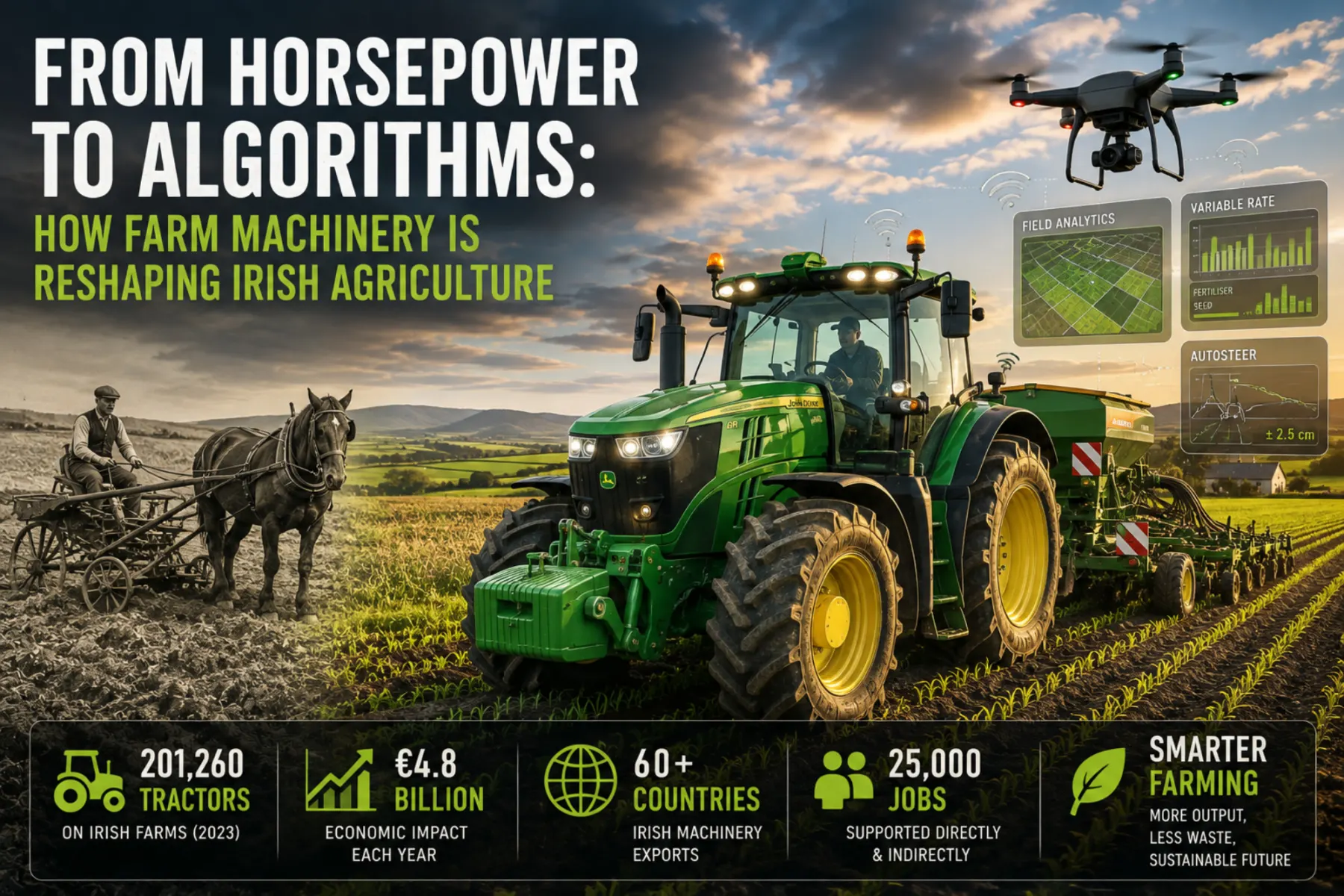
Ireland now has more than 200,000 tractors on its farms and a machinery industry estimated to contribute almost €5 billion to the economy. John Deere, Massey Ferguson and New Holland remain dominant names in tractors, while Irish manufacturers such as McHale, Abbey, MAJOR and Malone have built international businesses. The next transformation, however, is increasingly about precision, automation and using machines more intelligently rather than simply making them larger.
A modern Irish tractor can steer itself to within centimetres, automatically switch individual sections of a fertiliser spreader or sprayer on and off, record where it has worked, exchange information with attached implements and transmit machine data back to a farm office or dealer.
That is a remarkable distance from the machinery that first mechanised Irish agriculture.
Yet the tractor remains at the centre of Irish farming. The Central Statistics Office estimated that 201,260 tractors were owned on Irish farms in 2023. Almost 94,500 of them — 47 per cent — were in the 81hp-to-134hp range. Ireland had an estimated 133,174 farms that year.
Those numbers help explain why agricultural machinery has developed into considerably more than a supporting trade.
A study produced by the Farm Tractor & Machinery Trade Association and ifac in late 2025 estimated the industry’s total economic impact at approximately €4.8 billion a year, supporting almost 25,000 direct and indirect jobs. It estimated direct annual output at about €2.6 billion and machinery exports at more than €700 million, with Irish manufacturers supplying over 60 countries. As an industry-commissioned economic assessment, those figures should be understood as estimates rather than a CSO measure of national output, but they illustrate the scale the sector has reached.
Irish farm machinery has therefore become two industries at once.
One imports some of the world’s largest agricultural brands.
The other designs and manufactures specialised equipment in Irish towns and rural communities and increasingly exports it around the world.
Ireland Has a Long Machinery History
Mechanisation did not arrive in Ireland all at once.
For generations, agricultural work depended heavily on people and horses. Ploughing, cultivation, harvesting and transport required large amounts of labour, and the amount of work that could be completed during a short period of suitable weather was limited.
The arrival of the tractor changed that calculation.
Ireland even played an early role in tractor manufacturing. Ford established tractor production in Cork, and the first Fordson tractors from the Cork operation were produced in 1919.
Another important connection was Harry Ferguson, born in County Down, whose work on tractor implements and the three-point linkage became enormously influential in modern tractor design and whose name survives in Massey Ferguson.
But the deeper transformation came when tractors and powered machinery moved from being exceptional equipment to standard farm infrastructure.
Post-war mechanisation reduced the amount of labour required for many agricultural operations. Tractors became more powerful. Hydraulic systems improved. Power take-off systems allowed one engine to operate increasingly sophisticated implements.
Mowers, balers, forage harvesters, slurry tankers, loaders, combines and feeding equipment progressively changed how quickly farms could operate.
Ireland’s agricultural structure changed with the machinery.
Farms became more specialised. Dairy herds became larger. Contractors developed into major operators of expensive harvesting equipment. Tillage farming adopted increasingly large cultivation, drilling and harvesting systems.
Modern machinery did not merely make the old farm faster.
It helped create a different type of farm.
The Irish Tractor Market Has Recovered Strongly
The machinery business is highly sensitive to farm income.
A tractor can remain useful for decades, so farmers can postpone replacing equipment when margins are weak. Conversely, periods of stronger agricultural income can quickly produce increased machinery investment.
The recent Irish market illustrates this cycle.
After 1,817 new tractors were registered in 2024, registrations recovered to 2,067 during 2025 — an increase of 14 per cent. Ireland also first-time registered 2,971 imported used tractors during 2025, 7.4 per cent more than in the previous year.
The improvement has continued into 2026.
The latest available FTMTA figures, released on 10 August 2026, show that 1,770 new tractors were registered during the first seven months of this year, around 5 per cent more than during the equivalent period of 2025. Another 1,729 used imported tractors were first-time registered over the same period.
That matters because the used market remains almost as important as the new market.
For many smaller farms, purchasing a new six-figure tractor may make little economic sense. A well-maintained used tractor, machinery sharing or employing an agricultural contractor can provide considerably better utilisation of capital.
Irish machinery investment therefore cannot be understood solely through new-equipment sales.
Irish Tractors Are Becoming More Powerful
The type of tractor being purchased has also changed.
During 2025, the 161hp-to-200hp category was Ireland’s largest new-tractor power band, accounting for 24.43 per cent of registrations. Tractors above 200hp accounted for 11.7 per cent.
The latest figures show that this does not mean every farm is automatically moving toward extremely large machines. In July 2026, the biggest individual category was 121hp to 140hp, representing one quarter of new registrations that month, while average registered tractor power was 145hp.
Several forces are operating simultaneously.
Larger farms and contractors often need higher horsepower to pull wider equipment, move heavier loads and complete work quickly during Ireland’s narrow weather windows.
But horsepower alone is becoming a less useful measure of agricultural progress.
A 140hp tractor equipped with automatic steering, implement control, telemetry and variable-rate technology may operate substantially more precisely than a much larger but less sophisticated machine.
The technological race is increasingly moving from the engine compartment to the electronics.
Who Are Ireland’s Biggest Tractor Suppliers?
There is an important statistical limitation when attempting to rank Ireland’s machinery suppliers.
There is no comprehensive public real-time ranking covering every type of agricultural machine by company revenue or total Irish machinery sales. Different manufacturers are strong in different segments, while full brand-level tractor information is published with a delay.
It is therefore more accurate to identify market leaders by machinery category rather than declare one company Ireland’s largest agricultural machinery supplier overall.
For tractors, the most recent publicly available brand-level FTMTA figures cover 2024.
They show John Deere leading the Republic of Ireland tractor market with 422 registrations, or 23.2 per cent.
Massey Ferguson and New Holland were tied behind it, each recording 320 tractors and approximately 17.6 per cent of the market. Case IH recorded 202 tractors, or around 11.1 per cent, while Valtra followed with roughly 7 per cent. Together, John Deere, Massey Ferguson and New Holland represented more than 58 per cent of the new tractor market.
John Deere
John Deere currently occupies the strongest position in the latest available Irish tractor brand statistics.
Its Irish presence also demonstrates the importance of the dealer rather than simply the manufacturer.
Templetuohy Farm Machinery, or TFM, describes itself as Ireland’s largest John Deere dealer and operates six John Deere locations — Thurles, Clonmel, Laois, Enniscorthy, Kilkenny and Tuam — covering 13 counties.
For farmers buying increasingly sophisticated machines, that network matters.
A tractor is no longer merely purchased and serviced mechanically. Software, electronic diagnostics, GPS systems, displays, sensors and machine connectivity have increased the importance of technical support.
Downtime during silage or harvest can be extremely expensive.
The quality of a dealer’s parts and service operation can therefore influence purchasing decisions almost as strongly as the specification of the tractor itself.
Massey Ferguson
Massey Ferguson retains an unusually strong historical connection with Irish farming and remains one of the country’s leading tractor brands.
Today it belongs to AGCO and offers tractors alongside combines, balers, hay and forage machinery and other agricultural equipment through its dealer network.
Its joint second-place position in the latest public Irish tractor ranking illustrates the durability of the brand in a market where farmers frequently develop long relationships with individual manufacturers and dealerships.
New Holland
New Holland shares that second position in the latest available brand statistics.
Its Irish range extends well beyond tractors into combine harvesters, forage equipment, balers, loaders and precision-farming systems. The company maintains a Republic of Ireland dealer network and increasingly integrates machinery through its FieldOps digital platform and precision technology products.
That broader portfolio matters because larger farms and contractors may favour machinery ecosystems in which tractors, harvesters and digital systems can share information.
Case IH, Valtra, Fendt, CLAAS and Others
The market below the three largest tractor brands remains highly competitive.
Case IH holds a significant position, while Valtra, Fendt, CLAAS, Kubota, Deutz-Fahr, Landini and other manufacturers give Irish buyers a much wider choice than market-share statistics alone might suggest.
And the ranking changes once the analysis moves beyond tractors.
CLAAS Leads Ireland’s Combine Market in 2026
Combines provide a good example.
Only 34 new combine harvesters had been registered in Ireland during 2026 up to the end of July — a tiny market compared with tractors.
But within that specialised market, CLAAS held 50 per cent with 17 machines, John Deere had 11, or approximately 32 per cent, and New Holland had four, or 12.5 per cent. Case IH and Deutz-Fahr had one registration each.
Geography explains part of this specialised demand.
Tillage farming is concentrated particularly strongly in eastern and south-eastern Ireland. The CSO recorded 10,290 farms growing cereals in 2023, with substantial cereal areas in the South-East and Dublin/Mid-East regions.
A combine can cost hundreds of thousands of euro but may only work intensively for a relatively short harvest period.
That makes contractors and machinery utilisation particularly important.
JCB and Manitou Dominate the Telehandler Market
Another machine has quietly become central to modern livestock agriculture: the telescopic loader.
Telehandlers perform work that would previously have been divided between tractors with loaders and various specialist machines. They can handle silage, feed, manure, bales and bulk materials while providing considerably greater lifting height and reach.
The Irish telehandler market is currently highly concentrated.
Through July 2026, JCB and Manitou together accounted for approximately 70 per cent of new telehandler registrations, with Weidemann and Kramer behind them.
That dominance demonstrates why identifying the “largest machinery company” depends on the particular job being examined.
John Deere may lead tractors.
CLAAS currently leads new combines.
JCB and Manitou dominate telehandlers.
And forage machinery presents another picture again.
Contractors Drive the Market for the Biggest Machines
Some of Ireland’s most impressive agricultural machines are rarely owned by ordinary individual farms.
Self-propelled forage harvesters are a prime example.
By the end of June 2026, 43 new self-propelled forage harvesters had already been registered in Ireland — close to the 49 recorded during the whole of 2025. CLAAS led the market, followed by John Deere and Krone. Seven of those 43 machines produced more than 900 horsepower.
Machines of that scale make economic sense only when they cover substantial acreage.
That is why agricultural contractors are such an important part of Ireland’s machinery system.
A contractor can spread the enormous fixed cost of a forage harvester, combine, baler or slurry-spreading system over hundreds or thousands of hectares and many customers.
Farmers effectively purchase access to machinery capacity without purchasing the machine itself.
The distinction will become increasingly important as equipment prices rise.
Ireland Is Also a Machinery Manufacturer
Imported international brands receive much of the attention because tractors are highly visible.
But one of the most interesting aspects of the Irish machinery industry is the size of its indigenous manufacturing base.
Irish companies have developed particular expertise in machinery suited to grassland and livestock agriculture — exactly the farming systems that dominate Ireland.
Several have turned solutions developed for Irish conditions into export businesses.
McHale: From Mayo to International Grassland Markets
McHale is one of the best-known examples.
Based in Ballinrobe, County Mayo, the company was established by brothers Padraic and Martin McHale in the mid-1980s and specialised in grassland equipment.
Its product range now includes round balers, integrated baler-wrapper combinations, bale wrappers and handling and cutting equipment.
The company’s development illustrates a broader strength of Irish agricultural engineering.
Wet grass, rapidly changing weather and the need to harvest forage quickly created practical engineering problems on Irish farms.
Machinery developed to solve those problems could subsequently be sold into other grass-based agricultural markets.
The Irish climate, in that sense, became part of the industry’s research laboratory.
Abbey Machinery: Slurry and Feeding Become High Technology
Abbey Machinery in Toomevara, County Tipperary, has another long Irish manufacturing history.
The business produces slurry equipment, diet feeders, fertiliser spreaders and grassland machinery and increasingly incorporates precision application and low-emission technology into its products.
This is an area where agricultural machinery and environmental policy are converging particularly rapidly.
A slurry tanker was once fundamentally a tank, pump and spreading plate.
Modern systems can include trailing shoes or injection equipment, flow measurement, application control and data systems designed to place nutrients more accurately and reduce emissions.
The machine is becoming part of the environmental-management system of the farm.
MAJOR Equipment: An Export Business Built in Mayo
MAJOR Equipment, based in Ballyhaunis, County Mayo, was established in 1976.
The company manufactures agricultural and professional mowing equipment and says its products are sold through dealers in more than 30 countries.
Its development highlights another feature of Irish machinery manufacturing.
A company does not need to manufacture tractors or combines to build an international agricultural business.
Specialised implements can occupy valuable niches within a global machinery market far larger than Ireland itself.
Malone Farm Machinery: Another Mayo Manufacturer
Malone Farm Machinery, based in Ballyglass near Claremorris, was founded in 1999.
Its agricultural range now includes mowers, tedders, rakes, post drivers and other equipment, distributed through dealer networks in Ireland, Britain and other markets.
McHale, MAJOR and Malone also demonstrate the concentration of agricultural engineering expertise that has developed in the west of Ireland.
It is an industry built unusually close to its customers.
Machines can be designed, manufactured and tested in communities where agriculture remains a major part of everyday economic life.
Distributors Are an Important Part of the Industry
Between multinational manufacturers and individual dealerships sits another important group: national distributors.
Farmhand is one of the most established examples.
Founded in 1962, it distributes brands including Krone, Amazone, Quicke, APV and Zuidberg and says 33 dealers are responsible for sales and service of major parts of its machinery portfolio across the island.
The model demonstrates how the machinery supply chain actually operates.
The farmer may buy from a local dealer.
Behind that dealer can be an Irish distributor.
Behind the distributor may be a German, American, French, Italian or other international manufacturer.
And alongside all of them are Irish manufacturers selling directly or through their own international dealer networks.
Ireland’s farm machinery industry is therefore both local and global at the same time.
The Machine Is Becoming a Data Platform
The next major transformation has already begun.
Precision agriculture changes the fundamental objective from simply completing a task to completing exactly the right amount of that task in exactly the right place.
Traditional fertiliser spreading might apply one rate across an entire field.
A variable-rate system can divide the field into zones.
Traditional spraying treats a wide area.
Modern section control can shut off parts of the boom automatically.
More advanced systems can control individual nozzles.
Camera and sensor systems can increasingly identify weeds and apply treatment only where required.
Teagasc documented a Wexford tillage farm in 2026 using yield maps, precision soil analysis, GPS auto-steering, variable-rate fertiliser application and a precision sprayer capable of operating individual nozzles according to prescription maps generated from field information.
Teagasc separately reported that precision sprayers using GPS section control, variable-rate maps and camera or sensor-based spot spraying are gaining traction in Ireland. The technology can reduce overlap and unnecessary pesticide use, although high capital cost, maintenance, calibration and training remain limitations.
This is likely to define the next decade of machinery development.
The objective is no longer necessarily a bigger machine.
It is a machine that wastes less.
Why Economics May Accelerate Precision Farming
Environmental benefits are important, but economics may ultimately determine adoption.
Fertiliser, fuel, crop-protection products and labour are expensive.
Every unnecessary overlap costs money.
Every pass across a field consumes diesel and operator time.
Every machine sitting unused represents capital that must somehow be financed.
For Irish tillage farms, machinery is already one of the largest components of production cost. Teagasc’s cost analysis has estimated machinery at roughly 25 to 30 per cent of crop-growing costs in typical tillage systems.
The 2025 National Farm Survey subsequently found average machinery operating costs of €12,748 on the tillage farms represented, alongside average machinery depreciation of €10,728.
The financial question facing farmers therefore becomes increasingly sophisticated:
Not “Can this machine do the job?”
But “Can this machine save enough fertiliser, labour, fuel, time or contracting expense to justify its ownership cost?”
That is a much higher standard.
The Cost of Machinery Is Becoming a Constraint
Modern machinery is extraordinarily productive.
It is also expensive.
Electronic transmissions, emissions-control systems, satellite guidance, sophisticated hydraulics, sensors, telematics, more comfortable cabs and increasingly complex implements have all added capability — and cost.
The FTMTA/ifac economic study highlighted substantial increases in machinery prices and in the operating costs faced by machinery businesses.
That changes purchasing behaviour.
A farm may keep an older tractor for longer.
Another may buy used.
Several farms may share specialised equipment.
Others may outsource major operations to contractors.
Larger operations may still justify highly advanced machinery because they can distribute its cost over more hectares, livestock or working hours.
The gap between what technology can do and what an individual farm can economically justify is likely to become one of the defining issues of agricultural machinery over the next decade.
Environmental Regulation Is Changing Machine Design
Another force is increasingly visible: regulation.
Ireland’s agricultural environmental targets require more accurate management of fertiliser, slurry, pesticides, energy and emissions.
That creates direct demand for new types of equipment.
Low-emission slurry-spreading systems are one example.
Precision fertiliser application is another.
Sprayer control, nutrient sensors, flow meters, soil mapping and digital records increasingly allow farmers to demonstrate not only what they applied, but how much and where.
Government schemes such as TAMS 3 also provide investment support for specified farm buildings and qualifying equipment, with different support levels depending on the investment category and applicant.
This means environmental policy is not only affecting how farmers operate.
It is influencing what machinery companies design.
The Future Tractor May Still Have a Diesel Engine — But That Will Not Be the Whole Story
A complete disappearance of diesel-powered Irish tractors over the next decade appears unlikely.
Large tractors require enormous amounts of energy during prolonged heavy work. Batteries suitable for small machines do not automatically translate economically into a 200hp tractor working continuously with heavy implements.
But alternative drivetrains are developing.
New Holland, for example, currently offers its T7.270 Methane Power tractor, rated at 271hp and designed particularly for operations capable of producing biomethane through anaerobic digestion.
Battery-electric equipment may find earlier opportunities in smaller tractors, loaders, yard machinery and machines that operate relatively close to charging infrastructure.
Methane, renewable fuels, hybrid systems and improved conventional engines may coexist for considerable time.
The transition is therefore likely to be much less simple than replacing every diesel tractor with an electric one.
Automation May Arrive Before Full Autonomy
The image of a completely driverless tractor working across an Irish field attracts attention.
The more important transformation may occur before that.
Many farm machines are already semi-autonomous.
Automatic steering can control direction.
Headland-management systems can execute several operations automatically.
Balers can automate parts of the baling cycle.
Dairy systems can automatically identify and feed animals.
Sprayers can decide which nozzle should operate.
Telematics can identify maintenance requirements before the farmer notices a mechanical problem.
The operator increasingly moves from physically controlling every action to supervising a machine executing predefined instructions.
Full autonomy could eventually extend that process.
But safety, field boundaries, public-road transport, liability, regulations and the unpredictable nature of livestock and Irish field conditions mean completely driverless farming is unlikely to replace human operators everywhere in the near term.
Automation is more likely to arrive task by task.
Artificial Intelligence Will Probably Enter Through the Workshop First
Artificial intelligence is another term likely to become increasingly common in machinery marketing.
Its most practical early applications may be less spectacular than autonomous tractors.
AI can potentially help analyse fault codes, predict component failure, optimise machine settings, identify plants through camera systems, interpret yield data and help engineers design equipment.
The 2025 FTMTA/ifac economic assessment reported that Irish machinery businesses were already using AI and automation in areas including design, diagnostics and internal systems.
For the farmer, predictive maintenance could prove particularly valuable.
A warning that a component has a high probability of failing next week is far more useful than discovering the problem after the forage harvester stops in the middle of a perfect harvesting day.
In agriculture, reliability has an economic value that extends far beyond the repair bill.
Dealers Will Need More Software Specialists
The changing tractor also changes the person who repairs it.
Mechanical engineering will remain essential. Engines, transmissions, hydraulics, bearings and drivetrains still require skilled technicians.
But workshops increasingly need expertise in electronics, networking, satellite guidance, software and data.
That creates a workforce challenge.
FTMTA’s economic research identified shortages of technicians and other skilled employees as a significant constraint on machinery businesses.
This could become strategically important.
A farmer may be willing to purchase a sophisticated connected machine only if somebody nearby can repair it quickly.
The strongest machinery companies of the future may therefore be those with the best technical support networks, not simply those offering the highest horsepower.
Ireland’s Weather Will Continue to Shape Its Machinery
Technology changes, but Irish weather remains remarkably influential.
Grass must be cut when conditions permit.
Silage must be harvested quickly.
Tillage farmers can have short windows for sowing, spraying and combining.
A delayed operation can reduce crop quality or yield.
That helps explain why contractors operate extremely powerful machinery capable of completing enormous amounts of work quickly.
It also explains why reliability remains so important.
Teagasc estimated in May 2026 that rising fuel and machinery costs continued to put pressure on silage production and reported harvesting as the largest component of contractor-based baled-silage costs.
The economic value of a large machine is therefore not simply that it can perform more work.
It can perform more work while the weather allows it.
That distinction is particularly important in Ireland.
What Irish Farm Machinery Could Look Like by 2035
The safest forecast is not that Irish farms will simply contain larger machines.
Several trends point toward a more complex future.
Precision will probably become increasingly standard. GPS guidance, section control and machine connectivity are likely to migrate from premium equipment into ordinary mid-range tractors and implements.
Application equipment could become much more selective. Rather than applying one treatment across a field, cameras, maps and sensors could increasingly allow individual sections — and eventually individual plants — to be treated differently.
Machinery ownership may become more selective. As capital costs increase, contractors, leasing and shared machinery could become even more important for expensive equipment with limited annual utilisation.
Data will become part of the machine. A farmer purchasing a tractor may increasingly be purchasing a connected operating system involving tractor, implement, agronomic records, satellite information and farm-management software.
Irish engineering companies could gain opportunities from environmental regulation. Grassland, slurry and livestock systems are areas where Ireland already has manufacturing expertise.
Alternative fuels will develop unevenly. Smaller machines may electrify faster, while high-horsepower field equipment could use several different energy technologies for longer.
Automation will expand progressively. Driver assistance and automatically controlled individual operations are likely to become commonplace before completely autonomous farms do.
These are plausible developments rather than certainties. Farm profitability, regulation, technology costs, fuel prices and the willingness of farmers to adopt new systems will determine their speed.
The Biggest Machine May No Longer Be the Most Advanced
For most of the twentieth century, progress in agricultural machinery was easy to see.
More horsepower.
A wider implement.
A larger combine.
A faster forage harvester.
Those measures still matter, but they increasingly tell only part of the story.
The next generation of agricultural technology is concerned with centimetres, litres, kilograms and data points.
Can the tractor avoid an unnecessary overlap?
Can the spreader vary fertiliser automatically?
Can a sensor recognise the section of crop that actually needs nitrogen?
Can a sprayer treat a weed without treating the entire field?
Can the machine tell the workshop that a component is beginning to fail?
Can two machines exchange information without the farmer manually entering it?
Can all of that reduce cost enough to justify the investment?
Those questions point toward a different definition of agricultural productivity.
A Machinery Industry Entering a New Era
Ireland’s farm-machinery sector has travelled an extraordinary distance.
What began with implements designed to reduce physical labour has developed into a network of multinational brands, local dealerships, agricultural contractors, technology specialists and internationally successful Irish manufacturers.
Today more than 200,000 tractors sit on Irish farms. New tractor registrations rose strongly in 2025 and remain ahead year-on-year through July 2026. John Deere leads the latest available tractor-brand statistics, while Massey Ferguson and New Holland remain formidable competitors. CLAAS currently leads new combine registrations, JCB and Manitou dominate telehandlers, and Irish manufacturers including McHale, Abbey Machinery, MAJOR Equipment and Malone have demonstrated that Ireland can be a producer as well as a buyer of agricultural technology.
But the most important development may now be taking place almost invisibly.
Farm machinery is evolving from mechanical equipment into connected technology.
Engines and steel will remain essential. Yet sensors, satellites, cameras, software, artificial intelligence and data are becoming increasingly important to what the machine actually achieves.
For Irish farming, the economic challenge will be deciding which of those technologies genuinely save money, labour or resources — and which merely add cost.
For the machinery industry, the opportunity is equally significant.
Ireland’s next great agricultural machine may not be defined by how much horsepower it produces.
It may be defined by how intelligently it uses every one of them.
Source & Transparency
This article is published by Ireland Newspaper for editorial and informational purposes.
Published: 11 August 2026 · Updated: 11 August 2026

Newsroom Ireland Newspaper
Ireland Newspaper editorial team prepares daily news coverage for readers in Ireland and abroad.