Breeding a Better Irish Flock: How Genetics, Health and Data Are Changing Sheep Farming
Irish sheep breeding is moving beyond choosing a ram on appearance alone. Genomic evaluations, €uro-Star indexes, performance recording and increasingly precise health management are giving breeders new ways to select animals for fertility, survival, growth, milk, ease of lambing and resilience. For breeders preparing for the 2026 mating season, the opportunity is significant — but so is the need to choose genetics that actually suit the farm.
A ram bought during the summer of 2026 could still be influencing an Irish sheep flock well into the 2030s.
That is particularly true when his daughters are retained as replacements.
The purchase price of a breeding animal attracts attention on sale day, but its real value is determined years later: how many lambs its daughters produce, whether those lambs survive, how much assistance is required at lambing, how well the ewes milk, whether they remain sound on their feet and how quickly their offspring reach slaughter weight.
That is why sheep breeding in Ireland is undergoing a quiet but important transformation.
The traditional skills of judging conformation, feet, mouth, breed character and physical soundness remain essential. But modern breeders can now add another layer of information: pedigree records, individual performance, DNA, genomic evaluations and national genetic indexes.
Ireland’s 2026 breeding season is therefore not simply about finding a good-looking ram.
It is increasingly about finding the right genetics for a particular production system.
Ireland Remains a Major Sheep-Producing Country
Sheep continue to occupy an important place in Irish agriculture, particularly across western, border, hill and marginal-land regions where other intensive agricultural systems may be less suitable.
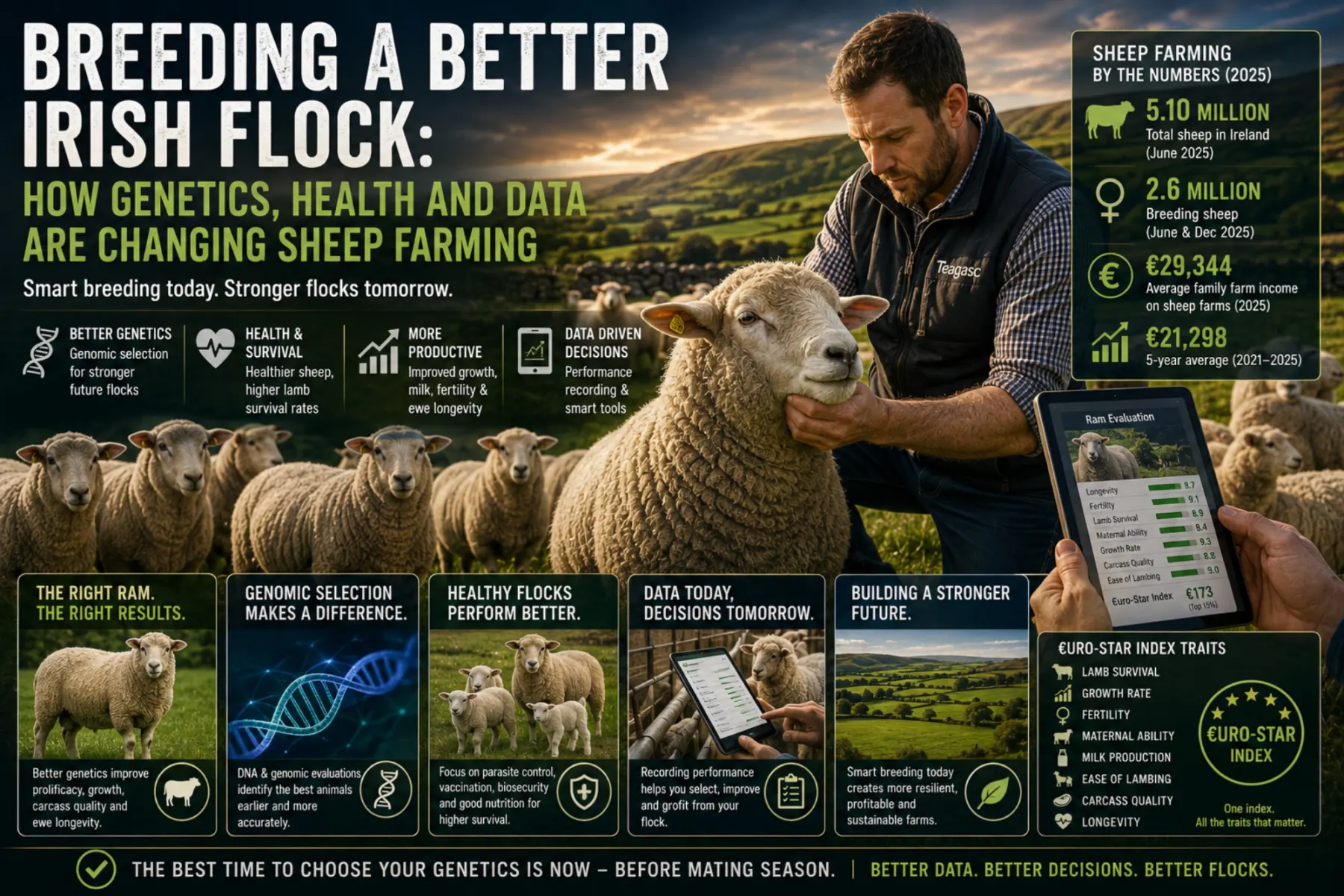
The Central Statistics Office recorded 5.10 million sheep in Ireland in June 2025, including approximately 2.6 million breeding animals. Total sheep numbers were 1.5 per cent lower than a year earlier, while the breeding population declined by 2.7 per cent. The seasonal December count subsequently recorded almost 3.69 million sheep, with breeding sheep rising by about 1 per cent year-on-year to 2.6 million. The June and December totals should not be compared directly because sheep numbers change substantially through the production year.
The economics remain challenging.
Teagasc’s latest National Farm Survey estimates average family farm income on sheep farms at €29,344 in 2025, 7 per cent higher than in 2024. Stronger lamb prices helped, but lower output volumes limited the increase. The five-year average for sheep farms between 2021 and 2025 was only €21,298, illustrating how important efficiency remains in a sector where margins can fluctuate substantially.
That economic background matters to breeders.
A breeding programme cannot be judged only by whether animals look impressive in a sale ring. Ultimately, the genetics have to produce more saleable output, reduce costs or labour, improve ewe longevity — or ideally achieve several of those objectives together.
The First Question Is Not “Which Breed?” but “What Does the Farm Need?”
Irish sheep farmers have access to an enormous variety of breeds.
Suffolk, Texel, Charollais and Vendeen genetics are widely used where terminal performance is important. Maternal breeding programmes may incorporate breeds such as Belclare and other prolific or maternal lines. Hill farms operate under an entirely different set of environmental constraints, with hardiness and the ability to perform on difficult ground becoming particularly important.
There is no universally superior breed.
A ram that is highly suitable for producing fast-growing slaughter lambs from mature lowland ewes may be inappropriate for breeding replacement females.
Similarly, increasing prolificacy is not automatically profitable if a farm lacks the grass, labour, housing or management capacity required to rear additional lambs.
The starting point should therefore be a breeding objective.
Does the flock need:
more lambs born?
more lambs surviving?
easier lambing?
better maternal ability?
more milk?
faster lamb growth?
earlier finishing?
better carcasses?
smaller mature ewe size?
less lameness?
greater parasite resilience?
Or some combination of these?
Once that question has been answered, breed and ram selection becomes much more rational.
The Two Indexes Every Irish Breeder Should Understand
The Irish national breeding system divides much of this information into two principal economic indexes: Replacement and Terminal.
The Replacement Index is designed for animals whose genetics will contribute to future breeding females as well as slaughter lambs. It combines traits including survival, growth, fertility, prolificacy and milk production.
The Terminal Index is intended primarily for rams producing slaughter lambs and places much greater emphasis on survival and growth to finishing.
That distinction is fundamental.
A farmer breeding his own replacement females should not select entirely on terminal performance.
Conversely, if every daughter from a particular mating is destined for slaughter and no females will enter the flock, maternal performance several generations later carries less economic importance.
Teagasc consequently recommends a structured breeding policy in which part of the flock can be mated to maternal sires to generate replacements while the remainder is mated to terminal sires to maximise the performance of slaughter lambs. The proportion required depends partly on the flock’s existing weaning rate. Teagasc has estimated that a flock weaning around 1.3 lambs per ewe may need roughly 40 per cent of ewes mated maternally, falling toward 30 per cent as weaning rates approach 1.7.
This effectively creates two breeding businesses within the same flock.
One produces tomorrow’s ewes.
The other produces today’s sale lambs.
What Five Stars Actually Mean
The €uro-Star system makes complex genetic information easier to interpret, but the stars can also be misunderstood.
A five-star animal ranks within the top 20 per cent of its breed for the relevant evaluation. Four stars represent the next band, with the ranking continuing downward in 20 per cent intervals.
Importantly, the stars are primarily within-breed rankings.
A five-star animal from one breed should therefore not automatically be assumed to have a greater economic genetic value than a five-star animal from another breed.
For comparisons across breeds, breeders should pay attention to the associated euro values, which Sheep Ireland says can be compared across breeds.
There is another number that deserves almost as much attention as the star rating:
accuracy.
A high genetic index with low accuracy carries more uncertainty because comparatively little information may yet support the estimate.
An animal backed by its own performance records, relatives, progeny and genomic information can eventually achieve a much more reliable evaluation.
In practical terms, an impressive headline figure with poor accuracy should be treated more cautiously than an equally strong figure supported by substantial data. Sheep Ireland explicitly advises placing less emphasis on evaluations when the displayed accuracy percentage is low.
Why €uro-Stars Can Change
Breeders sometimes become concerned when a ram’s evaluation moves after purchase.
That does not necessarily mean anything went wrong.
Ireland’s genomic sheep evaluation now operates weekly, and fresh information is continually entering the system. New weights, lambing records, relatives, progeny data and genomic information can alter the estimate of an animal’s true genetic merit.
Sheep Ireland’s first 2026 genomic evaluation incorporating that year’s lamb crop was published in March. The organisation notes that animals with lower-accuracy evaluations are naturally more likely to move as additional evidence becomes available.
For pedigree breeders, this creates an important lesson:
recording quality is part of breeding quality.
If birth information, lambing difficulty, weights and other measurements are entered accurately and at the appropriate time, the resulting genetic evaluation becomes more informative.
A breeder who measures consistently is therefore contributing not merely data to a computer.
The breeder is making future selection decisions more reliable.
Performance Recording Is Becoming Part of the Pedigree Business
Sheep Ireland’s LambPlus programme is the national performance-recording system available to pedigree and commercial flocks.
Its 2026 breeder directory specifically highlights pedigree breeders participating in LambPlus and recording performance data that feed into €uro-Star genetic evaluations. It also allows commercial farmers to locate performance-recording breeders and search for rams through Sheep Ireland’s online tools.
This is gradually changing what a pedigree breeder can offer a customer.
Traditionally, pedigree, physical appearance and bloodline were central selling points.
Increasingly, the buyer can ask:
How did this bloodline perform?
How easily were the lambs born?
How quickly did they grow?
What happened to the daughters?
How many lambs did those daughters produce?
Were they good mothers?
How long did progeny take to finish?
What is the accuracy behind the evaluation?
Those questions move pedigree sheep breeding closer to measurable livestock improvement.
A Beautiful Ram Can Still Be the Wrong Ram
None of this makes physical assessment obsolete.
Quite the opposite.
Genetic data cannot compensate for a structurally unsound breeding animal.
Before buying, a ram should still be examined carefully for locomotion, feet and legs, teeth, eyes, body condition and reproductive organs. Teagasc recommends that breeding rams be checked well ahead of mating so that problems can be corrected or replacements sourced before they are required.
The key principle is simple:
selection should combine figures and phenotype rather than substitute one for the other.
A breeder should not buy solely because an animal is visually impressive.
Nor should an animal be purchased solely because a catalogue displays five stars.
The strongest candidate is one whose physical soundness, genetic information and traits all match the breeding objective of the flock.
Survival Deserves More Attention Than Birth Numbers Alone
Prolificacy is understandably attractive.
More lambs born per ewe can increase output.
But lambs that do not survive produce no sale revenue.
The 2026 Sheep Ireland evaluation explicitly includes lamb survivability, combining factors related to lambing ease and survival. The system also evaluates lamb vigour — an increasingly useful trait where labour availability at lambing is limited.
This changes how breeders should think about reproductive performance.
The objective should not necessarily be the maximum number of lambs born.
A better target is the greatest number of healthy lambs reared efficiently per ewe joined, within the capabilities of the farm.
A prolific ewe requiring repeated assistance, producing weak lambs and demanding substantial supplementary feeding may be less profitable than a slightly less prolific ewe consistently rearing vigorous twins from grass.
Breeding decisions need to reflect that distinction.
Mothering Ability Is an Economic Trait
There is a tendency to view maternal behaviour as something that cannot easily be measured.
Ireland’s genetic programme increasingly challenges that assumption.
The Replacement Index incorporates maternal traits, while individual evaluations can include daughters’ milk and ewe mothering ability. Sheep Ireland’s 2026 trait definitions also include predicted barrenness and mature ewe weight.
Those characteristics have major practical consequences.
A ewe that finds her lambs quickly, stands for them to suck, produces sufficient milk and requires little assistance reduces labour precisely when the farmer is under the greatest pressure.
For large flocks, that becomes increasingly valuable.
Labour efficiency may therefore become one of the strongest arguments for maternal genetic selection over the coming decade.
The best ewe is not necessarily the one that produces the most impressive single lamb.
It may be the ewe the farmer barely notices because she lambs, mothers and rears consistently without intervention.
Mature Ewe Weight Is More Important Than It Looks
One of the more interesting traits in the modern Replacement Index is mature ewe weight.
Larger ewes generally require more maintenance feed.
If two ewes produce similar lifetime lamb output but one requires significantly more feed simply to maintain her own body, the smaller efficient ewe may offer an economic advantage.
That does not mean breeders should automatically select the smallest sheep possible.
Size can be associated with other useful production characteristics and must suit the farming system.
The important development is that the mature size of replacement females can now be considered as part of lifetime efficiency rather than as an aesthetic preference.
This is exactly the type of trait likely to grow in importance if fertiliser, feed and land remain expensive.
Faster Finishing Has Benefits Beyond Lamb Price
The Days to Slaughter trait ranks genetics according to the ability of progeny to reach target weight more rapidly.
Sheep Ireland’s commercial validation work has reported that progeny of five-star Terminal rams reached slaughter around 14 days sooner than progeny of one-star Terminal rams in participating commercial flocks.
Two weeks may not sound revolutionary.
Across hundreds of lambs it can be highly significant.
Earlier finishing can mean less grass consumed by finished animals, reduced parasite exposure, lower supplementary-feed requirements, more grass available for breeding ewes and fewer lambs carried into autumn when grazing conditions deteriorate.
Genetic improvement therefore does not have to create spectacular individual changes.
Small improvements repeated across every animal and every year can accumulate into substantial economic differences.
Parasite Resistance Is Becoming a Breeding Issue
One of the most important future challenges for Irish sheep farming may be invisible.
Anthelmintic resistance means worm treatments that were once highly effective may perform poorly on individual farms.
Teagasc therefore recommends using faecal egg counts to establish whether treatment is needed and testing treatment effectiveness rather than assuming a particular wormer still works.
Genetics can eventually become another part of that strategy.
Sheep Ireland now reports a faecal egg count genetic trait, predicting whether progeny are likely to have higher or lower egg counts relative to the population average.
This should not be interpreted as a replacement for sound parasite management.
But it demonstrates where breeding is heading.
Future sheep may increasingly be selected not merely for growth and carcass characteristics, but for their ability to remain productive under disease and parasite pressure.
Resilience itself could become a valuable genetic product.
Lameness Is Also Entering the Genetic Conversation
Lameness costs more than veterinary treatment.
A lame ewe grazes less effectively, may lose body condition, can perform poorly at mating and creates additional labour.
The Irish genetic evaluation now contains predicted lameness traits for both ewes and lambs.
Again, genetics cannot compensate for poor foot management, contaminated ground or the introduction of infectious disease.
But identifying families with consistently better locomotion and hoof health gives breeders another tool.
Over multiple generations, that can gradually change the type of ewe within a flock.
The wider lesson is important: do not repeatedly breed from problems simply because the animal otherwise looks good.
A ewe that is persistently lame, has a damaged udder, repeatedly prolapses or consistently creates severe lambing difficulty is passing more than her attractive characteristics into the next generation.
Culling Is Part of Breeding
Breeding progress depends as much on what leaves the flock as on what enters it.
Good flock records should make it possible to identify ewes associated with repeated problems.
Teagasc specifically recommends scrutinising udders and previous lambing records before breeding, with animals suffering problems such as damaged or blind teats, serious previous mastitis or prolapse among those that may warrant culling rather than another mating.
This can be uncomfortable for pedigree breeders because an animal may possess a valuable bloodline.
But genetics do not improve merely by retaining pedigrees.
They improve by repeatedly selecting the animals that best fulfil the breeding objective.
A disciplined breeder therefore asks a difficult question every year:
Would I deliberately breed another ewe exactly like this one?
If the answer is no, retaining her daughters requires careful justification.
Body Condition Remains One of the Cheapest Breeding Technologies Available
Genetics cannot perform if nutrition prevents animals from expressing their potential.
For lowland flocks, Teagasc generally targets ewes around body condition score 3 to 3.5 at mating, with more detailed guidance suggesting an average around 3.5 and avoiding animals below 3.0. Hill ewes can be managed at approximately half a condition score lower.
The principle matters more than the precise decimal.
Thin ewes need enough time before mating to regain condition.
That means breeding preparation starts weeks rather than days before the ram is turned out.
Flushing cannot magically correct severe under-condition in a short period.
For breeders aiming to maximise conception and litter size, August and September management can therefore have consequences well into the following spring.
Ewe Lambs Can Accelerate Genetic Progress — If They Are Ready
Mating selected ewe lambs can shorten the generation interval and produce another lamb crop from the female during her lifetime.
But it requires careful management.
Teagasc recommends mating only ewe lambs that have achieved at least 60 per cent of their expected mature weight, typically around 45–50kg for many breeds. Research from Teagasc Athenry indicates that well-managed maternal replacements lambing for the first time at one year of age can produce around 1.2 additional lambs over their lifetime compared with females first lambing at two years.
This should not be treated as a universal instruction.
On farms where ewe lambs cannot reach suitable weight economically or where labour and feed resources are constrained, later mating may remain more appropriate.
The lesson is instead that age alone should not determine the decision.
Liveweight, development and management capacity matter.
The Ram Needs Preparing Long Before Mating Day
A breeding ram cannot be taken from poor condition in late September and expected automatically to perform in October.
Sperm production takes approximately six to seven weeks, meaning illness, fever, severe lameness or other stress well before turnout can affect fertility during the breeding season.
Teagasc recommends rams enter mating in strong condition, generally around BCS 3.5–4.0, while feet, legs, teeth, eyes and reproductive organs should be checked in advance.
For breeders, that has an immediate implication in August 2026.
The mating season has effectively already begun.
Not because rams are necessarily running with ewes yet, but because semen that will be required later is being produced now.
A breeder buying a replacement ram should consequently allow enough time for transport recovery, quarantine and acclimatisation.
Buying a Ram: Do Not Start With the Sale Ring
The best purchasing decisions often happen before the animal enters the ring.
The breeder should first identify what the flock needs and use available records to narrow the candidates.
Sheep Ireland’s Ram Search allows farmers to search current evaluations by factors including county and breed. Evaluations can then be checked again close to purchase because genomic rankings are updated weekly.
For the 2026 season, Sheep Ireland is also holding its Elite €uro-Star Multi-Breed Ram Sale at Kilkenny Mart on Saturday, 22 August, with viewing from 9am and selling scheduled from 10:30am. Sheep Ireland says more than 500 five-star rams are expected.
Breed societies are running numerous additional sales across Ireland during August and September.
The important point is not where the ram is bought.
It is that the breeder arrives knowing which traits matter.
Biosecurity: The Expensive Ram Can Bring More Than Genetics
Every purchased breeding animal also represents a disease risk.
Teagasc recommends keeping incoming sheep separate from the existing flock for a minimum of 28 days, with a farm-specific quarantine and vaccination programme developed with the veterinary practitioner.
New animals should be assessed for lameness, internal and external parasites and vaccination status, while breeding females may require consideration of protection against abortion-related diseases depending on flock history and veterinary advice.
This is particularly relevant to pedigree breeders.
Animals may travel between farms, sales and shows much more frequently than ordinary commercial stock.
A genetically exceptional ram that introduces resistant worms, foot disease or another infectious problem can become one of the most expensive animals a farm ever purchases.
Biosecurity should therefore be considered part of the acquisition cost.
Bluetongue Changes the Health Calculation in 2026
The health environment facing Irish sheep breeders has changed materially this year.
Ireland confirmed Bluetongue Virus serotype 3, BTV-3, for the first time in January 2026, and it has subsequently been detected in multiple cattle herds across several counties. Sheep can experience more severe clinical disease than cattle.
The Department’s animal-health authorities have warned that warmer conditions increase the ability of the virus to replicate in the Culicoides midges that transmit it. The June national update advised farmers to seriously consider vaccination with their veterinary practitioner as protection against clinical losses; no national restriction zones or general movement controls were in place at that update. The Department’s main bluetongue information page was most recently updated on 6 August 2026.
For pedigree breeders, this matters beyond animal health.
Movement, sales, export certification and the reproductive value of breeding stock can all be affected by disease status.
The correct response will vary between farms, so vaccination and movement decisions should be made using the latest Department guidance and veterinary advice rather than relying on assumptions from previous years.
Ten Practical Rules for the 2026 Breeding Season
For breeders turning all of this information into a practical plan, the priorities can be condensed into ten principles:
- Define the breeding objective before buying the ram. Decide whether the priority is replacements, slaughter lambs or both.
- Use the correct index. Replacement genetics for future ewes; Terminal genetics primarily for slaughter progeny.
- Look beyond the stars. Check individual traits, euro values and particularly the accuracy percentage behind the evaluation.
- Select against recurring problems. Poor udders, persistent lameness, prolapse, difficult lambing and poor mothering should influence culling and replacement decisions.
- Record everything useful. Accurate lambing data, weights, survival and ewe performance improve both flock decisions and national genetic evaluations.
- Condition-score early. Do not wait until mating to discover that breeding females are too thin.
- Give rams a pre-breeding examination. Feet, teeth, condition and reproductive soundness should be checked weeks before turnout.
- Quarantine purchases. Treat the health status of a new ram or ewe as seriously as its pedigree.
- Match prolificacy to farm capacity. More lambs are valuable only if the farm can rear them efficiently.
- Measure lifetime performance. The best breeder is not necessarily producing the most spectacular lamb at four months; the goal is producing animals that remain profitable across several years.
The Breeder’s Most Valuable Animal May Be the Invisible One
Pedigree breeding naturally places considerable emphasis on individual animals.
But commercial profitability is generated by populations.
One exceptional show winner may attract attention.
A hundred daughters that each lamb without assistance, rear vigorous twins, remain sound for several seasons and produce fast-finishing offspring can transform a farm.
That is the deeper purpose of genetic evaluation.
It attempts to identify animals whose desirable characteristics are more likely to be inherited rather than simply observed once under favourable management.
For that reason, the modern breeder needs to distinguish between performance and genetics.
An exceptionally heavy lamb may have benefited from a high-milking ewe, excellent grass or preferential feeding.
Its genetic evaluation attempts to separate those environmental advantages from the inherited component that can be transmitted to its progeny.
That separation is never perfect.
But more data, genomic information and progeny records make it progressively more reliable.
Genomics Is Changing How Quickly Breeders Can Learn
Traditional progeny testing has a fundamental limitation: breeders often have to wait years before discovering whether a young ram produces good daughters.
Genomic selection helps shorten that delay.
DNA information can strengthen the relationship between a young animal and reference populations whose performance is already known, increasing the information available before the ram has accumulated a large number of progeny.
Ireland’s 2026 genomic evaluations are now updated every week as new information enters the system.
This does not make breeding instant.
Maternal traits such as longevity and lifetime reproductive performance still take years to observe fully.
But genomic technology allows breeders to make more informed decisions earlier in an animal’s life.
The result should be faster genetic progress if the underlying measurements remain accurate.
The Future Is Likely to Reward Balanced Sheep
For decades, visible production traits naturally attracted attention: heavier lambs, more muscle and greater growth.
Those characteristics will remain important.
But the direction of Irish genetic evaluation suggests a broader definition of the valuable sheep.
The future animal may increasingly be selected simultaneously for:
survival,
fertility,
milk,
mothering ability,
growth,
lower lambing difficulty,
sound feet,
appropriate mature size,
reduced parasite burden,
efficient finishing,
carcass quality,
and potentially lower environmental impact.
Sheep Ireland’s current evaluations already include traits for methane output and faecal egg count alongside conventional production characteristics.
That is a significant shift.
It means breeding is beginning to account for costs and characteristics that were historically difficult to see.
Hill Breeding Will Need Its Own Answer
Not every lesson from a highly productive lowland flock transfers directly to the hills.
A hill ewe must survive and reproduce under environmental conditions where grass availability, terrain and weather can impose very different pressures.
Hardiness, mothering ability, mobility and suitability to the local environment may therefore carry greater importance than maximising output per individual ewe.
Sheep Ireland’s 2026 breeder programme is expanding its work with hill breeding groups, flockbooks and genotyping, with an explicit aim of improving information while preserving useful breed characteristics and identifying robust, fertile animals suited to hill conditions.
That approach is important.
Genetic progress does not mean making every sheep in Ireland the same.
It means identifying the animal best suited to each system.
What Could Irish Sheep Breeding Look Like by 2035?
The direction is clearer than the exact outcome.
More animals are likely to have genomic information.
More commercial farmers may select rams using individual trait data rather than breed reputation alone.
Performance recording could become easier as electronic identification, automatic weighing and farm software reduce manual recording.
Health traits may become increasingly important as antimicrobial and anthelmintic resistance place greater emphasis on prevention and biological resilience.
Environmental traits could also become more valuable if agricultural policy increasingly rewards lower emissions or more efficient resource use.
And breeders capable of demonstrating the commercial performance of their bloodlines may find themselves in a stronger position than those selling almost entirely on pedigree and appearance.
None of this eliminates traditional stockmanship.
It makes good stockmanship more measurable.
Ireland Is Moving From Breeding Sheep to Breeding Outcomes
The fundamental purpose of sheep breeding has not changed.
Farmers have always selected animals they believed would improve the next generation.
What has changed is the amount of information available before that decision is made.
An Irish breeder in 2026 can examine the animal standing in front of him, study its pedigree, inspect its physical soundness, review its genetic indexes, compare individual traits, check evaluation accuracy and increasingly use genomic information to estimate what that animal may pass to its offspring.
That creates opportunity, but it also requires discipline.
More data does not automatically create better sheep.
The breeder must still decide which traits matter.
A farm producing replacements needs different genetics from one concentrating entirely on terminal lambs. A hill flock has different requirements from intensive lowland grassland. A system short of labour may value lamb vigour and mothering ability differently from one with substantial lambing assistance available.
The most successful breeding programme is therefore unlikely to be the one chasing the highest number in a catalogue.
It will be the one that defines precisely what a profitable ewe should look like on that particular farm, records performance honestly and then selects relentlessly toward that objective.
For generations, Irish breeders improved sheep largely through observation, experience and memory.
Those abilities still matter.
But they now have something their predecessors never possessed: the ability to combine the stockman’s eye with national performance records and genomic evidence.
The future of Irish sheep breeding will be built from both.
Source & Transparency
This article is published by Ireland Newspaper for editorial and informational purposes.
Published: 11 August 2026 · Updated: 11 August 2026

Newsroom Ireland Newspaper
Ireland Newspaper editorial team prepares daily news coverage for readers in Ireland and abroad.