
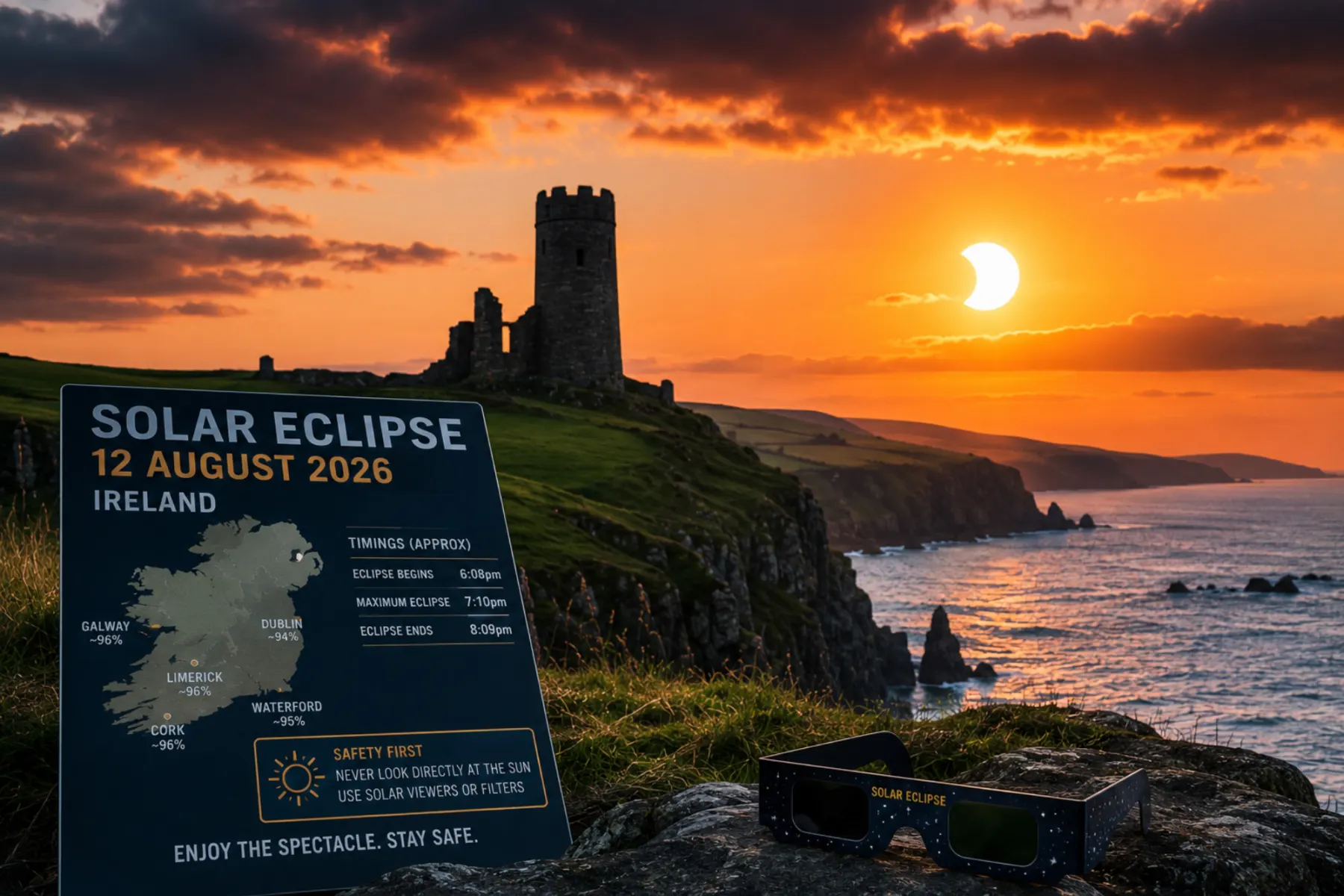
Ireland’s Evening Sky Is About to Change: How to Watch Tomorrow’s Solar Eclipse Safely
On Wednesday, 12 August 2026, the Moon will cover more than 90 per cent of the Sun across Ireland, producing one of the country’s most dramatic astronomical sights in years. Cork, Galway and Limerick will see roughly 96 per cent of the solar disc obscured at maximum eclipse. But there is one rule that matters above all others: from Ireland, the eclipse is never total, so there is never a safe moment to look directly at the Sun without proper solar protection.
Tomorrow evening, something remarkable will happen above Ireland.
Shortly after 6pm, a dark edge will begin moving slowly across the Sun.
At first, the change may seem almost insignificant. A small section of the solar disc will disappear. Minute by minute, however, the Moon will advance until little more than a brilliant crescent of sunlight remains.
In Cork, approximately 96.4 per cent of the Sun’s visible disc will be obscured at maximum eclipse. Limerick will reach about 96.0 per cent, Galway about 96.0 per cent and Waterford roughly 95.2 per cent. Even Dublin will see approximately 94 per cent of the solar disc covered.
For Ireland, this is a partial solar eclipse.
Elsewhere, the same astronomical event will be total.
The Moon’s central shadow will sweep across parts of Greenland and Iceland, cross the North Atlantic and continue into Spain and a small part of Portugal. Observers inside that narrow corridor will experience totality, when the Moon completely covers the bright face of the Sun. Ireland lies outside that corridor, but close enough to experience an exceptionally deep partial eclipse.
That distinction is crucial.
No part of Ireland experiences totality tomorrow. At no point during the eclipse is it safe to look directly at the Sun without proper solar protection.
When the Eclipse Happens in Ireland
The eclipse begins and ends at slightly different times depending on location.
Across Ireland as a whole, the partial eclipse begins at approximately 6:08pm in the first locations to experience it and ends shortly after 8:09pm in the last.
For several major locations, the approximate timetable is:
Dublin
Eclipse begins: 6:12pm
Maximum eclipse: 7:10pm
Eclipse ends: 8:05pm
Solar disc obscured at maximum: approximately 94.0 per cent.
Cork
Eclipse begins: 6:15pm
Maximum eclipse: 7:13pm
Eclipse ends: 8:08pm
Solar disc obscured at maximum: approximately 96.4 per cent.
Galway
Eclipse begins: 6:12pm
Maximum eclipse: 7:10pm
Eclipse ends: 8:06pm
Solar disc obscured at maximum: approximately 96.0 per cent.
Limerick
Eclipse begins: 6:13pm
Maximum eclipse: 7:12pm
Eclipse ends: 8:07pm
Solar disc obscured at maximum: approximately 96.0 per cent.
Waterford
Eclipse begins: 6:14pm
Maximum eclipse: 7:12pm
Eclipse ends: 8:07pm
Solar disc obscured at maximum: approximately 95.2 per cent.
Letterkenny
Eclipse begins: 6:09pm
Maximum eclipse: 7:07pm
Eclipse ends: 8:02pm
Solar disc obscured at maximum: approximately 94.1 per cent.
Belfast
Eclipse begins: 6:10pm
Maximum eclipse: 7:08pm
Eclipse ends: 8:03pm.
The most dramatic period will therefore be around 7:05pm to 7:15pm, depending on where in Ireland the observer is standing.
Why the South-West Gets the Greatest Eclipse
The eclipse will not look exactly the same everywhere.
Western and south-western Ireland lie closer to the path of totality crossing the North Atlantic towards Spain.
That is why Cork experiences a slightly deeper eclipse than Dublin.
The differences may sound small — 96 per cent compared with 94 per cent — but near the maximum of a solar eclipse, a few percentage points can produce a visibly thinner remaining solar crescent.
Even so, 96 per cent is not the same as 100 per cent.
And in solar-eclipse observing, that final distinction is enormous.
During a total eclipse, the brilliant visible surface of the Sun eventually disappears completely for observers inside the path of totality.
That never happens in Ireland tomorrow.
A small section of the Sun will remain exposed throughout the event.
That remaining sunlight is powerful enough to damage the eye.
Why the Sky Will Not Become Completely Dark
Anyone expecting midnight darkness in Ireland may be surprised.
Even when more than 95 per cent of the Sun’s disc is obscured, the remaining portion is extremely bright.
The atmosphere will dim noticeably if skies are sufficiently clear, and the character of the light may become unusual.
Colours can appear different.
Shadows may become sharper or stranger.
The surrounding landscape can take on an unfamiliar appearance.
The temperature may also respond slightly as incoming sunlight declines.
But Ireland will not enter the darkness associated with totality.
That is one of the most extraordinary characteristics of the Sun: even a small visible section produces a tremendous amount of light.
And that is precisely why eye protection remains essential.
The Most Important Rule: Never Look Directly at the Sun Without Proper Protection
Tomorrow’s eclipse can be observed safely.
But there is no safe shortcut.
NASA and the American Astronomical Society are explicit: during every phase of a partial solar eclipse, direct viewing requires special-purpose solar filters. Normal sunglasses are not sufficient, regardless of how dark they appear.
The correct equipment is a pair of eclipse glasses or a handheld solar viewer that conforms to the ISO 12312-2 international safety standard for direct solar viewing.
Ordinary sunglasses are designed to make everyday daylight more comfortable.
Solar eclipse filters perform a completely different task.
They reduce the intense visible light of the Sun while also protecting against harmful ultraviolet and infrared radiation.
That is why putting several pairs of sunglasses on top of one another does not turn them into eclipse glasses.
Not Every Pair Marked “ISO 12312-2” Can Automatically Be Trusted
There is another important warning.
Consumers should not assume that glasses are safe merely because “ISO 12312-2” has been printed on them.
The American Astronomical Society warns that manufacturers of unsafe products can simply print the standard number on packaging or frames.
Its recommendation is to use solar viewers from manufacturers whose products have been independently tested by properly accredited laboratories, preferably purchased from a recognised manufacturer or authorised reseller.
For tomorrow’s eclipse, that creates a simple rule:
If you are uncertain whether your eclipse glasses are genuine and safe, do not use them for direct solar viewing.
There is a completely safe alternative that requires no direct view of the Sun at all.
Check Eclipse Glasses Before Using Them
Even genuine eclipse glasses should be inspected before use.
Look carefully at the filter.
If it is scratched, punctured, torn, peeling away from the frame or otherwise damaged, discard it.
Do not attempt to repair a damaged solar filter with tape or another transparent material.
The American Astronomical Society also advises following any instructions provided with the viewer and supervising children whenever solar filters are being used.
If you normally wear prescription glasses, keep them on.
Put the eclipse glasses over them or hold a certified handheld solar viewer in front of your spectacles.
The Safest Way to Put Eclipse Glasses On
There is a simple sequence that reduces the chance of accidentally looking at the Sun.
First, stand still.
Look away from the Sun.
Put the eclipse glasses securely over your eyes.
Only then turn your head towards the Sun.
When you have finished viewing, turn away from the Sun again before removing the glasses.
That sequence is recommended by the American Astronomical Society.
For children, an adult should supervise the process.
A child may instinctively remove the glasses to compare what the eclipse looks like without them.
That must not happen.
There Is No “Safe Moment” in Ireland Tomorrow
This deserves repeating because it is the most important difference between watching the eclipse in Ireland and watching it from the path of totality.
People may see television coverage from Spain or Iceland in which observers remove their eclipse glasses during totality.
They can do that only because the Sun’s brilliant photosphere has become completely covered at their particular location.
Ireland does not experience that phase.
NASA states that during a partial solar eclipse it is never safe to look directly at the Sun without proper eye protection.
So even at approximately 7:13pm in Cork, when around 96 per cent of the Sun is hidden:
keep the eclipse glasses on.
In Dublin at 7:10pm:
keep them on.
In Galway:
keep them on.
In Limerick:
keep them on.
From beginning to end, Ireland remains inside the partial phase.
Binoculars and Telescopes Require Completely Different Precautions
One of the most dangerous mistakes is combining eclipse glasses with binoculars or a telescope.
Do not do it.
The lenses in binoculars, telescopes and cameras concentrate sunlight.
Looking through an unfiltered optical device while wearing eclipse glasses can concentrate enough energy onto the solar filter to damage it and allow dangerous light into the eye.
The American Astronomical Society advises that filters for telescopes, binoculars and camera lenses must be specifically designed for the equipment and securely attached to the front of the optics, before sunlight enters the instrument.
A small pair of eclipse glasses placed between your eye and binoculars is not an acceptable telescope filter.
Anyone planning magnified solar observation should use correctly fitted specialist equipment and follow the manufacturer’s instructions or advice from an experienced astronomer.
If there is any uncertainty, do not use magnification.
The eclipse is impressive without it.
Cameras Need Solar Protection Too
The same principle applies to photography.
A camera pointed directly at the Sun through a telephoto lens concentrates solar energy inside the optical system.
Specialist solar photography requires a suitable solar filter mounted securely over the front of the camera lens.
Ordinary photographic neutral-density filters are not automatically safe solar filters.
Nor should eclipse glasses simply be improvised as a camera filter unless the product is specifically intended and securely configured for that purpose.
For most casual observers, the sensible approach is straightforward:
enjoy the eclipse with certified eye protection rather than trying to improvise a high-magnification photographic setup at the last moment.
The Safest Method Requires No Eclipse Glasses at All
Anyone without certified eclipse glasses can still experience the event safely.
Use projection.
A simple pinhole projector works because sunlight passing through a tiny opening creates an image of the Sun on another surface.
You do not look through the hole.
You stand with your back to the Sun and look at the projected image.
During tomorrow’s eclipse, the projected Sun will gradually transform from a circle into a narrowing crescent.
The American Astronomical Society recommends pinhole projection as a safe indirect observing method.
How to Make a Simple Pinhole Eclipse Viewer
The simplest version requires only two pieces of white card or stiff paper.
Make a very small round hole in one piece of card using a pin.
Stand outside with your back towards the Sun.
Hold the card containing the hole so sunlight passes through it.
Hold the second white card approximately half a metre or more behind it.
A small image of the Sun should appear on the second card.
Moving the cards farther apart produces a larger image, although it also becomes fainter.
As the eclipse develops, the projected circle will become a crescent.
The critical rule is:
look at the projection, not through the hole at the Sun.
Even a Kitchen Colander Can Show the Eclipse
There is an even easier experiment.
Take a kitchen colander containing many small holes.
Stand with your back to the Sun and hold the colander so its shadow falls onto a white wall, pavement or sheet of paper.
Normally, each small hole produces a tiny circular image of the Sun.
During tomorrow’s partial eclipse, dozens of miniature crescents should appear instead.
The same phenomenon can happen naturally beneath leafy trees.
Small gaps between leaves act as pinhole projectors, covering the ground with repeated crescent-shaped images of the eclipsed Sun.
The effect is one of the most beautiful ways of experiencing a partial eclipse and requires no direct solar viewing at all.
What Not to Use
Several familiar objects are not safe substitutes for eclipse glasses.
Do not use:
ordinary sunglasses,
several pairs of sunglasses together,
smoked glass,
exposed photographic film,
CDs or DVDs,
food wrappers,
dark plastic,
camera filters not specifically designed for solar observation,
or improvised tinted material.
A filter that makes the Sun appear comfortably dim is not necessarily protecting the eye from invisible radiation.
The appearance of darkness alone cannot establish safety.
Why Eye Damage Can Be So Deceptive
Looking directly at the Sun can injure the retina, the light-sensitive tissue at the back of the eye.
One of the dangerous aspects of solar retinal injury is that the retina does not contain pain receptors capable of providing an immediate warning in the way skin might when touching something hot.
The American Academy of Ophthalmology notes that retinal damage from eclipse viewing may occur without immediate pain or discomfort.
A person can therefore make the mistake of assuming:
“It does not hurt, so it must be safe.”
That assumption is wrong.
Symptoms of solar retinal injury can include blurred vision, altered colour perception or a dark or distorted area near the centre of vision.
Anyone who believes they may have damaged their vision after looking at the Sun should seek professional eye-care assessment rather than waiting for pain to appear.
Why an Eclipse Happens at All
The mechanism behind tomorrow’s spectacle is beautifully simple.
The Moon is vastly smaller than the Sun.
But it is also vastly closer to Earth.
By extraordinary geometric coincidence, the Sun and Moon therefore appear roughly similar in size in our sky.
During a solar eclipse, the Moon passes between Earth and the Sun.
Usually the Moon’s orbit carries it slightly above or below the line between Earth and the Sun.
But occasionally the alignment becomes sufficiently precise for the Moon’s shadow to fall across Earth.
Inside the narrow central shadow, observers experience a total eclipse.
Farther from that centre, the Moon covers only part of the Sun.
Ireland tomorrow lies in that much wider partial-eclipse region. NASA confirms that the 12 August eclipse reaches Ireland and the United Kingdom during the evening after the Moon’s shadow has crossed the northern Atlantic region.
Why 96 Per Cent Is Still So Different From 100 Per Cent
It seems mathematically reasonable to think that a 96 per cent eclipse should be almost the same as totality.
Astronomically, it is not.
During totality, the final brilliant section of the Sun disappears.
The sky can darken dramatically.
Bright planets and stars may become visible.
The Sun’s corona — its faint outer atmosphere — emerges around the black silhouette of the Moon.
None of those effects can be experienced in the same way while even a small section of the bright solar surface remains uncovered.
Ireland therefore gets an extraordinary eclipse tomorrow, but not a total one.
That is not a disappointment.
A 94-to-96-per-cent partial solar eclipse is a remarkable astronomical event in its own right.
Choose Your Viewing Location Carefully
Tomorrow evening’s Sun will be moving lower towards the western horizon as the eclipse progresses.
For that reason, a good viewing site should have a clear view towards the west.
A large open field, coastal viewpoint, elevated location or other area without tall buildings, trees or hills blocking the western sky can improve the experience.
Safety matters here too.
Do not stop on road shoulders or create traffic hazards simply to obtain an unobstructed view.
Choose the location in advance.
Arrive before the eclipse begins.
And remember that cloud is always capable of changing the experience in Ireland.
Even with cloud present, gaps can appear.
But anyone waiting for a sudden opening in the clouds should already have certified eclipse glasses ready. Thin cloud does not make direct solar viewing safe.
Children Can Turn the Eclipse Into a Science Experiment
Tomorrow provides an unusually good opportunity to introduce children to astronomy because the event develops slowly enough to observe change.
Rather than staring continuously at the Sun, children using certified viewers can take brief observations every five or ten minutes.
They can draw the shape they see.
Record the time.
Compare the projected crescent.
Observe shadows.
Measure whether the light appears to change.
Notice how the solar crescent becomes narrower approaching maximum eclipse and then gradually expands again.
The American Astronomical Society notes that partial eclipses progress slowly enough that continuous viewing is unnecessary; brief observations separated by several minutes make the Moon’s movement readily apparent.
That also means a family does not necessarily need one viewer for every person as long as safe glasses are carefully shared and children remain supervised.
Around 7:10pm, Ireland Reaches the Moment to Remember
For roughly the first hour tomorrow evening, the Moon will steadily cover more of the Sun.
Then, shortly after 7pm, the process reaches its maximum.
In Dublin, that occurs at approximately 7:10pm.
In Galway, also around 7:10pm.
In Limerick, around 7:12pm.
In Cork, approximately 7:13pm.
For several minutes around those times, Ireland will experience the deepest part of the eclipse.
The Sun will resemble an extraordinarily thin crescent when viewed through proper solar filters.
The daylight may feel unfamiliar.
Shadows may look unusual.
People separated by hundreds of kilometres will be watching the same celestial geometry unfold above them.
Then the movement begins to reverse.
The solar crescent widens.
More sunlight returns.
By shortly after 8pm, the Moon has moved away from the Sun from Ireland’s perspective, and the eclipse is over.
The Eclipse Is Global — But Ireland Gets a Front-Row Partial View
Tomorrow’s event connects Ireland with observers across an enormous section of the Northern Hemisphere.
NASA’s eclipse path crosses northern Russia, Greenland, Iceland and the North Atlantic before reaching the Iberian Peninsula. Other regions across Europe, Canada, parts of the United States and north-western Africa experience varying degrees of partial eclipse.
Ireland occupies an especially interesting position.
It misses totality.
But only just far enough away to leave a narrow piece of the Sun exposed.
That makes the event dramatic across the entire island and particularly deep in the south and west.
For many people, it will be the first time they have seen almost the entire Sun disappear behind the Moon.
A Five-Minute Safety Checklist Before Going Outside
Tomorrow’s eclipse can be remembered for the right reasons if a few simple rules are followed.
Use only trustworthy eclipse glasses or handheld solar viewers meeting ISO 12312-2 requirements.
Inspect them for scratches, holes, tears or other damage before use.
Put them on before turning towards the Sun and turn away before removing them.
Supervise children carefully.
Never use ordinary sunglasses as eclipse protection.
Never look through binoculars, telescopes or camera lenses unless the equipment has a correctly fitted specialist solar filter over the front of the optics.
Never combine binoculars or telescopes with ordinary eclipse glasses worn over your eyes.
If you do not have safe solar filters, use pinhole projection instead.
And above all:
Do not remove eclipse glasses at maximum eclipse. Ireland does not experience totality.
For Two Hours, the Familiar Sun Will Look Completely Different
Solar eclipses are powerful partly because nothing physical has happened to the Sun itself.
It has not become weaker.
It has not switched off.
The Moon has simply moved into exactly the right position to intercept our line of sight.
Three astronomical bodies — the Sun, Moon and Earth — align closely enough for a shadow hundreds of thousands of kilometres away to transform an ordinary Irish summer evening.
Tomorrow, that geometry becomes visible.
Shortly after 6pm, the first small interruption appears.
Around 7:10pm, depending on location, Ireland reaches maximum eclipse.
By shortly after 8pm, it is gone.
For Cork, Galway and Limerick, approximately 96 per cent of the solar disc will disappear at maximum. Dublin will approach 94 per cent.
Those figures make Wednesday evening one of the most interesting astronomical events visible from Ireland in recent years.
But the most important number remains 100 per cent.
Ireland does not reach it.
And because it does not, there is never a moment tomorrow when the unfiltered Sun is safe to look at directly.
With certified solar protection — or the wonderfully simple trick of projecting the Sun onto a piece of card — the eclipse can be watched safely by adults and children alike.
For approximately two hours tomorrow evening, millions of people across Ireland will have the opportunity to stop what they are doing, look west and watch the movements of the solar system become visible in real time.
Just make sure that when Ireland looks up, it does so safely.
Source & Transparency
This article is published by Ireland Newspaper for editorial and informational purposes.
Published: 11 August 2026 · Updated: 11 August 2026

Newsroom Ireland Newspaper
Ireland Newspaper editorial team prepares daily news coverage for readers in Ireland and abroad.