
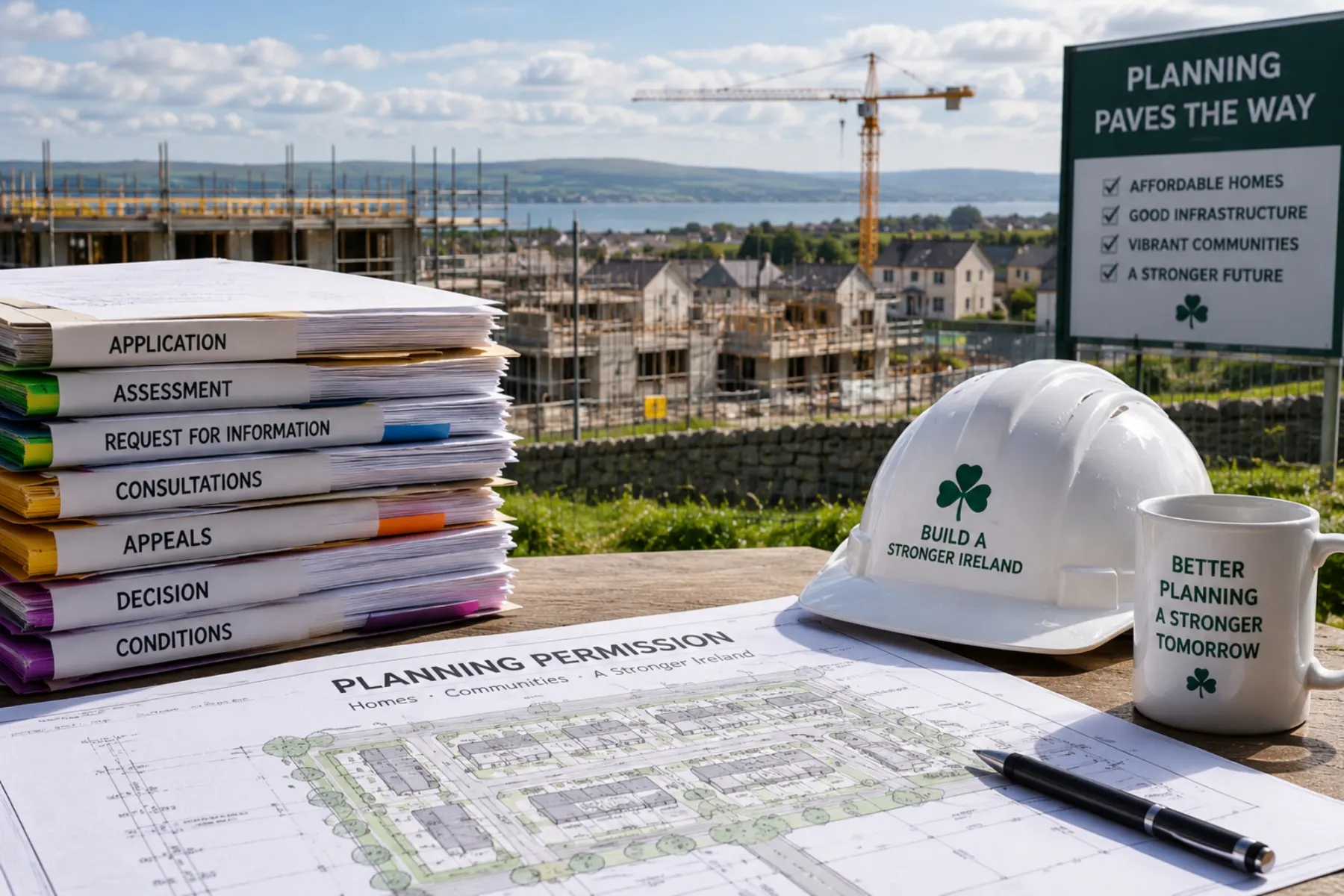
Ireland’s Planning Waiting Game: Why Getting Permission to Build Can Still Take So Long
A straightforward planning application can be decided by a local authority within weeks. But requests for further information, appeals, legal challenges and increasingly complex environmental requirements can turn the journey from proposal to construction into months or years — at precisely the time Ireland needs housing and infrastructure delivered faster.
Ireland’s planning problem is often described in a single sentence: it takes too long to get permission to build.
The reality is more complicated.
For an ordinary valid planning application submitted to a local authority, the system is designed to move relatively quickly. In general, a planning authority is expected to make its decision within eight weeks.
Yet that timetable represents only the simplest version of the process.
Requests for additional information, appeals to An Coimisiún Pleanála, environmental assessments, legal proceedings and post-permission requirements can extend the effective waiting period considerably.
That distinction matters because Ireland is trying to accelerate the construction of homes, electricity networks, transport infrastructure, renewable energy projects and commercial developments at the same time.
The country completed a record 36,284 new homes in 2025. But the latest figures show 8,823 completions in the second quarter of 2026, 3.6% fewer than a year earlier. Meanwhile, 8,092 dwelling units received planning permission during the first quarter of 2026, broadly unchanged from the same period a year earlier.
Planning is not the only factor determining how many homes Ireland builds.
But when demand for housing and infrastructure is already intense, every additional period during which viable projects remain uncertain becomes economically important.
Eight Weeks on Paper Does Not Mean Eight Weeks to Construction
One of the most common misconceptions is that every person waiting months for a project is waiting months for a local authority simply to examine an application.
That is not usually how the system works.
A local authority generally has eight weeks to decide a standard planning application. But the process can become longer if additional information is required, and a planning decision may subsequently be appealed to An Coimisiún Pleanála.
The original eight-week period is therefore only one stage in a much longer potential development timeline.
Before an application is even submitted, a project may require architects, engineers, planning consultants, environmental assessments, drainage proposals, traffic analysis and discussions over connections to water, electricity or roads.
After a local authority decision, there is also an appeal period.
If an appeal is lodged, construction cannot simply proceed as though the original planning decision were final. The proposal enters another decision-making process at national level.
Even when planning permission ultimately survives that stage, developers may still face conditions that have to be satisfied before construction begins.
The useful measure is therefore not simply: How long did the planning authority take to issue a decision?
The more meaningful question is:
How much time passed between deciding to develop a site and being in a position to start building with sufficient legal, financial and infrastructural certainty?
Those are very different questions.
Ireland’s Appeals Backlog Became a Serious Problem
The national appeals system provides the clearest evidence of how planning delays accumulated.
The former An Bord Pleanála entered the middle of the decade carrying a substantial backlog.
At one stage in 2023, the number of cases on hand exceeded 3,600. By the end of 2024, that had fallen to 1,576 as additional personnel and decision-making capacity were introduced.
The improvement since then has been substantial.
At the end of June 2026, An Coimisiún Pleanála reported 1,358 cases on hand across all categories.
That remains far below the peak recorded several years earlier.
But the latest figures also show why the problem cannot simply be declared solved.
During the second quarter of 2026, the Commission received 765 cases and disposed of 674. As a result, the number of cases on hand increased again during the period.
This does not represent a return to the severe backlog of previous years.
It does demonstrate something more fundamental: a planning authority can reduce historic delays only if its continuing capacity is sufficient to process new cases at least as quickly as they arrive.
Backlogs are not single events.
They are the accumulated result of an imbalance between workload and decision-making capacity.
Most Appeals Are Moving Faster — but Not Every Case Is
The latest performance data presents a mixed but improving picture.
Across all categories measured by An Coimisiún Pleanála, more than three-quarters of cases disposed of in June 2026 were completed within the applicable objective period.
Performance differs substantially depending on the type of development.
Normal planning appeals and large-scale residential cases have generally performed better than some of the more complex categories.
That distinction matters.
A simple residential appeal is not equivalent to a motorway, wind farm, electricity project or major infrastructure proposal.
Some developments involve extensive environmental law, European legislation, compulsory acquisition, ecological assessment, public submissions and highly technical evidence.
Treating every planning case as though it should require exactly the same amount of work would produce faster decisions only by ignoring the complexity of the decisions being made.
The challenge is therefore not merely speed.
It is speed without sacrificing legal quality.
Some Cases Really Have Been Waiting for Years
Although the broad backlog has declined, a relatively small number of old cases remains.
Earlier in 2026, An Coimisiún Pleanála identified normal planning appeals dating from before 2025 that were still within its system.
Some dated back several years because of outstanding information, legal issues or other complications.
These cases demonstrate why national averages can be misleading.
If nine applications are decided quickly while a tenth becomes legally or environmentally complex, the average may still appear reasonable.
For the household or business connected with that tenth application, however, the delay is very real.
A family waiting to build a home does not experience the national average.
It experiences its own file.
A developer does not finance the average planning case.
It finances a specific project.
Further Information Can Turn One Application into Several Rounds of Work
One of the most common ways in which a planning application becomes longer is through a request for further information.
The principle behind such requests is reasonable.
If a planning authority cannot properly assess issues such as drainage, road safety, wastewater treatment, environmental impact, design or access from the information originally supplied, it may need additional evidence before reaching a defensible decision.
The alternative — deciding an incomplete case simply to meet a deadline — could result in poor planning or increase the likelihood of a successful challenge later.
But additional information consumes time.
Consultants may have to be brought back onto a project.
Drawings may require revision.
Engineering calculations can need updating.
Environmental reports may have to be expanded.
In some circumstances, new information can itself become significant enough to require further public procedures.
This is why the quality of the original application matters.
A faster planning system depends partly on public authorities having sufficient capacity.
It also depends on applicants submitting technically robust and sufficiently complete proposals from the beginning.
The Appeal System Serves a Purpose
It would be easy to conclude that planning appeals themselves are the problem.
That would ignore why the appeals system exists.
Planning decisions affect more than the person applying to build.
A housing development can affect neighbouring properties, roads, drainage and public infrastructure.
A wind farm can raise environmental, visual and ecological questions.
A commercial development can alter traffic patterns.
Large infrastructure can affect entire communities.
Ireland’s planning framework therefore allows qualifying participants to challenge decisions through an independent national planning body.
Only a minority of local planning decisions proceed to appeal.
But the projects that do can include some of the country’s largest and most consequential developments.
A relatively small number of delayed cases can therefore represent thousands of potential homes or major pieces of infrastructure.
A Planning Permission Can Still End Up in Court
The planning process does not necessarily end with a decision from An Coimisiún Pleanála.
A decision can also be challenged through judicial review.
Judicial review is not another planning appeal in which a judge decides whether a development is desirable.
Its purpose is to examine whether the decision-making process was legally valid.
That is an important safeguard in a system involving property rights, public participation and extensive Irish and European environmental law.
But court proceedings can create another substantial period of uncertainty.
In 2025, 143 judicial reviews were lodged involving planning decisions. Permissions covering more than 2,400 housing units were among the projects affected.
Further cases were lodged during the early months of 2026.
Those figures do not mean every judicial review is unnecessary or without merit.
The right to challenge potentially unlawful public decisions is an important element of the legal system.
The economic difficulty is that planning certainty can disappear again after a project has already passed through extensive administrative procedures.
Delay Has a Financial Cost Even When Nothing Is Being Built
Time in planning is not economically neutral.
Consider a housing development.
A developer acquires or controls land.
Architects prepare plans.
Engineers and consultants are paid.
Planning documentation is produced.
Financing arrangements are made.
The application is submitted.
If the project then spends another year in an appeal or legal process, the site may remain physically unchanged while economic costs continue to accumulate.
Borrowed money can continue attracting interest.
Professional advisers may need to carry out additional work.
Construction prices can change.
Regulations can change.
Contractor quotations can expire.
Potential buyers or investors face uncertainty.
The assumptions used when the project was originally designed can be very different by the time permission becomes usable.
This does not mean every delay should be eliminated.
Some delays are the unavoidable consequence of properly examining difficult issues.
But unnecessary delay has a real economic price.
Ultimately, part of that price can determine whether a development proceeds at all.
Small Applicants Experience Delay Differently
The same problem looks very different to a household trying to build a single rural home.
A major developer may have several projects progressing through different stages simultaneously.
A private household usually has one.
For somebody who has purchased or inherited a site, engaged an architect, applied for finance and planned a family home, an additional six or twelve months can be deeply disruptive.
Construction costs may change during the wait.
Mortgage approval may have to be revisited.
The applicant may continue paying rent elsewhere.
Design changes can result in additional professional fees.
In rural areas, questions surrounding road access, wastewater treatment, local settlement policy and housing need can add particular complexity depending on the location and development plan.
The latest figures nevertheless show that Ireland has not stopped approving individual rural homes.
Permissions for one-off houses increased during the first quarter of 2026.
The issue is therefore not that individual construction has become impossible.
It is the uncertainty that can arise once an application ceases to follow the straightforward route.
The Bigger Housing Pipeline Is Not Growing Evenly
Ireland’s latest planning statistics also reveal considerable volatility.
Across 2025, planning permission was granted for 34,974 dwelling units, 7.9% more than in 2024.
The final quarter was particularly strong.
The opening quarter of 2026 was weaker.
Permission was granted for 8,092 homes, around 1% fewer than during the corresponding period of 2025.
House approvals were broadly unchanged, while apartment approvals fell.
Dublin showed a more pronounced decline.
The four Dublin local authorities approved 1,452 dwelling units during the first quarter, 34% fewer than a year earlier.
One quarter does not establish a permanent trend.
Large projects can cause substantial fluctuations in planning statistics depending on when individual decisions are issued.
But the figures demonstrate why the planning pipeline deserves as much attention as construction completions.
Today’s permissions form part of tomorrow’s potential housing supply.
A weak pipeline now can become a construction problem later.
Permission Is Necessary — but It Is Not the Same as a Home
There is another important distinction.
Ireland granted planning permission for almost 35,000 dwelling units during 2025.
The country also completed more than 36,000 homes during the year.
Those figures should not be matched as though the homes approved in 2025 were the same homes completed during 2025.
They belong to different project generations.
A house completed last year may have received planning permission several years earlier.
Likewise, a development approved today may not begin construction until financing, infrastructure and market conditions allow.
Some permissions will never be built.
Others will be amended.
Some developments will proceed in phases.
This is why planning reform alone cannot solve Ireland’s housing shortage.
A site can have planning permission and still lack a viable water connection.
A developer can have permission but insufficient finance.
A project can be approved but remain commercially unviable at prevailing construction costs.
Housing supply is a chain.
Planning is one of its most important links, but it is not the entire chain.
Infrastructure Can Create a Second Planning Problem
Housing developments themselves depend on infrastructure that may require lengthy consent processes of its own.
New communities require water and wastewater capacity.
Electricity demand requires grid connections and additional generation.
Population growth requires roads and public transport.
Industrial expansion requires energy infrastructure.
A housing development can therefore be ready in planning terms while the infrastructure required to serve it is still moving through another planning or approval process.
Ireland’s competitiveness strategy increasingly identifies planning and regulatory delays as barriers not only to housing but also to energy and electricity-grid expansion.
This is one reason planning delays can multiply rather than simply add together.
One project can depend on another.
If an electricity connection is late, housing can wait.
If wastewater infrastructure is delayed, development capacity can remain constrained.
If transport infrastructure required to support zoning has not been delivered, land can remain difficult to activate.
The planning system is therefore part of a much larger infrastructure system.
Environmental Law Makes Modern Planning More Complex
Planning applications today are legally and technically more demanding than those of several decades ago.
Major projects can interact with environmental impact assessment, habitats protection, climate legislation, water law and European Union requirements.
That complexity exists for a reason.
A fast planning decision that is legally defective does not create certainty.
It can create an appeal, judicial review and an even longer overall process.
This produces an unavoidable tension.
Ireland wants faster planning.
Ireland also needs planning decisions capable of surviving legal scrutiny.
The two objectives are not necessarily incompatible.
But achieving both requires sufficient numbers of experienced planners, inspectors, ecologists, engineers, lawyers and administrative staff.
Speed produced merely by reducing scrutiny could simply transfer delay from the planning office to the courtroom.
That would not represent genuine reform.
The Planning Authority Itself Went Through a Difficult Period
Part of the historic delay problem also reflected institutional capacity.
The national appeals body experienced a particularly difficult period around 2022 and 2023, with reduced decision-making capacity and a substantial accumulation of cases.
By 2024, additional members and staff had been appointed, allowing far more cases to be processed.
Thousands of cases were decided during that year and the overall backlog fell sharply.
That improvement demonstrates a straightforward principle.
Administrative capacity matters.
Planning legislation can establish deadlines.
But somebody still has to examine the application, assess submissions, inspect sites, consider environmental evidence, prepare reports and produce legally defensible decisions.
A planning system is ultimately a human system.
If workload grows faster than staffing and specialist expertise, waiting times eventually increase.
Ireland Has Rebuilt Much of the Planning Framework
The State’s response has gone considerably further than simply adding staff.
The Planning and Development Act 2024 introduced a major restructuring of the planning system, including the replacement of An Bord Pleanála by An Coimisiún Pleanála and a stronger emphasis on defined decision-making timelines.
The new framework has been introduced in stages, with further provisions commencing during 2026.
The objective is greater certainty.
For applicants, predictability can be almost as important as speed.
Knowing that a decision should take a defined period allows planning and financing.
Not knowing whether the same process might take months or years creates much greater difficulty.
The New System Is Being Measured More Closely
An Coimisiún Pleanála has increasingly published performance data showing how quickly different categories of case are being processed.
Normal planning appeals and large-scale residential cases have generally shown substantial improvement.
That provides a more useful way of judging reform than simply asking whether people still complain about delays.
The relevant questions are measurable.
Is the number of old cases falling?
Are new cases being decided within their target periods?
Is the organisation disposing of cases at least as quickly as new ones arrive?
Are complex cases becoming more predictable?
The planning system will never eliminate every difficult or unusually long case.
But it can make delay the exception rather than something applicants routinely have to fear.
Digitalisation Is Finally Reaching Appeals
Another important change arrived in August 2026 with the launch of an online appeals service by An Coimisiún Pleanála.
That may appear minor compared with rewriting planning legislation.
Operationally, it matters.
Planning systems generate enormous quantities of documentation.
Applications can contain drawings, reports, photographs, environmental evidence, public submissions and technical correspondence.
Moving those documents physically between applicants, local authorities and a national planning body consumes administrative time without improving the substance of the planning assessment.
Greater digitalisation, online documentation and modern case-management systems can reduce duplication.
Technology cannot decide whether a housing development or wind farm should receive permission.
It can reduce the amount of time qualified planning staff spend handling paperwork instead of assessing cases.
Minor Developments Can Also Be Removed from the Full Planning System
Reform is occurring at the opposite end of the scale as well.
Changes to Ireland’s exempted-development rules during 2026 widened the circumstances in which certain relatively minor household works can proceed without a full planning application.
The logic is straightforward.
Every planning officer spending time assessing a genuinely minor proposal is a planning officer not spending that time on a large housing scheme, energy project or major infrastructure case.
But exemptions have limits.
Development affecting neighbours, protected structures, environmental sites or wider planning policy may still require proper assessment.
The objective is therefore not to remove scrutiny.
It is to make sure the full machinery of the planning system is concentrated on proposals that genuinely require it.
A more efficient planning system is not necessarily one that processes every application faster.
It may be one that requires fewer unnecessary applications in the first place.
Regional Differences Make a National Solution Difficult
Planning demand varies sharply across Ireland.
Dublin and Cork process large numbers of apartments, housing schemes and major commercial developments.
Other counties deal with a greater proportion of one-off rural housing.
Some areas experience intense population and development pressure.
Others receive comparatively few large applications.
The latest figures illustrate that difference.
During the first quarter of 2026, Cork recorded permission for hundreds of new dwellings, Dublin more than 1,400 and Limerick more than 700.
Counties including Roscommon, Longford and Leitrim recorded far smaller totals.
The type of development differs too.
Dublin accounts for a large share of apartment planning, while many rural counties process proportionately more individual houses.
A planning department dealing mainly with rural homes therefore faces a different workload from an urban authority assessing dense apartment schemes, regeneration projects and commercial developments.
National rules operate through local authorities with very different geography, population growth and development pressure.
Standardisation can improve consistency.
It cannot make the underlying workload identical.
Fast Planning and Good Planning Are Not Opposites
Public debate often presents two competing positions.
One side demands rapid approvals because Ireland urgently needs development.
The other emphasises environmental protection, public participation and proper assessment.
A functioning planning system requires both.
A housing shortage does not justify constructing unsuitable development in the wrong locations without infrastructure.
Nor should procedural complexity prevent well-designed housing on appropriately zoned and serviced land from progressing within a predictable period.
The real objective is therefore not a planning system that simply says yes faster.
Nor is it one that says no faster.
It is a system that reaches a robust answer faster.
That difference is fundamental.
Why Simply Setting Deadlines Is Not Enough
Statutory timelines can create discipline.
They cannot solve every underlying problem.
If a planning authority has insufficient staff, a deadline does not create planners.
If environmental information is incomplete, a deadline does not create the missing survey.
If water capacity is unavailable, a faster planning decision does not build a treatment plant.
If a case reaches court, the administrative planning timetable is no longer the only relevant one.
That is why planning reform has to operate alongside recruitment, digitalisation, infrastructure investment and improvements to legal and administrative processes.
The system is interconnected.
Changing one element can simply move the bottleneck somewhere else.
Why Long Planning Times Ultimately Matter to Everyone
Planning delays can appear to be a problem affecting developers and architects.
Their consequences reach much further.
If housing developments are delayed, potential supply arrives later.
If energy infrastructure is delayed, electricity capacity can remain tighter.
If transport projects are delayed, congestion persists.
If commercial developments are delayed, investment decisions can be postponed.
If an individual home is delayed, a family may continue paying rent while waiting to build.
None of these consequences means every planning application should be approved.
The economic cost of approving unsuitable development can also be substantial.
But predictable decision-making reduces uncertainty whether the eventual answer is yes or no.
A refusal delivered within a reasonable period allows an applicant to redesign, abandon the project or use the land differently.
An unresolved case does none of those things.
It leaves capital, land and people waiting.
Ireland Is in a Better Position Than It Was Three Years Ago
The available evidence supports one important conclusion.
Ireland’s national planning appeals system is functioning more effectively than it was at the height of the backlog.
The number of cases on hand has fallen substantially from the levels seen in 2023.
Staffing and decision-making capacity have been strengthened.
Large-scale residential appeals are being processed more quickly.
New legislation is moving the system towards clearer timetables.
Digital appeals are becoming part of ordinary administration.
But improvement is not the same as completion.
More than a thousand cases remain within the national system, and performance continues to vary between categories.
Recent figures also show that the number of new cases arriving can still exceed the number being completed during particular periods.
That does not amount to a new crisis.
It is a warning that reform has to be maintained.
The Real Test Begins Now
Ireland has spent years debating planning reform.
The country now has something more useful: a restructured national planning body, a significantly reduced legacy backlog, a new legislative framework, more detailed performance reporting and an increasingly digital system.
The question is whether those changes produce a lasting improvement visible to the people who actually use the system.
For a homeowner, success means knowing whether a proposed home can be built without spending an indefinite period in uncertainty.
For a developer, it means being able to calculate the time risk of a project.
For neighbours and communities, it means retaining meaningful participation without processes becoming needlessly prolonged.
For the State, it means making decisions on housing and infrastructure quickly enough to keep pace with a growing population and economy.
Ireland does not need planning without scrutiny.
It needs scrutiny without unnecessary paralysis.
The long waiting times of recent years were not created by one rule, institution or group of participants.
They emerged from a combination of capacity shortages, accumulated appeals, increasingly complex legislation, incomplete information, legal challenges and the sheer scale of development the country is now attempting to deliver.
That complexity also explains why no single reform will make every planning delay disappear.
But the direction can change.
The reduction in the backlog has already demonstrated that.
The challenge for Ireland in 2026 is to make that improvement permanent — so that obtaining permission to build becomes a predictable stage of development rather than an unpredictable test of how long an applicant can afford to wait.
Source & Transparency
This article is published by Ireland Newspaper for editorial and informational purposes.
Published: 10 August 2026 · Updated: 10 August 2026

Newsroom Ireland Newspaper
Ireland Newspaper editorial team prepares daily news coverage for readers in Ireland and abroad.