
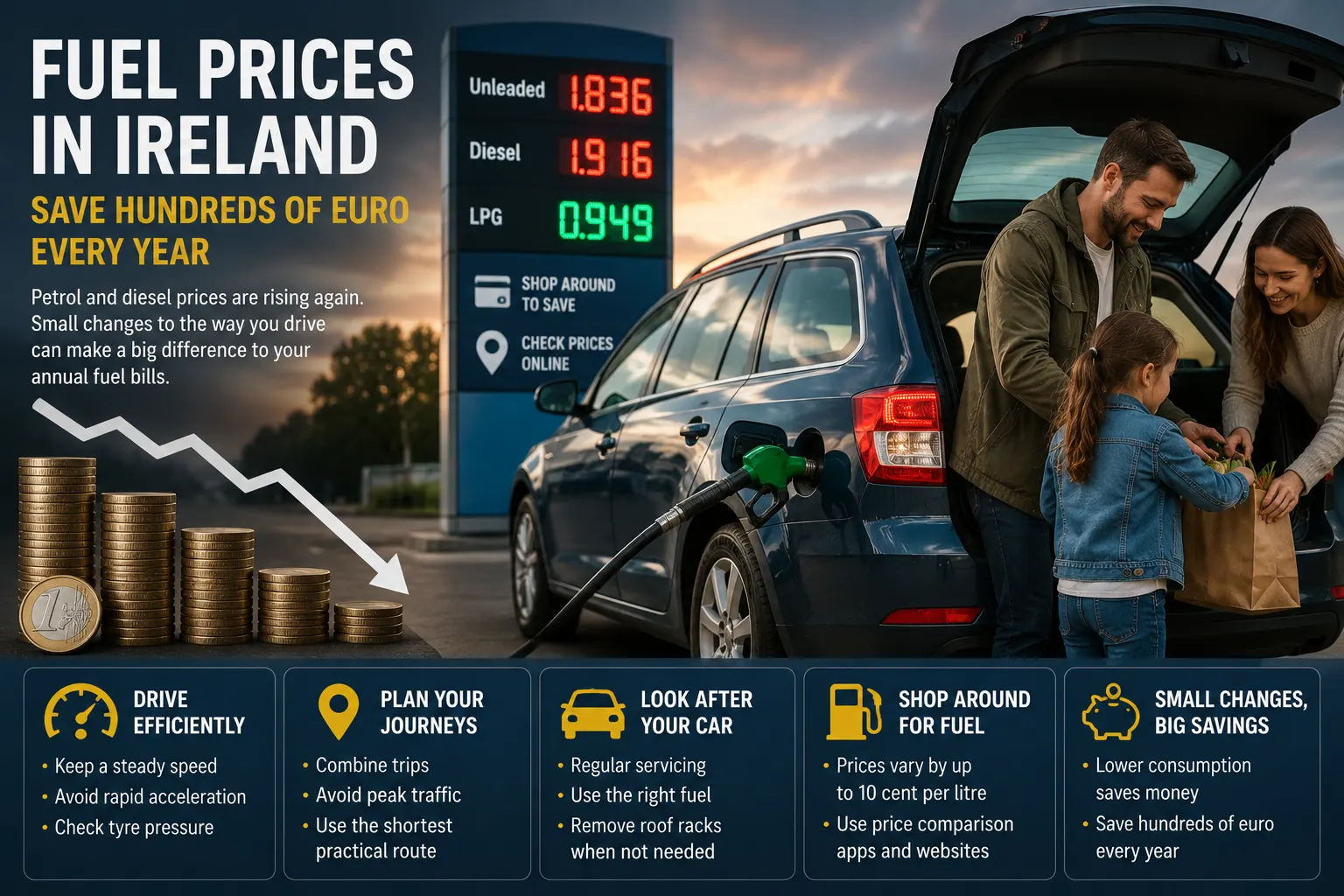
Fuel Prices in Ireland: How Families Can Cut Hundreds of Euro From Their Annual Driving Costs
Petrol and diesel prices rose sharply again in August 2026, and further tax increases are currently scheduled from September. Irish households cannot control oil markets, exchange rates or fuel taxation, but they can control how many kilometres they drive, how efficiently they drive them and how much they pay for unnecessary journeys. For many families, relatively small changes can add up to several hundred euro a year without replacing the family car.
For an Irish household filling a family car, the mathematics has become difficult to ignore.
AA Ireland’s August 2026 national survey puts the average price of petrol at 183.66 cent per litre and diesel at 191.56 cent. A 50-litre fill therefore costs approximately €91.83 for petrol and €95.78 for diesel.
Only a month earlier, average petrol had been around €1.75 and diesel €1.73. By August, petrol had risen about nine cent per litre and diesel by around 19 cent. AA Ireland attributes the latest monthly rise primarily to wholesale-market movements rather than a change in excise during August.
For families driving children to school, commuting to work, shopping and visiting relatives, the individual journeys can appear too small to matter.
Added across a year, they matter enormously.
A petrol car travelling 15,000 kilometres a year and averaging 7 litres per 100 kilometres would consume approximately 1,050 litres. At the August national average price, that represents about €1,928 a year in petrol.
A diesel car travelling 20,000 kilometres at 6 litres per 100 kilometres would consume around 1,200 litres and cost approximately €2,299 a year in diesel at the current national average.
That is before insurance, tax, servicing, tyres, depreciation, parking or tolls.
Fuel is therefore one of the few major motoring expenses a household can influence every single week.
Why Fuel Prices Have Risen Again
It is tempting to attribute every increase at a filling station either to government taxation or to fuel retailers.
The real price structure is more complicated.
Ireland imports the overwhelming majority of the petroleum products used in road transport. Retail prices are influenced by international refined-fuel prices, crude-oil markets, transport and distribution costs, taxation and the euro’s value against currencies used in global energy markets.
The Competition and Consumer Protection Commission examined Irish fuel prices again in 2026 and concluded that the sharp increases it investigated were principally associated with movements in wholesale costs rather than evidence of a competition problem in the retail market.
Tax is nevertheless a substantial part of what motorists pay.
According to AA Ireland’s August breakdown, taxes, levies and associated charges accounted for approximately 47 per cent of the average petrol pump price and 39 per cent of diesel. The components include excise, carbon tax, the National Oil Reserves Agency levy and VAT.
This distinction matters because households need realistic expectations.
Shopping around can save money.
Driving differently can save money.
Driving fewer kilometres can save considerably more.
But no household budgeting technique can completely protect a family from a large international rise in oil prices.
Another Increase Is Currently Scheduled From September
There is a second reason families may want to review their fuel spending now.
The Government’s temporary reductions in fuel excise and the NORA levy were extended through 31 August 2026. Under the current timetable, those reductions are then due to be restored in four stages.
AA Ireland lists the scheduled increases as:
1 September: approximately 9 cent per litre on petrol and 10 cent on diesel;
1 October: another 8 cent on both;
1 November: another 5 cent on petrol and 7 cent on diesel;
1 December: another 5 cent on petrol and 7 cent on diesel.
Taken together, that represents scheduled restoration of about 27 cent per litre for petrol and 32 cent for diesel.
That does not mean today’s pump price should simply be increased by those amounts to forecast December.
Wholesale prices may rise or fall.
Exchange rates can change.
Retail margins can move.
Government policy could also change.
But if everything else were unchanged and the entire scheduled increase were reflected at the pump, a 50-litre fill would cost approximately €13.50 more for petrol and €16 more for diesel than before the full restoration.
That makes reducing unnecessary consumption more valuable than it was only a few months ago.
The First Saving: Stop Measuring Fuel Economy in Euro Per Fill
Many motorists judge fuel cost by what they hand over at the till.
That can be misleading.
A driver who puts €50 into the tank twice a month may feel that fuel spending is relatively stable even while the amount of fuel received for that €50 is declining.
A better family calculation is:
annual kilometres ÷ 100 × litres per 100 km × fuel price.
Take a family covering 15,000 kilometres annually in a petrol car consuming 7 litres per 100 kilometres.
At €1.8366 per litre, annual fuel expenditure is approximately €1,928.
That figure becomes the family’s savings target.
A 5 per cent improvement is worth approximately €96.
A 10 per cent improvement is worth approximately €193.
A 15 per cent reduction in consumption and unnecessary driving is worth almost €290.
Suddenly, small behavioural changes become meaningful.
Saving 1: Drive More Smoothly
One of the cheapest improvements costs nothing.
SEAI advises motorists to accelerate and brake smoothly, avoid unnecessary idling and maintain an efficient driving style. It notes that harsh acceleration and braking can use substantially more fuel.
The practical version is straightforward.
Look farther ahead.
If a traffic light 200 metres away is red, accelerating hard towards it and then braking wastes fuel.
If traffic ahead is slowing, lift off the accelerator earlier.
Maintain a steady speed instead of repeatedly accelerating and slowing.
Avoid racing away from junctions.
For a family spending roughly €1,900–€2,300 annually on fuel, even a sustained 10 per cent reduction in fuel consumption represents about €190–€230 a year.
That is real household money created without buying anything.
Saving 2: On the Motorway, 120 km/h Is Expensive
Aerodynamic resistance increases rapidly as speed rises.
SEAI notes that travelling at 120 km/h can use around 10 per cent more fuel than travelling at 100 km/h.
This does not mean motorists should travel unnecessarily slowly or impede traffic.
It means a family has a financial choice when the speed limit is 120 km/h.
On a long motorway journey, cruising at a steady 100–110 km/h rather than continuously trying to maintain the maximum permitted 120 km/h can reduce fuel consumption.
The time difference is often smaller than people imagine once traffic, junctions and stops are included.
For somebody driving large motorway distances every week, the annual saving can become substantial.
Saving 3: Check the Tyres Once a Month
Tyre pressure is one of those savings measures almost everybody knows about and many people ignore.
SEAI recommends checking tyre pressures at least monthly and before long journeys. Under-inflated tyres increase rolling resistance and therefore fuel consumption; they can also affect tyre safety and wear.
SEAI has estimated that tyres around 10 per cent below their recommended pressure can increase consumption by approximately 2 per cent.
For the €1,928 petrol family example, 2 per cent represents nearly €39 a year.
That may not sound transformative.
But correcting tyre pressure costs virtually nothing.
It can also prolong tyre life, making the total saving larger than the fuel figure alone.
Use the vehicle manufacturer’s recommended pressures, normally shown inside the driver’s door area, fuel flap or owner’s manual.
Do not simply inflate every tyre to the pressure printed on the tyre sidewall.
Saving 4: Remove the Roof Box When the Holiday Is Over
Many Irish cars spend months carrying equipment that was needed for one weekend.
Roof boxes.
Roof bars.
Bike racks.
Heavy tools in the boot.
Children’s equipment that is no longer being used.
Extra weight increases the energy required to move the vehicle, while equipment mounted outside the car can increase aerodynamic drag.
SEAI specifically recommends removing unnecessary weight, roof boxes and bike racks when they are not required.
The individual saving varies considerably with the vehicle, equipment and driving speed, so there is no responsible universal euro figure.
But the principle is free:
if the car is carrying something every day that the family uses once a month, take it out.
Saving 5: Combine Journeys — This Is Often Worth More Than Eco-Driving
The greatest saving normally comes from fuel that is never burned.
Consider a family making two unnecessary 8-kilometre return trips every week — perhaps separate journeys to a supermarket, pharmacy or activity that could have been combined with another trip.
Across 52 weeks, that is 832 kilometres.
In a petrol car using 7 litres per 100 kilometres at the current average price, those journeys cost approximately €107 a year in fuel alone.
The household does not need to become car-free.
It needs to ask a different question before leaving:
“Is there something else we will need tomorrow that can be done on this journey today?”
Shopping, parcel collection, pharmacy visits, children’s activities and family errands are particularly suitable for combining.
Three avoided journeys a week can be more financially valuable than obsessing over tiny differences between filling stations.
Saving 6: Create a Family ‘One-Car-Day’
For two-car households, one useful experiment is choosing one regular day each week when only one vehicle is used unless absolutely necessary.
Parents can coordinate school, work and shopping.
One person may be dropped at a public-transport stop.
Activities can be grouped.
Some journeys can be postponed.
The purpose is not environmental symbolism.
It is to discover how much duplicated driving occurs simply because two cars are available.
If the experiment saves only 30 kilometres each week, that is more than 1,500 kilometres annually.
At 7 litres per 100 kilometres in a petrol car, the saving at current prices would approach €200 a year.
Saving 7: Share the Commute
Car pooling produces unusually clear mathematics.
Suppose two colleagues each drive a 30-kilometre return commute, three days a week for 46 working weeks.
In a petrol car consuming 7 litres per 100 kilometres, that commute uses roughly €532 worth of petrol annually at current prices.
If the two employees alternate cars fairly, each person’s fuel requirement for those shared journeys can fall by roughly half.
That is around €266 per person per year, before considering parking or other costs.
SEAI explicitly recommends car pooling with colleagues, neighbours, friends and family where practical.
The savings become larger for longer commutes.
For rural households where public transport may not provide a realistic alternative, car sharing can therefore be one of the most practical options available.
Saving 8: School Runs Offer Families a Special Opportunity
A school journey creates a strange economic pattern.
The car is often started cold.
The journey may be short.
Traffic can be heavy.
The vehicle returns largely empty.
Then the entire process happens again in the afternoon.
Not every child can walk or cycle safely to school, and rural Ireland is very different from central Dublin or Cork.
But where conditions permit, families can consider:
walking or cycling some days;
sharing collection duties with another family;
dropping several children together;
using school transport;
or walking the final section rather than joining congestion directly outside the school gate.
Even eliminating one school run per week accumulates across a school year.
The important point is consistency.
A €2 saving repeated 150 times is €300.
Saving 9: Do Not Drive Ten Kilometres to Save Three Cent Per Litre
Shopping around is sensible.
Driving a long distance solely for cheaper fuel may not be.
Imagine a filling station offers petrol 3 cent per litre cheaper, and a motorist needs 50 litres.
The saving is €1.50.
If reaching that station requires a special 20-kilometre round detour in a car consuming 7 litres per 100 kilometres, the petrol used on the detour itself costs about €2.57 at current prices.
The driver has spent more money chasing the discount than the discount was worth.
The right strategy is therefore:
compare stations already on your normal route;
fill when passing a competitively priced station;
and avoid special journeys for very small price differences.
If a station on the normal route is consistently 5 cent cheaper, the calculation changes.
For the 15,000-kilometre petrol family consuming 1,050 litres a year, a 5-cent-per-litre difference represents approximately €52.50 annually.
Useful — but still smaller than what can be achieved by eliminating unnecessary kilometres.
Saving 10: Avoid Running the Engine While Waiting
School gates, sports grounds and railway stations produce a familiar sight: parked cars with engines running.
Idling moves the family exactly zero kilometres.
SEAI advises motorists to avoid unnecessary idling as part of efficient driving.
Modern vehicles normally do not need prolonged warming before driving.
If somebody is going to be waiting for a meaningful period and it is safe and appropriate to switch the engine off, doing so saves fuel directly.
The individual saving is small.
The annual habit can still matter.
Saving 11: Maintain the Car Before Efficiency Starts Falling
A neglected vehicle can consume additional fuel without giving the driver an obvious warning.
SEAI recommends regular servicing as part of efficient motoring, alongside correct tyre pressures.
Maintenance should not be performed merely to save petrol.
Safety and reliability come first.
But worn components, incorrect wheel alignment, neglected filters or engine problems can increase consumption.
A useful family habit is to record the car’s actual consumption every few months.
If a vehicle that normally uses 6.5 litres per 100 kilometres suddenly begins using 7.5 under similar driving conditions, investigate rather than simply accepting the higher fuel bills.
Saving 12: Use the Car’s Own Fuel Computer Properly
Most relatively modern cars display average fuel consumption.
Drivers frequently reset it after filling and then ignore it.
Instead, turn it into a household target.
If the car currently averages 7.2 litres per 100 kilometres, try to reach 6.8 without driving impractically slowly.
Observe which journeys cause consumption to rise.
Compare motorway speeds.
Watch the effect of carrying a roof box.
See what happens on repeated short journeys.
Fuel consumption becomes easier to control once it is visible.
Public Transport Can Save More Than Fuel
For households with usable public transport, the comparison should include all car costs rather than simply petrol.
Transport for Ireland says an adult Leap Card can save up to 30 per cent compared with cash fares, while eligible Young Adult and Student Leap Cards can provide savings of up to 50 per cent.
Within Dublin’s Zone 1, the current multimode Leap cap is €6 per day or €24 per week for an adult, with lower caps for young adults, students and children. The 90-minute adult fare remains €2 across qualifying Dublin services.
This does not mean every family should abandon its car.
For many rural households that would be unrealistic.
But a family may find that one commuter can use public transport several days a week while the household retains a car for the journeys where it is genuinely required.
The most financially important question is sometimes not whether a car can be eliminated.
It is whether the second car is still necessary.
Insurance, tax, depreciation and servicing can make removing one lightly used vehicle worth far more than fuel savings alone.
Rural Ireland Needs Different Solutions
Advice written for a household beside a DART station is not automatically useful to a family in Donegal, Mayo, Kerry, Cavan or rural Tipperary.
Many rural households require cars for work, school, healthcare and shopping.
The realistic savings strategy is therefore different.
Car sharing becomes more important.
Combining journeys becomes more important.
Avoiding unnecessary short trips becomes more important.
Keeping one efficient vehicle rather than two poorly utilised vehicles can matter.
Using TFI Local Link where routes and times fit the journey may help for particular trips.
And when replacing a vehicle, fuel consumption should receive greater weight in the buying decision because annual rural mileage can be high.
A household travelling 25,000 kilometres annually gains much more from reducing consumption by one litre per 100 kilometres than a city household travelling 6,000 kilometres.
At current petrol prices, saving 1 litre per 100 kilometres across 25,000 kilometres is worth roughly €459 a year.
Efficiency becomes more valuable as mileage rises.
Should a Family Change From Petrol to Diesel?
Not automatically.
Diesel traditionally appealed to high-mileage drivers because many diesel cars consume fewer litres per 100 kilometres.
But diesel is currently more expensive per litre than petrol in Ireland: approximately €1.92 compared with €1.84 in AA Ireland’s August averages.
The right comparison is therefore not:
petrol price versus diesel price.
It is:
annual kilometres × actual fuel consumption × price per litre, followed by the other ownership costs.
A diesel doing 5 litres per 100 kilometres can still cost less to fuel than a petrol car doing 7 litres even when diesel itself costs more per litre.
But a family making mostly short urban journeys should not buy a diesel purely because diesel cars once had a reputation for economy.
Vehicle price, maintenance, emissions-system suitability, tax, insurance and expected mileage all belong in the decision.
The CCPC similarly advises consumers to consider the full ownership cost of a vehicle, including fuel, tax, insurance, servicing, tolls and parking rather than purchase price alone.
What About an Electric Car?
For a household already planning to replace a vehicle, electric driving can materially reduce energy costs — particularly where most charging can take place at home on a suitable tariff.
SEAI’s official Q3 2026 fuel-price comparison estimates the energy cost for a typical C-segment vehicle at:
€9.80 per 100 km for petrol;
€10.02 for diesel;
and €3.27 for electric driving, based on a blended assumption of 90 per cent home night-rate charging and 10 per cent public fast or high-powered charging.
At 15,000 kilometres a year, those benchmark figures correspond to approximately:
€1,470 for petrol energy;
versus
€491 for electricity.
The difference is nearly €980 a year.
But that figure alone is not a reason to spend €30,000 or €40,000 replacing a perfectly serviceable car.
The purchase price, finance costs, depreciation, insurance, expected ownership period, charging availability and resale value all matter.
The rational approach is usually:
when the family is replacing the car anyway, compare the total ownership cost of petrol, diesel, hybrid and electric alternatives.
Do not spend €10,000 unnecessarily in order to save €1,000 a year.
The Cheapest Car Is Often the One You Already Own
Fuel prices can create pressure to replace a vehicle immediately.
That can be a financial mistake.
Suppose a newer car saves €500 annually in fuel but costs the household €12,000 more after trading in the existing vehicle.
Fuel savings alone would take 24 years to recover that difference, ignoring financing and depreciation.
A replacement may still make sense for reliability, safety or other reasons.
But the fuel calculation must stand on its own.
Families should calculate:
extra purchase cost ÷ annual running-cost saving.
That gives a rough payback period.
If the payback is longer than the expected ownership period, fuel economy alone cannot justify the change.
A Realistic €500 Family Savings Plan
A household does not need one dramatic change to save €500.
Consider a petrol family currently spending roughly €1,900 annually.
A realistic combination might be:
€190 from reducing consumption by about 10 per cent through smoother driving, moderate motorway speeds and better vehicle management;
€107 from eliminating two unnecessary 8-kilometre return journeys each week;
€100–€150 from consolidating school, shopping or family journeys;
€50 from consistently buying fuel around 5 cent cheaper when that station is already on the normal route;
and additional savings from car sharing, correct tyre pressures and avoiding unnecessary idling.
Not every saving can simply be added because some measures overlap.
But the example demonstrates the scale.
A family does not need to stop travelling.
It needs to make each kilometre more deliberate.
A Higher-Mileage Family Can Save Even More
For a household travelling 20,000 or 25,000 kilometres a year, the opportunity is greater.
A diesel vehicle travelling 20,000 kilometres at 6 litres per 100 kilometres currently uses around €2,299 of fuel annually.
A sustained 10 per cent reduction represents roughly €230.
Reducing consumption by one litre per 100 kilometres across 20,000 kilometres saves 200 litres.
At today’s diesel average, that is approximately €383.
For high-mileage households, choosing an appropriately efficient vehicle at the next replacement point can therefore produce savings that behavioural changes alone cannot match.
Families Should Separate Three Types of Saving
The most effective household strategy is to divide the problem into three categories.
Pay less for each litre
Compare convenient filling stations.
Use legitimate discounts where they genuinely save money.
Do not drive long distances to obtain them.
Use fewer litres per kilometre
Drive smoothly.
Moderate motorway speed.
Maintain tyres.
Service the vehicle.
Remove unnecessary drag and weight.
Drive fewer kilometres
Combine errands.
Share commutes.
Walk short suitable journeys.
Use public transport when practical.
Coordinate school runs.
This final category often provides the largest saving because consumption falls to zero for the kilometre not driven.
What Families Should Not Do
Panic filling generally makes little sense unless there is a genuine supply warning.
Fuel stored improperly creates a fire and environmental hazard.
Driving with dangerously high tyre pressures in an attempt to reduce rolling resistance is unsafe.
Travelling unreasonably slowly to save petrol can create traffic risk.
Skipping essential servicing to save money can produce a much larger repair bill.
And replacing a reliable vehicle with an expensive new one purely to reduce fuel consumption may increase rather than reduce total household expenditure.
Fuel saving should never come at the expense of road safety or basic vehicle maintenance.
A 30-Day Fuel-Saving Challenge
A family wanting to find out what is genuinely possible can run a one-month experiment.
At the first fill, record the odometer reading, litres purchased and amount paid.
For the following month:
- Check all tyre pressures.
- Remove unused roof bars, boxes and unnecessary boot weight.
- Drive smoothly and avoid aggressive acceleration.
- Use slightly lower motorway cruising speeds where safe and practical.
- Combine shopping and errands.
- Eliminate at least two unnecessary car journeys each week.
- Share at least one regular journey where practical.
- Avoid unnecessary idling.
- Compare fuel prices only along routes already being travelled.
- Record litres used and kilometres travelled at the end of the month.
Then compare litres per 100 kilometres, not merely euro spent.
Prices may have changed during the experiment.
Consumption tells the family whether behaviour actually improved.
A reduction from 7.5 to 6.8 litres per 100 kilometres is measurable progress regardless of what happened to the pump price.
The Autumn of 2026 Could Make These Savings More Valuable
Ireland enters the remainder of 2026 with unusually uncertain fuel costs.
Petrol and diesel have already risen substantially between July and August. Temporary tax reductions remain in place until the end of August, but their phased restoration is currently scheduled from September through December.
International fuel markets remain capable of moving in either direction.
That means nobody can responsibly state what petrol or diesel will cost in December.
What families can know is how much they consume.
A household using 1,000 litres a year is twice as exposed to every 10-cent increase as a household using 500 litres.
Reducing consumption therefore does more than save money at today’s price.
It reduces vulnerability to tomorrow’s price.
The Most Important Saving Is Not at the Pump
For years, motorists have treated fuel saving primarily as a search for the cheapest filling station.
That is understandable because the price sign is visible.
But the difference between two forecourts may be only several cent per litre.
The difference between driving 15,000 kilometres and 13,000 kilometres is 2,000 kilometres.
The difference between 7 and 6.3 litres per 100 kilometres is 10 per cent of annual consumption.
Those changes are much larger.
Ireland’s families cannot negotiate directly with international oil producers.
They cannot control global refining markets.
They cannot determine the euro-dollar exchange rate.
And they do not individually decide fuel taxation.
But they can control much of what happens after the fuel enters the tank.
They can drive more smoothly.
They can maintain tyres.
They can reduce unnecessary speed.
They can share journeys.
They can combine errands.
They can use public transport where it works.
And when the time genuinely comes to replace a vehicle, they can choose one based on the journeys their family actually makes rather than simply buying a larger version of what they already own.
At August 2026 prices, a typical family car can easily consume €2,000 or more of petrol or diesel each year.
That makes fuel efficiency no longer a minor environmental consideration.
For many Irish households, it is one of the most practical areas of the family budget where hundreds of euro can still be saved through decisions they can make themselves.
Source & Transparency
This article is published by Ireland Newspaper for editorial and informational purposes.
Published: 12 August 2026 · Updated: 12 August 2026

Newsroom Ireland Newspaper
Ireland Newspaper editorial team prepares daily news coverage for readers in Ireland and abroad.