
The German Shepherd and Ireland’s Dangerous-Dog Debate: What the Evidence Actually Shows
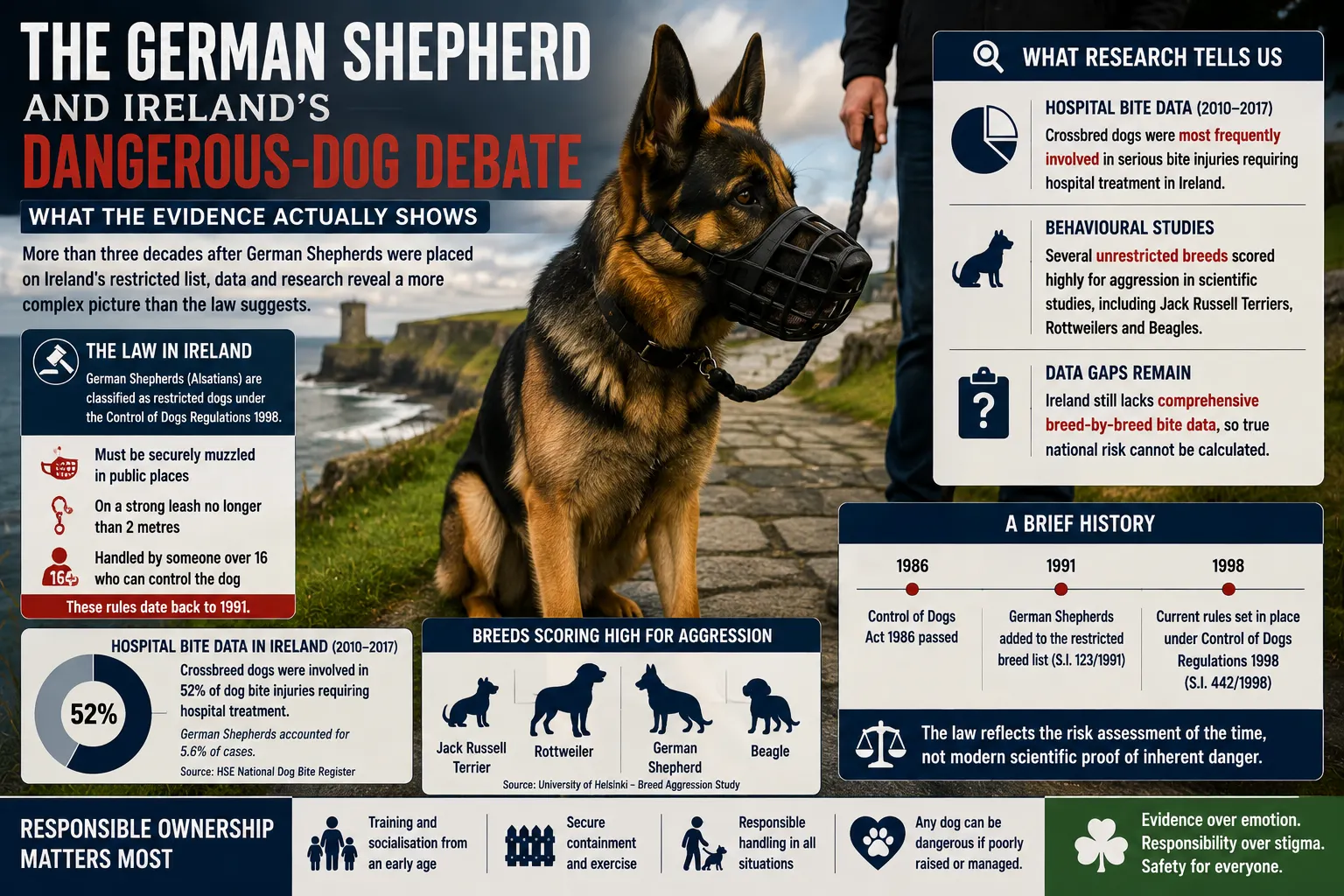
German Shepherds have faced special public-control rules in Ireland since 1991. More than three decades later, hospital data and behavioural research show a considerably more complicated picture than the breed’s legal status suggests: aggression is not confined to restricted breeds, several unrestricted breeds score highly in scientific aggression studies, and Ireland still lacks the comprehensive breed-by-breed bite data needed to calculate which dogs pose the greatest national risk.
A German Shepherd walking through an Irish public place is treated differently in law from a Labrador Retriever, Border Collie, Rough Collie, Miniature Schnauzer or Jack Russell Terrier. The German Shepherd must be securely muzzled and, under the national regulations, kept on a sufficiently strong chain or leash no longer than two metres, handled by somebody over 16 who is capable of controlling the dog. Those additional requirements apply because the German Shepherd — also described in the legislation as the Alsatian — belongs to Ireland’s restricted category. (Irish Statute Book)
That legal distinction can easily become a social one. A muzzled dog looks different from an unmuzzled dog, and the existence of a statutory restricted list can understandably lead members of the public to assume that every breed on it has been scientifically established as inherently more aggressive than every breed outside it.
The evidence does not support such a simple conclusion.
This does not mean that German Shepherds cannot be dangerous. They are large, powerful working dogs, and an inadequately socialised, fearful, poorly managed or genuinely aggressive German Shepherd has the physical capacity to cause serious injury. Research has also found elevated aggression measures in German Shepherds in some populations. But that is very different from saying that a German Shepherd is inherently dangerous simply because it is a German Shepherd, or that an unrestricted dog must consequently be safer.
Irish bite research, international behavioural studies and the history of the legislation all point towards a more nuanced reality.
The Rule Is Older Than Many Dog Owners Realise
Ireland’s present restrictions are commonly associated with the Control of Dogs Regulations 1998, but the German Shepherd’s special legal status actually goes further back.
The first specific Irish restrictions were introduced through S.I. No. 123/1991, the Control of Dogs (Restriction of Certain Dogs) Regulations 1991. The regulations were made under powers contained in sections 19 and 31 of the Control of Dogs Act 1986, and German Shepherds were explicitly included. Contemporary RTÉ archive material from 1991 records German Shepherd owners confronting the arrival of the new public-muzzling requirement. (Irish Statute Book)
The 1991 regulations were subsequently revoked when the broader Control of Dogs Regulations 1998, S.I. No. 442/1998, came into force. The later regulations retained the breed-specific system and remain the foundation of the rules applying to German Shepherds today. (Irish Statute Book)
This distinction matters. Ireland did not conduct a new experiment in 1998 and then discover from subsequent national statistics that German Shepherds needed to be added to a dangerous-dog category. The breed had already been singled out in 1991.
The published statutory instruments themselves do not contain a statistical risk analysis demonstrating a bite rate for each selected breed. A later peer-reviewed Irish study examining the legislation described its original rationale as a belief that the listed breeds had a greater disposition towards aggression and should therefore be restricted as a public-health measure. (Springer)
In other words, the legislation reflected the risk assessment and policy thinking of the period. It should not be read as though the presence of a breed on the list were itself modern scientific proof that the breed is inherently more aggressive.
What the Law Actually Requires in 2026
As of August 2026, the German Shepherd remains within Ireland’s restricted-breed framework. In a public place, a dog covered by the regulations must be securely muzzled and led on a sufficiently strong chain or leash of no more than two metres by somebody aged over 16 who is capable of controlling it. Government guidance continues to identify the German Shepherd, or Alsatian, among the dogs subject to additional controls. (Irish Statute Book)
The important word is restricted, not automatically dangerous in every individual case. The legislation imposes precautionary requirements based on breed or type; it does not constitute a behavioural assessment of the individual animal standing in front of someone.
That difference is central to understanding the controversy around breed-specific legislation.
A well-socialised German Shepherd with no history of aggression remains subject to the public muzzle rule because of its breed. An unrestricted dog displaying substantial aggression is not automatically subject to that same breed-based muzzle requirement merely because of its breed — although owners remain responsible for controlling their dogs and other legal powers can apply where an individual animal creates a danger.
Ireland’s Hospital Numbers Do Not Produce a Breed League Table
The strongest national evidence about dog bites in Ireland comes from hospital records, and those records establish beyond doubt that dog bites are a genuine public-health problem. What they do not establish is that German Shepherds are responsible for a disproportionate share of that problem.
A peer-reviewed analysis of Irish hospital admissions between 1998 and 2013 recorded 3,164 hospitalisations for dog bites. Rather than falling after the 1998 regulations, the number of admissions increased over the period. The researchers identified children under ten as a particularly vulnerable group and concluded that the available hospital evidence did not demonstrate the effectiveness of breed-specific legislation as a bite-reduction strategy. (University of Limerick)
A later nationwide analysis covering 2012 to 2021 found another 3,158 hospital admissions. The hospitalisation rate rose from 5.6 per 100,000 people in 2012 to 8.7 per 100,000 in 2021. More than 1,200 of the patients were children, more than 80 per cent were emergency admissions, approximately three quarters involved open wounds and 24 per cent involved facial wounds. (UL Research Repository)
Those are serious numbers. But there is a crucial limitation: the national hospital data do not provide a reliable breed-by-breed denominator showing how many German Shepherds, Labradors, terriers or other dogs caused the injuries and how many dogs of each breed were living in Ireland at the time.
The 2023 analysis itself highlighted Ireland’s limited information on dog attacks and the absence of a comprehensive reporting system. (TheJournal.ie)
That means a claim such as “Breed A is responsible for X per cent of Irish attacks and therefore is Y times more dangerous than a German Shepherd” cannot currently be made responsibly from Ireland’s national hospital statistics.
One Irish Study Compared Restricted and Unrestricted Dogs Directly
A particularly relevant Irish Veterinary Journal study published in 2017 examined 140 reported bite incidents involving larger dogs. Of those incidents, 100 involved breeds not covered by the breed-specific legislation and 40 involved legislated breeds. (PubMed Central (PMC))
Those figures must not be misused. They do not mean that an unrestricted dog is two-and-a-half times more likely to bite. The study was not a census of the entire Irish dog population, and without knowing the number of dogs of every breed in the population, such a risk calculation would be invalid.
What the research could compare was the nature of the incidents.
It found no statistically significant difference in the type or severity of bites between the legislated and non-legislated groups and no statistically significant difference in the medical treatment required after the bite. The researchers also found differences in perception and reporting: incidents involving dogs covered by the legislation were more likely to be reported, while legislated breeds were perceived as more aggressive. (PubMed Central (PMC))
That finding goes directly to the German Shepherd’s reputation problem. If a person sees a muzzled German Shepherd and already knows that the state places the breed on a restricted list, expectations of danger can be reinforced before that individual dog has displayed any problematic behaviour.
The researchers did not conclude that large dogs present no risk. Their central point was that breed-specific legal status was not a reliable proxy for the characteristics or medical severity of the bites in their sample. (PubMed Central (PMC))
The Irish Evidence Is Not Entirely Favourable to the German Shepherd — and That Matters
A credible examination of the issue also has to acknowledge evidence that does not support the most favourable interpretation of the breed.
A 2012 study of official dog-control records in County Cork examined reports from 2007. German Shepherds were the breed most frequently identified in reports of aggressive behaviour. Among bite or snapping reports where a breed could be identified, German Shepherds were also recorded most frequently, and the researchers calculated a high incidence relative to the licensed German Shepherd population. (SpringerLink)
That sounds powerful until the limitations are examined.
In more than 60 per cent of biting or snapping reports, the complainant could not identify the breed at all. The researchers also estimated dog-licence compliance at only about 60 per cent of the county dog population, meaning the breed population used as a denominator was incomplete. They explicitly identified breed recognition and differences in licensing as limitations of the dataset. (SpringerLink)
The same study found another interesting result. Although German Shepherds generated the greatest number of general aggressive-behaviour reports, Staffordshire Bull Terriers and Rottweilers showed a higher proportion of reported aggressive incidents relative to their recorded licensed populations. (SpringerLink)
The responsible conclusion is therefore neither “German Shepherds never present an elevated risk” nor “German Shepherds are proven to be one of Ireland’s most dangerous dogs.” The Irish evidence is too incomplete and methodologically constrained to justify either sweeping statement.
Unrestricted Breeds Can Score Very Highly for Aggression
The most revealing evidence comes from large behavioural studies that measure aggressive behaviour rather than relying solely on hospital injuries.
A 2021 study published in Scientific Reports analysed 9,270 dogs. Researchers examined aggression towards people while adjusting statistically for age, sex, fearfulness, body size, whether the dog lived with other dogs and the owner’s previous dog experience. (PubMed Central (PMC))
Breed mattered — but the ranking did not resemble Ireland’s restricted list.
The breeds with the highest adjusted odds of aggressive behaviour in that study were the Rough Collie, Miniature Poodle and Miniature Schnauzer. None of those three breeds is subject to Ireland’s automatic restricted-breed muzzle requirement. German Shepherds also appeared among breeds with a relatively high probability of aggressive behaviour, an important reminder that the evidence should not be distorted in the opposite direction. (PubMed Central (PMC))
The numerical differences were substantial. Compared with the Labrador Retriever, the study found an odds ratio of 5.44 for the Rough Collie, 5.13 for the Miniature Poodle and 5.08 for the Miniature Schnauzer. These figures refer to the particular definition of aggressive behaviour used by the researchers; they do not mean that those dogs are five times more likely to hospitalise somebody or cause a serious injury. (PubMed Central (PMC))
That distinction between aggression and dangerousness is critical. A small dog may growl, snap or attempt to bite relatively frequently while having far less capacity to inflict major trauma than a large dog. Conversely, a large dog may display aggressive behaviour less frequently but cause much greater injury on the rare occasion when a serious bite occurs.
This is one reason a scientifically defensible article cannot simply replace one breed stereotype with another.
Dachshunds, Chihuahuas and Jack Russells Complicate the Picture Further
An influential 2008 behavioural study using the C-BARQ owner questionnaire produced another result that sits awkwardly with simple dangerous-breed lists. The research covered thousands of dogs across dozens of breeds and found high levels of particular forms of aggression among several small or medium-sized breeds that are unrestricted in Ireland.
Dachshunds and Chihuahuas scored highly for human-directed aggression, while Jack Russell Terriers were among breeds displaying serious aggressive behaviours in some categories. Beagles and American Cocker Spaniels also featured prominently for aggression towards owners. (TheJournal.ie)
None of those breeds carries an automatic Irish public-muzzling requirement simply because of breed.
But there is an equally important scientific warning against turning that finding into a headline proclaiming that a Chihuahua is “more dangerous” than a German Shepherd. The later 2021 study produced different results after adjusting for other variables: Chihuahuas and Jack Russell Terriers were among the lower-aggression breeds in that model. The authors specifically discussed the contrast with the earlier research. (PubMed Central (PMC))
That disagreement is scientifically useful. It demonstrates why a single universal ranking of “the most aggressive breeds” is problematic. The answer changes depending on the population studied, how aggression is defined, whether owner reports or actual bites are measured, whether severity is considered, and which environmental factors are statistically controlled.
What the Numbers Really Say
| Evidence | Result | What It Can — and Cannot — Tell Us |
|---|---|---|
| Irish hospital admissions, 1998–2013 | 3,164 admissions | Serious bites remained a public-health problem after breed-specific regulation; hospital data did not identify breed-specific national risk. (University of Limerick) |
| Irish hospital admissions, 2012–2021 | 3,158 admissions; rate rose from 5.6 to 8.7 per 100,000 | The national burden increased, but the data cannot establish which breed was responsible for the increase. (UL Research Repository) |
| Irish 2017 bite study | 140 incidents: 100 non-legislated, 40 legislated | There was no significant difference in bite severity or medical treatment between the two groups; the raw 100/40 split is not a breed-risk ratio. (PubMed Central (PMC)) |
| County Cork dog-control data | More than 60% of bite/snapping reports had no identifiable breed | Shows why breed-based risk calculations from complaint records can be unreliable. (SpringerLink) |
| Finnish behavioural study, 2021 | 9,270 dogs | Rough Collie, Miniature Poodle and Miniature Schnauzer had the highest adjusted aggression odds; all are unrestricted under Ireland’s German-Shepherd-style muzzle rules. (PubMed Central (PMC)) |
| Same 2021 study | Highly fearful dogs had 5.18 times the odds of aggressive behaviour compared with low-fear dogs | Individual behavioural characteristics can be at least as informative as a simple breed label. (PubMed Central (PMC)) |
| Same 2021 study | First-time owners: OR 1.21; dogs living without another dog: OR 1.23; males: OR 1.72 | Environment, ownership and demographic factors also contributed to aggression risk. (PubMed Central (PMC)) |
The table makes the central issue visible. Breed is not irrelevant — several studies find genuine differences among breeds — but neither is breed a stand-alone explanation for aggressive behaviour. Fearfulness, sex, age, body size, experience of the owner, living circumstances, socialisation and the individual animal all affect the result. (PubMed Central (PMC))
Why a Small Aggressive Dog and a Large Powerful Dog Are Not the Same Risk
This is where arguments about German Shepherds frequently become confused.
Suppose a behavioural study finds that a Miniature Poodle displays aggressive behaviour more frequently than a particular large breed. That does not automatically make the Poodle the greater public-safety threat. The physical consequences of a bite depend on much more than the probability that a dog will growl, lunge or snap.
Size, strength, bite location, duration of an attack, the vulnerability of the victim, whether several dogs are involved and how quickly an adult can intervene can all affect the seriousness of an incident. Ireland’s hospital data show particularly clearly why children require protection: more than 1,200 children were among the 3,158 people hospitalised during the 2012–2021 period. (TheJournal.ie)
A responsible approach therefore has to hold two ideas at the same time.
First, a German Shepherd’s size and power mean that responsible breeding, socialisation, training, supervision and control are extremely important.
Second, size and breed cannot tell us with certainty whether the individual dog is aggressive.
The first proposition justifies taking large, powerful dogs seriously. The second is why science struggles with systems that imply a whole breed can be understood from its name alone.
Fear May Matter More Than the Muzzle Suggests
One of the most striking numerical findings from the 9,270-dog study concerned not breed but fearfulness.
Highly fearful dogs had 5.18 times the odds of aggressive behaviour compared with dogs with low fearfulness. Male dogs had 1.72 times the odds of females, while dogs owned by first-time dog owners had 1.21 times the odds of those belonging to experienced owners. (PubMed Central (PMC))
These results make behavioural sense. Aggression is often contextual. A dog can respond aggressively because it is frightened, guarding a resource, in pain, protecting territory, poorly socialised or reacting to a situation it does not know how to handle.
A breed label tells an observer none of those things.
It does not reveal whether the individual animal received careful socialisation as a puppy, whether it has a history of bites, whether it has untreated pain, whether the owner understands canine body language, whether it is accustomed to children, or whether it is frightened by the situation in which it has been placed.
That is precisely why judging safety exclusively by appearance creates the possibility of two errors: overestimating the danger of a calm restricted dog and underestimating the danger of an aggressive unrestricted one.
How the Muzzle Rule Can Influence Reputation
The German Shepherd’s Irish image is affected by something that many unrestricted breeds never experience: every law-abiding owner must visually mark the dog as different in public by using a muzzle.
Muzzles are valuable safety equipment and should not themselves be regarded negatively. They can protect people and dogs in many circumstances and responsible owners should never be stigmatised for using one.
The social effect of a compulsory breed-based muzzle is nevertheless worth examining. The 2017 Irish bite study found that legislated breeds were perceived as more aggressive, while bites by non-legislated breeds were less likely to be reported to authorities. (PubMed Central (PMC))
That creates a potential feedback loop. A breed is legally classified as restricted, the public becomes more conscious of that breed as a danger, incidents involving it may attract greater attention, and the resulting visibility can then reinforce the original reputation.
None of this demonstrates that reports involving German Shepherds are false. It simply means reporting patterns and perceptions must be considered when interpreting the numbers.
The County Cork research provides a useful illustration. German Shepherds featured prominently in complaints, but the authors themselves warned about public-reporting bias, incomplete licensing information and the difficulty of breed identification. (SpringerLink)
The Law Was a Precautionary Policy Choice, Not a Permanent Scientific Verdict
The historical background matters because legislation can outlive the scientific assumptions under which it was created.
Ireland’s breed restrictions originated in 1991, more than three decades ago. The 1998 regulations replaced the earlier statutory instrument but preserved the basic approach. Peer-reviewed analysis of the Irish rules describes the original policy rationale as the belief that certain breeds possessed a greater disposition towards aggression and therefore warranted additional restrictions to reduce serious bites and fatalities. (Irish Statute Book)
Since then, behavioural science has become considerably more sophisticated. Researchers increasingly examine individual temperament, fearfulness, environment, owner experience, socialisation and the circumstances surrounding an incident rather than treating breed as an isolated causal explanation. The large 2021 study is an example: breed was statistically significant, but so were age, sex, fearfulness, body size, household dog composition and owner experience. (PubMed Central (PMC))
Irish policymakers have also continued to debate the framework. As recently as 26 May 2026, a parliamentary question asked the Minister for Agriculture, Food and the Marine whether dog-breed legislation would be reviewed with a view to replacing it with proportionate, breed-neutral measures that protect public safety while recognising responsible ownership. That question does not itself change the law, but it demonstrates that the basis of the current system remains an active policy issue.
For German Shepherd owners, the practical position is therefore straightforward: whatever the scientific debate, the existing rules must be followed unless and until the law changes.
German Shepherds Should Not Be Romanticised Either
Correcting a stereotype does not require creating a new one.
German Shepherds were developed as working dogs. Their intelligence, physical ability, alertness and trainability are among the characteristics that have made the breed useful in policing, security, search work and many other demanding roles. Those same qualities mean that a German Shepherd generally requires appropriate exercise, training, socialisation and competent handling.
The 2021 Finnish study did not place the German Shepherd among its least aggressive breeds. It found the breed among those with a relatively high probability of aggressive behaviour, alongside several unrestricted breeds. (PubMed Central (PMC))
That is an important fact because the strongest argument against unfair stereotyping is not that every German Shepherd is gentle. No serious evidence could guarantee that about any breed.
The stronger argument is that individual dogs vary enormously, and current evidence does not justify treating legal breed status as a scientific personality test.
A badly bred, frightened and poorly controlled German Shepherd can be dangerous. So can an aggressive dog from a breed absent from the restricted list. Conversely, a responsibly bred, well-socialised and carefully trained German Shepherd can spend its life without displaying dangerous aggression.
“Which Breed Is Most Aggressive?” Is the Wrong Question
The desire for a simple ranking is understandable. Governments need rules, parents want to know which dogs are safe around children, and owners want to understand risk.
But the scientific literature repeatedly demonstrates why the question is difficult.
One study places Dachshunds, Chihuahuas and Jack Russell Terriers high on particular aggression measures. Another, using different statistical controls, produces a different ranking. One dataset records German Shepherds prominently among bite complaints; another cannot determine the breed in most cases. National Irish hospital records reveal thousands of serious injuries but cannot reliably connect them to breed populations. (TheJournal.ie)
The better questions are more specific.
Does this individual dog have a history of aggression? Is it fearful? Has it been properly socialised? Can its owner physically control it? Is it showing warning signals? Is a child being left unsupervised with it? Is the animal in pain? Has it been deliberately encouraged to behave aggressively? Is the dog large and powerful enough that a bite could cause major trauma?
Those questions do not provide the simplicity of a breed list. They do, however, get closer to the circumstances in which bites actually happen.
Public Safety and Fair Treatment Do Not Have to Be Opposites
The debate over the German Shepherd sometimes becomes framed as though Ireland must choose between protecting people and treating dogs fairly. That is an unnecessarily narrow choice.
Public safety should remain the priority. Dog bites can produce serious injuries, reconstructive surgery and lasting psychological effects, and Ireland’s hospitalisation figures show that the problem deserves serious attention. (UL Research Repository)
At the same time, effective public-safety policy depends on measuring the right risks.
If an unrestricted dog has repeatedly demonstrated dangerous behaviour, the absence of its breed from a statutory list should never create false reassurance. Likewise, the sight of a legally muzzled German Shepherd should not automatically be interpreted as evidence that the particular animal has ever bitten anyone.
The strongest modern evidence points towards a combination of factors: the individual dog, its behaviour and history, the quality of breeding and early socialisation, owner knowledge and control, the circumstances of the encounter and the physical ability of the animal to cause injury.
Breed can be one part of that assessment. It is not the whole assessment.
After 35 Years, the German Shepherd Deserves a More Precise Conversation
Ireland’s German Shepherd restrictions date back to 1991. The present regulatory framework was consolidated in 1998, meaning that a breed can still be subject to a public muzzle requirement in 2026 because of a policy model introduced more than three decades ago. (Irish Statute Book)
During those decades, Ireland has accumulated thousands of hospital admissions from dog bites. Yet the country still does not possess the kind of comprehensive, verified national dataset that would allow every serious bite to be matched reliably to breed, breed population, ownership conditions, previous behaviour and circumstances of the attack. (TheJournal.ie)
The evidence that does exist makes one point particularly difficult to ignore. Aggressive behaviour is not confined to the breeds Ireland requires to wear a muzzle. In substantial scientific datasets, unrestricted breeds including the Rough Collie, Miniature Poodle, Miniature Schnauzer, Dachshund, Chihuahua, Jack Russell Terrier, Beagle and others have scored highly on particular measures of aggression. At the same time, the German Shepherd itself cannot simply be declared risk-free: some studies also place it above average on aggression measures. (PubMed Central (PMC))
That is precisely why the German Shepherd’s reputation deserves correction rather than reversal.
The breed should neither be feared automatically nor idealised automatically. It should be judged with the same seriousness that good dog ownership demands for every powerful animal: by behaviour, temperament, upbringing, socialisation, training, control and the competence of the person holding the lead.
Ireland’s muzzle law tells the public which category the German Shepherd occupies in legislation. It does not, by itself, tell us the character of the dog behind the muzzle.
Source & Transparency
This article is published by Ireland Newspaper for editorial and informational purposes.
Published: 13 August 2026 · Updated: 13 August 2026

Newsroom Ireland Newspaper
Ireland Newspaper editorial team prepares daily news coverage for readers in Ireland and abroad.