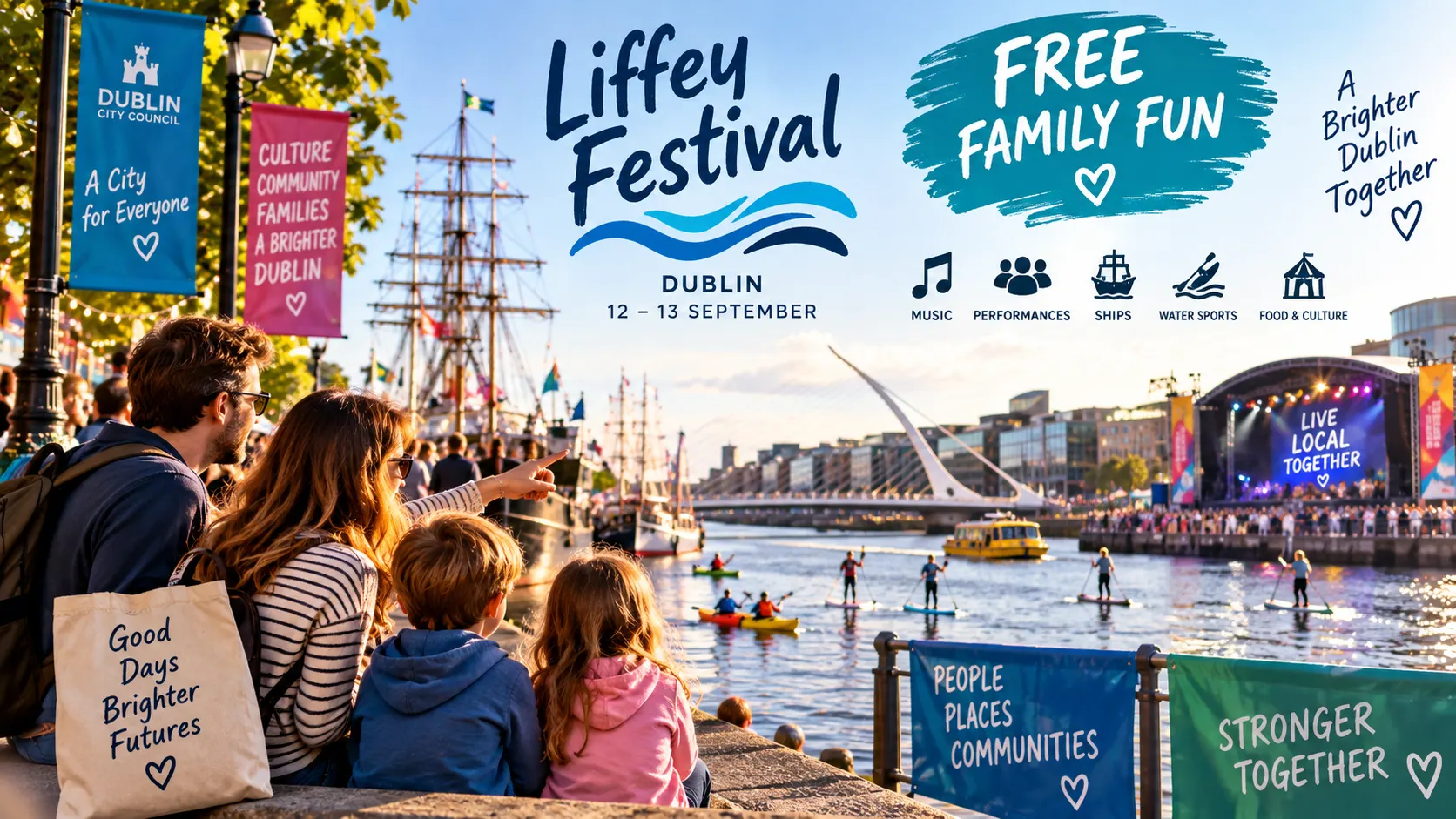
On 12 and 13 September, Dublin’s quays and the River Liffey will become the setting for a new two-day festival of ships, water sports, performances, heritage, music and family entertainment. Dublin City Council’s inaugural Liffey Festival is free to attend, apart from a small number of paid activities. That detail matters because, for a significant minority of Irish households, the difference between a free outing and a paid one is no longer merely a question of value for money: it can determine whether the family goes at all.
Ireland’s overall economic position remains comparatively strong, employment is high and median household income has increased. Yet national averages conceal sharply different experiences. The latest Survey on Income and Living Conditions found that 44.8% of households experienced at least some difficulty making ends meet in 2025, while almost half of people living in single-adult households with children experienced enforced deprivation. Leisure is one of the first parts of a household budget that can be reduced when rent, mortgages, utilities, groceries and other essentials take priority.
This helps explain why free festivals, library programmes, cultural nights, outdoor performances and publicly supported activities have acquired a wider significance. They are not simply entertainment provided by local authorities. Increasingly, they sit at the intersection of cost-of-living policy, children’s participation, cultural access, tourism, city-centre activity and community development.
Affordable leisure in Ireland
- 12.2% of people said in 2025 that they could not afford to participate regularly in a leisure activity that costs money.
- Among people living in single-adult households with children, the rate was 39.0%.
- 10.4% of people could not afford a morning, afternoon or evening out during the previous fortnight.
- 44.8% of households reported at least some difficulty making ends meet in 2025.
- 48.7% of people in single-adult households with children experienced enforced deprivation.
- 56% of respondents in the Arts Council’s 2025 Arts Insight research cited cost as a reason for not attending an arts event.
- Cruinniú na nÓg offered more than 1,300 free creative events across the island in June 2026.
The Cost of the Ticket Is Only the Beginning
A family day out rarely consists of one price. Admission may be the most visible charge, but travelling to the venue, parking, public transport, food, drinks and smaller purchases can turn a seemingly manageable activity into a substantial discretionary expense. Families with several children experience this multiplication particularly quickly because many of the individual costs apply to each additional person.
The current inflation picture is more complicated than saying that leisure prices are suddenly soaring. In July 2026, the overall Consumer Price Index was 3.4% higher than a year earlier, while recreation, sport and culture prices were only 0.5% higher year on year. However, restaurant and accommodation services increased by 3.6%, including a 3.5% rise in restaurants and cafés, while transport as a whole was 2.1% more expensive.
The longer-term change is more important for household behaviour. The all-items CPI index stood at 129.3 in July 2026 compared with 105.3 in July 2021 on the CSO’s December 2016 base. That means the general consumer price level was about 23% higher than five years earlier. Families therefore make leisure decisions after absorbing a much wider cumulative increase in the cost of everyday life.
This is why the affordability of recreation cannot be judged from ticket-price inflation alone. A museum, sports event or festival may hold its admission price steady while a household’s ability to pay still falls because rent, mortgage repayments, energy, groceries, insurance and other services consume a larger share of available income.
A Strong Economy Can Still Contain Families With Almost No Leisure Margin
The national income figures show improvement rather than universal deterioration. In SILC 2025, median nominal household disposable income reached €61,666, 4.7% higher than in the previous survey, while real median income increased by 2.4% after adjusting for inflation. The proportion of people living in enforced deprivation also fell slightly overall, from 15.7% in 2024 to 15.1% in 2025.
Yet the distribution of that improvement is highly uneven. Almost half of people in single-adult households with children were experiencing enforced deprivation in 2025, compared with 12.3% among people living in households with two adults and up to three children. More than four in five single-adult households with children reported at least some difficulty making ends meet.
The leisure figures expose the difference particularly clearly. Across the population, 12.2% of people said they could not afford regular participation in a leisure activity that costs money. For people in single-adult households with children the proportion was 39.0%, compared with 12.7% among those in two-adult households with one to three children.
Similarly, 20.5% of people could not afford a one-week holiday away from home in 2025. Among those living in single-adult households with children, the rate was 43.3%. These statistics do not mean that a free local festival substitutes for a family holiday, but they demonstrate why inexpensive activities close to home can have disproportionate value for households with limited discretionary income.
Where Leisure Affordability Differs Most
| Measure | All people | Single-adult household with children |
|---|---|---|
| Cannot afford regular paid leisure | 12.2% | 39.0% |
| Cannot afford one-week holiday | 20.5% | 43.3% |
| Enforced deprivation | 15.1% | 48.7% |
Source: Central Statistics Office, Survey on Income and Living Conditions 2025.
The differences matter for public policy because recreation is not consumed equally. A universal free event may appear financially modest to a higher-income household, but for another family it can provide access to an experience that would otherwise be postponed indefinitely.
Children Experience the Household Budget Without Controlling It
The importance of affordable recreation becomes clearer when the analysis moves from adults to children. The CSO’s dedicated 2024 child-deprivation module found that 12.1% of single-parent households could not afford regular leisure activities for their children, such as swimming, playing an instrument or participation in a youth organisation. The comparable rate for two-parent households was 4.3%.
This is a narrower and different measure from the general SILC leisure indicator, so the figures should not be treated as interchangeable. They nevertheless point in the same direction: financial pressure can affect children’s access to ordinary social and recreational activities long before a household reaches the most severe forms of material poverty.
That distinction is important because children’s leisure is not merely an optional consumer product. Ireland’s Young Ireland policy framework places children’s wellbeing, participation and inclusion within national policy, while the United Nations Convention on the Rights of the Child recognises children’s right to rest, leisure, play, recreation and participation in cultural and artistic life.
None of this means that attending a festival guarantees better educational, health or social outcomes. Such causal claims would go beyond the evidence. What free provision can demonstrably do is remove one barrier to participation: the requirement that a parent first decide whether the household can afford admission.
The Cost-of-Living Crisis Changed What Counts as a Luxury
Between 2021 and 2023, Ireland experienced a rapid acceleration in consumer prices, particularly for energy and other essentials. Inflation subsequently moderated, but prices generally did not return to their earlier levels. The result is an important distinction between lower inflation and lower prices: a slower rate of increase does not undo the cumulative rise already absorbed by household budgets.
This helps explain why families can report continuing pressure even during periods of wage growth. SILC 2025 found that 26.6% of households regarded housing costs as a heavy financial burden. More than one-third of households had no money left to set aside at the end of a typical month, while others reported having to draw on savings or borrow.
Discretionary spending absorbs the adjustment. Households can delay a restaurant meal, cinema trip, paid attraction or weekend away more easily than they can delay rent or electricity. The social cost is that people with the tightest budgets can gradually participate less in the ordinary recreational life of their communities.
The CSO’s deprivation data capture part of this effect. In 2025, 10.4% of people could not afford a morning, afternoon or evening out during the previous fortnight. That proportion was 7.5% in 2020, before the major inflationary surge of subsequent years.
Why the New Liffey Festival Is a Useful Example
Dublin City Council’s new Liffey Festival illustrates how public events are increasingly designed around broad participation rather than a conventional ticketed model. Running from noon to 6pm on 12 and 13 September, the event stretches across Custom House Quay, George’s Dock, Sir John Rogerson’s Quay and the river itself.
The programme includes the 106th Liffey Swim, visiting vessels, walking tours, maritime talks, live music, street theatre, craft activities and public performances. Entry to the festival itself is free, although a small number of activities are paid or require advance booking. Some vessel visits are also offered without charge.
This structure reduces the financial commitment required before a family decides to attend. Visitors can spend several hours in the city without purchasing a ticket for each child, while retaining the option of paying for food, attractions or selected activities. Families therefore gain more control over the total cost of the day.
It also turns a part of Dublin normally associated with transport, offices and commuting into a recreational public space. That matters to city policy because large free events can encourage residents to use familiar urban areas differently and can bring visitors into parts of the centre without requiring them to enter a commercial venue.
Ireland Is Already Running Free Cultural Events on a Large Scale
The Liffey Festival is not an isolated experiment. In June 2026, Cruinniú na nÓg, Ireland’s national day of creativity for children and young people, offered more than 1,300 free events across the island. Activities ranged from music, circus and theatre to storytelling, film, street art and creative technology.
Culture Night follows a similar model for a broader audience. More than 1,800 free events took place across Ireland during its 2025 edition, and the 2026 programme on 18 September again extends across every county through performances, exhibitions, workshops, libraries, cultural venues and public spaces.
These programmes are significant because free access is deliberately built into their design rather than treated as an occasional concession. The principle is that cultural participation should not depend entirely on an individual’s ability to buy a ticket.
Local authorities play a central role in delivering that system. Creative Ireland’s current local-authority strategies run to 2027, while councils work with arts organisations, cultural venues, community groups and creative practitioners to provide programmes adapted to their own areas.
Cost Is Now a Measured Barrier to Cultural Participation
Arts Council research provides another indication that affordability is influencing behaviour. The 2025 Arts Insight survey, conducted through nationally representative face-to-face research, found that 72% of adults attended at least one arts event during the year. Participation was particularly high among younger adults, with 90% of people under 35 attending an arts event.
Demand nevertheless exceeded actual participation. Some 63% of respondents said they wished they could take part more, while 56% of those identifying reasons for non-attendance said an event cost too much. Lack of time was cited by 38%, while 34% pointed to limited choice where they lived.
Those findings show why free admission is useful but insufficient. A family may be financially able to enter an event yet unable to reach it easily, particularly outside large urban areas. Parents may also be constrained by work schedules, caring responsibilities or the practical difficulty of travelling with young children.
Public policy therefore has to think about affordability more broadly than the ticket. Location, public transport, opening times, accessibility, advance-booking systems and the geographic distribution of events can all determine who ultimately participates.
A Free Event Still Costs Someone Money
Calling an event free describes the experience of the visitor, not the economics of producing it. Artists, technicians, security staff, event managers, cleaners and suppliers still need to be paid. Insurance, staging, electricity, temporary infrastructure, toilets, licences, traffic management, communications and emergency planning can all add to the bill.
The financial model therefore shifts the initial cost from the individual household towards a local authority, national agency, cultural organisation, sponsor or combination of funders. That can be justified where government considers broad access, tourism, community participation or local economic activity to have public value, but it does not mean the underlying resources are free.
This distinction matters when public budgets are under pressure. Councils must choose between many competing services, and cultural expenditure has opportunity costs just as other spending does. A free festival should therefore be judged not only by the size of its crowd but by whether it reaches people who would otherwise have limited access, supports local activity and creates sufficient wider value to justify its cost.
Why Local Authorities See Festivals as Economic Policy as Well as Culture
Public investment in festivals is not motivated solely by social inclusion. Fáilte Ireland explicitly treats events as tools for attracting visitors, increasing footfall and supporting jobs and revenue in local businesses. In March 2026, €623,250 was allocated through the Regional Festivals Fund across 31 local authorities to support approximately 250 festivals, alongside a new €310,000 Food Festival Fund.
The Department of Culture’s Small Scale Local Festivals and Summer Schools Scheme similarly describes local events as contributing both to cultural access and to sustainable cultural tourism. The economic logic is straightforward: admission can be free while visitors still buy lunch, coffee, fuel, accommodation or other goods during the trip.
For a town centre, this creates an apparent paradox. Charging less at the event itself can sometimes increase activity outside the event because more people are willing to attend. Cafés, shops, restaurants and transport providers may benefit from additional footfall even though the festival gate collects no admission revenue.
But these effects should not be exaggerated. A large crowd does not automatically represent new economic activity. Some spending may simply be transferred from another place or another day, while publicly funded events also have costs. The economic impact depends on how many visitors come from outside the immediate area, how long they stay and how much additional spending occurs because of the event.
Free Events Can Make Public Space Feel More Democratic
There is also a less easily measured reason for councils to invest in activities that take place in streets, parks, libraries, squares and waterfronts. These places are financed and maintained for the public, yet much city-centre leisure normally requires a commercial transaction. Eating in a restaurant, entering an attraction or attending a performance often begins with a purchase.
A free public event changes that relationship. People can enter the space, watch, leave, return or participate without proving an ability to spend. Families on different incomes can occupy the same environment under broadly the same conditions.
This does not erase inequality. One family may arrive by car, eat in a restaurant and pay for several optional activities while another brings food from home and chooses only the free programme. But both can share the central event, which is different from a leisure market in which the entire experience is behind a ticket barrier.
For children in particular, that shared access can matter socially. Free events can expose them to music, theatre, history, sport or creative activities without the experience being defined primarily by the household’s purchasing power.
The Geography of Free Leisure Is Still Unequal
Dublin can support unusually large free programmes because it combines a dense population, large public institutions, cultural venues, tourist demand and comparatively extensive public transport. Families elsewhere face different circumstances. A free event 40 kilometres away can still require fuel, parking and considerable travel time.
The Arts Council’s finding that 34% of respondents who identified barriers to arts attendance referred to limited choice where they live illustrates this geographic dimension. Access is therefore partly a question of whether events exist within reasonable reach, not just what they charge.
Local-authority delivery is important for that reason. Culture Night, Cruinniú na nÓg and Creative Ireland programmes are distributed across cities, towns, villages and rural communities rather than being concentrated entirely in Dublin. The scale and variety differ, but the intention is to make participation geographically broader.
This is also why parks, beaches, libraries, playgrounds, heritage sites, walking routes and community facilities remain important parts of the affordable-leisure landscape. A family does not require a major festival every weekend if attractive and safe public spaces are available close to home.
Free Does Not Always Mean Accessible
An event can remove admission charges and still exclude people unintentionally. Popular free activities may require online booking and fill rapidly. Large crowds can be difficult for people with sensory sensitivities, mobility impairments or very young children. Events concentrated in the evening may be unsuitable for some families, while poor public transport can leave households without a car at a disadvantage.
The latest SILC data make transport access relevant in another way. In 2025, 6.5% of people lived in households that could not afford a car or van for private use, rising to 18.1% among those in rented or rent-free accommodation. A free attraction beyond practical public-transport reach may therefore be inaccessible to precisely some of the households that would benefit most from free admission.
Good programme design consequently requires more than removing the ticket price. Information should be easy to find, booking rules transparent, locations reachable and facilities appropriate for different ages and abilities. A smaller local activity may sometimes deliver more equitable access than a spectacular free event concentrated in a distant city centre.
Affordable Recreation Is Also About Belonging
Leisure is sometimes treated as what remains after the serious household expenses have been paid. Economically, that is understandable. Socially, the distinction is less clear.
Children form friendships through sport, clubs, cultural activities and shared experiences. Families encounter neighbours at community events. New residents can experience local traditions without already belonging to established social networks. Public festivals can therefore operate as low-threshold places of contact between people who might otherwise move through the same town without meeting.
Creative Ireland’s local-authority strategies explicitly include social cohesion, inclusion and community participation among their objectives. That does not mean every festival achieves those goals, but it explains why public bodies assess such programmes differently from ordinary commercial entertainment.
The question is not simply how many tickets could have been sold. It is whether wider access creates a benefit that a purely commercial model would not provide.
There Is a Difference Between Universal Free Access and Targeted Support
Free public events are administratively simple because organisers do not need to assess household income. A wealthy family and a low-income family can attend on the same terms. That universality can reduce stigma and make participation straightforward.
It also means public money subsidises households that could easily afford to pay. From a narrow distributional perspective, targeted vouchers or reduced-price schemes could direct more resources towards families under financial pressure.
The two approaches serve different purposes. Targeted assistance can be efficient when the objective is specifically to help low-income households purchase an existing service. Universal free events are more useful when the aim includes creating a shared public gathering, broadening an audience or generating activity in a town or city centre.
A sensible leisure policy does not necessarily have to choose between them. Public parks and major community events can remain universally accessible while targeted supports address more expensive recurring activities such as organised sport, lessons or clubs.
The Leisure Gap Is Larger Than the Poverty Line
One of the most important lessons from the SILC data is that households do not have to be classified as living in poverty before they begin cutting back on participation. The national at-risk-of-poverty rate was 12.6% in SILC 2025, while 44.8% of households experienced at least some difficulty making ends meet.
The gap between those numbers contains families who may be paying all essential bills but have very little flexibility afterwards. They can appear economically secure in a conventional income measure while regularly rejecting invitations, outings or activities because the cost cannot be justified.
This is where free public provision has a wider audience than conventional anti-poverty measures. It benefits people experiencing severe deprivation, but it also reaches households that are managing financially by tightly controlling everything considered non-essential.
The distinction is particularly relevant after a prolonged period of elevated living costs. Households may have adapted by changing behaviour even if their income has subsequently improved. Eating out less frequently, choosing free activities and limiting spontaneous spending can persist after the immediate inflation shock has passed.
A Free Festival Can Still Create Expensive Pressure Around Its Edges
Organisers also have to recognise that families experience the commercial environment surrounding a free event. Food stalls, fairground rides, merchandise and optional activities can quickly recreate the spending pressure that free admission was intended to reduce.
This does not mean such commercial elements should be removed. Vendors contribute to atmosphere and can provide income for local businesses and traders. Optional paid experiences can also help broaden the programme without requiring the public authority to fund every component.
The balance matters. If the central experience is genuinely enjoyable without spending, the event remains meaningfully accessible. If children encounter repeated paid attractions immediately after entering, families with limited budgets may technically have free admission while still feeling excluded from much of what is happening around them.
The Liffey Festival’s model of a largely free central programme with a smaller number of paid activities represents one possible compromise. Its success will depend not only on attendance but on whether visitors can experience a substantial part of the event without additional payment.
For Cities, Family-Friendly Events Are Part of the Competition for People
Urban policy increasingly treats quality of life as part of economic attractiveness. Employers, workers, students and visitors do not evaluate a city only through wages, office space or transport infrastructure. Parks, culture, public events, safety and opportunities for families also influence how a place is experienced.
Family-oriented festivals can make a city centre attractive to residents who might otherwise visit primarily for shopping or work. They can also diversify the use of areas dominated by offices, nightlife or tourism and encourage people to spend time in public space during the daytime.
This does not mean a festival can compensate for poor housing affordability, congestion or inadequate services. Those structural issues remain far more important to long-term urban competitiveness. Events operate at a different level: they influence how effectively existing public space is used and whether residents feel that the centre offers something for them.
Smaller towns face a similar calculation. A well-designed free event can provide a reason to visit the centre, support cafés and shops and demonstrate that local public space can function as more than a route between parked cars and commercial premises.
The Future Is Unlikely to Be a Choice Between Free and Paid Leisure
Commercial attractions, cinemas, sports venues, theatres and entertainment businesses remain an important part of Ireland’s leisure economy. They employ people, invest in facilities and provide experiences that cannot all be financed through taxation or local-authority budgets. A healthy leisure sector therefore requires paying customers as well as public provision.
The growing policy interest in free events does not imply that paid leisure is disappearing. Instead, Ireland appears to be developing a mixed system in which commercial attractions coexist with publicly funded festivals, free cultural nights, libraries, parks, community programmes and national initiatives for children.
That mixture becomes more valuable when household finances are under pressure because it prevents recreation from becoming entirely dependent on disposable income. It also gives commercial businesses an indirect benefit when free events attract customers into town centres and destinations.
Future public funding will nevertheless face scrutiny. Inflation, infrastructure requirements, housing programmes and expanding public services all compete for state and local-authority resources. Free events will be easier to defend where organisers can show that they reach broad audiences, support inclusion and produce wider local benefits rather than merely generating impressive attendance figures.
What Success Should Actually Look Like
Counting visitors is the simplest way to assess a festival, but it is not necessarily the most useful. A genuinely successful free family programme should also be examined through who attends, whether different income groups participate, whether people with disabilities can access it and whether residents from disadvantaged areas are represented.
For local economic policy, organisers can look at visitor origin, dwell time and spending in surrounding businesses. For cultural policy, repeat participation and whether first-time audiences subsequently engage with other activities may matter more. For children’s policy, accessibility, age range and the quality of the experience deserve attention alongside crowd size.
Evaluation is particularly important because the case for free admission rests partly on removing financial barriers. If almost all attendees would have paid anyway, the social effect is different from an event that attracts families who normally participate less because of cost.
There will rarely be a single measure capable of capturing all these effects. But better evidence can help distinguish events that are simply popular from those that genuinely broaden access.
Free Time Has an Economic Value Even When No Ticket Is Sold
There is an understandable tendency to measure leisure through transactions. A €60 family admission can be counted; an afternoon spent watching a free performance cannot be valued as easily. Yet the absence of a ticket does not mean the activity has no economic or social importance.
For a household, free leisure preserves disposable income for essentials or other needs. For a child, it provides an experience without increasing financial pressure on the parent. For a town, the event can create footfall. For an artist or event worker, public funding can create paid employment even when the audience enters without charge.
This is the central economic logic of public cultural provision. Value can exist without being collected directly from the person consuming the experience.
Whether that value justifies the cost has to be assessed case by case. The strongest argument for free family events is therefore not that entertainment ought never to cost money. It is that a functioning society benefits from maintaining at least some forms of recreation, culture and public life that remain available regardless of what a household can spend that weekend.
Why Free Family Days Out Are Likely to Remain Important
Inflation may moderate further, household incomes may continue to rise and some of the cost pressures that dominated the first half of the 2020s may ease. Those are plausible developments, not guarantees. Even in a stronger household economy, substantial differences in income, housing costs, family structure and geographic access will remain.
That means the relevance of free events extends beyond the immediate cost-of-living cycle. They can support children’s participation, create common public experiences, broaden cultural audiences and give local authorities a way to animate public spaces. Their usefulness does not disappear simply because inflation falls.
The larger challenge is to ensure that “free” means genuinely accessible. A programme concentrated in locations that are difficult to reach, dependent on scarce online bookings or surrounded by expensive optional activities may remove the ticket price without removing the practical barrier.
On 12 and 13 September, families will be able to walk along Dublin’s quays, watch performances, explore the river and participate in much of the new Liffey Festival without buying admission tickets. For many visitors, that will simply make for an enjoyable weekend. For others, it represents something more consequential: the ability to say yes to a family day out without first calculating whether the household can afford to enter.
Sources
Dublin City Council — Dublin City Council Liffey Festival Programme
Central Statistics Office — Consumer Price Index July 2026
Central Statistics Office — Consumer Price Index July 2021
Central Statistics Office — SILC Enforced Deprivation 2025: Deprivation Items
Central Statistics Office — SILC Enforced Deprivation 2025: Key Findings
Central Statistics Office — Survey on Income and Living Conditions 2025
Central Statistics Office — SILC Module on Child Deprivation 2024
The Arts Council — Arts Insight 2025 Findings
The Arts Council — Culture Night 2026
Creative Ireland — Cruinniú na nÓg 2026
Fáilte Ireland — Regional and Food Tourism Festivals Support 2026
Department of Children, Disability and Equality — Young Ireland Policy Framework 2023–2028
Source & Transparency
This article is published by Ireland Newspaper for editorial and informational purposes.
Published: 5 September 2026 · Updated: 5 September 2026

Newsroom Ireland Newspaper
Ireland Newspaper editorial team prepares daily news coverage for readers in Ireland and abroad.