Drug Support and Counselling in Ireland: Where to Get Help and What Happens When You Ask
Ireland has a wide network of public addiction services, charities, residential treatment centres, counselling programmes, harm-reduction services and peer-support groups. The hardest part is often knowing which door to approach first. This guide explains the options available in 2026, what treatment can involve, where major services are located, when they can be contacted and what to do if somebody needs urgent help.
For somebody worried about their drug use, the first call does not have to be a commitment to residential rehabilitation.
It does not require a diagnosis.
It does not require somebody to have stopped using drugs.
And it does not require life to have reached a crisis point.
Ireland’s addiction-treatment system includes everything from confidential telephone advice and a conversation with a GP to counselling, community-based treatment, opioid substitution treatment, medically supported detoxification, residential rehabilitation, aftercare, family support and peer-led recovery groups.
The need for those services is substantial.
The Health Research Board recorded 15,422 treatment cases for problem drug use in Ireland during 2025, excluding alcohol. Cocaine was the most commonly reported main problem drug, accounting for 6,535 cases, or 42.4 per cent of treatment cases. Treatment demand for cocaine increased by almost 24 per cent from 2024, while demand involving new psychoactive substances and ketamine was also rising.
Those figures do not mean 15,422 different people necessarily entered treatment for the first time: Ireland’s treatment database counts treatment episodes and includes people who may previously have received care. They nevertheless show the scale and changing character of demand.
The most important message for anybody reading this because they are worried about themselves or somebody close to them is simpler:
help is available, and asking about your options does not commit you to any particular treatment.
Start Here: The HSE Drugs and Alcohol Helpline
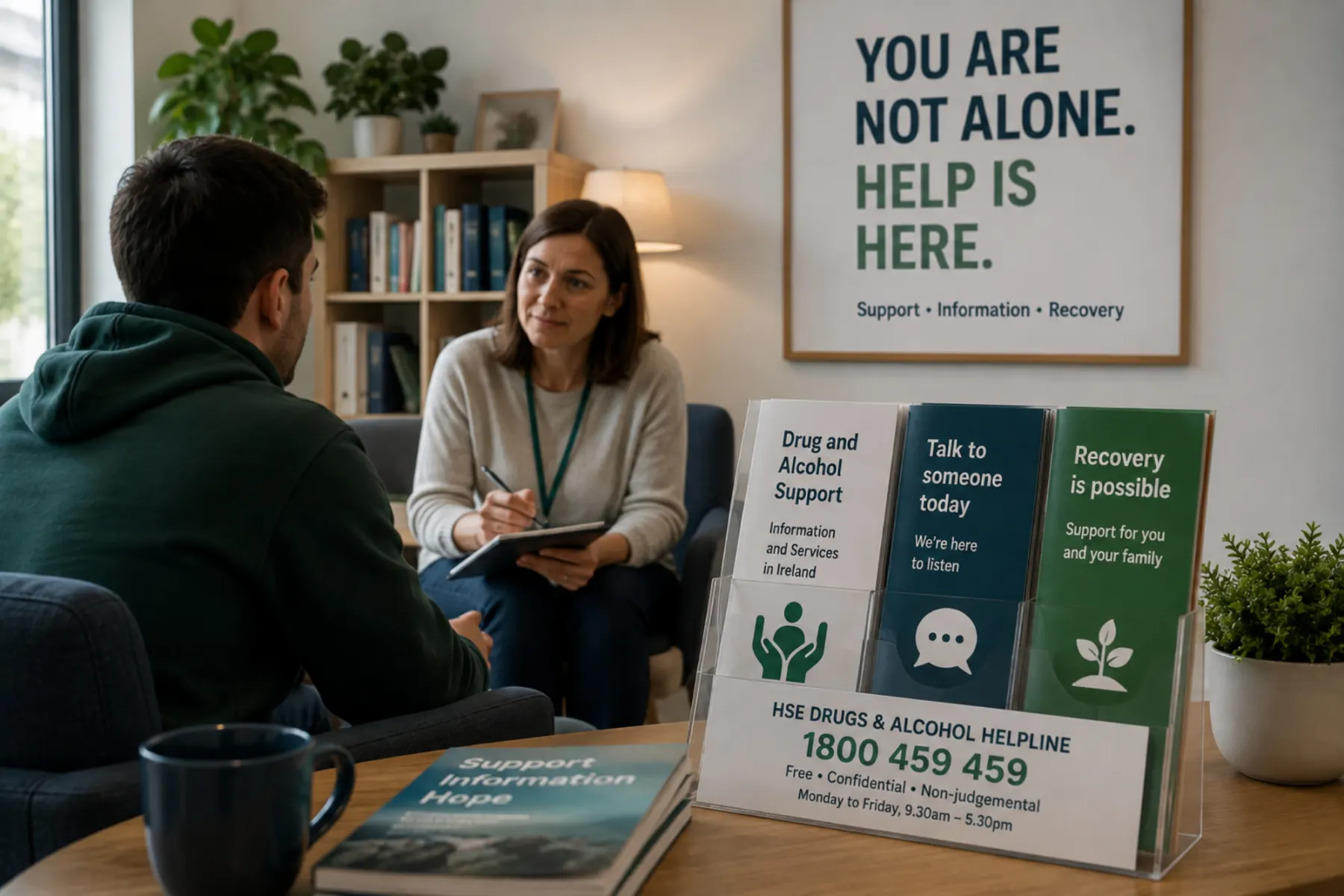
For somebody who has no idea which service they need, the most useful first contact in Ireland is often the HSE Drugs and Alcohol Helpline.
It is free, confidential and available to people concerned about their own drug or alcohol use as well as parents, partners, friends and professionals. Callers do not have to give their name. Staff can discuss treatment options and help identify an appropriate service.
HSE Drugs and Alcohol Helpline
Freephone: 1800 459 459
Opening hours: Monday to Friday, 9.30am–5.30pm
Email: helpline@hse.ie
The service can help if somebody wants to stop completely, reduce their use, prevent relapse, understand what treatment is available or find support for somebody who is not yet ready to change.
Ireland’s official Drugs.ie service directory can then be used to find local counselling, treatment, rehabilitation, information and support services around the country.
For someone who feels overwhelmed by the number of organisations listed in this guide, calling 1800 459 459 is therefore a very reasonable first step.
Your GP Can Be Part of Addiction Treatment
A GP is another important entry point.
Drug dependence can involve physical health, mental health, prescribed medicines, withdrawal symptoms and other conditions simultaneously. A GP can assess those issues and refer somebody to local addiction or specialist services where appropriate. HSE guidance specifically recommends speaking with a GP when somebody is concerned about an addiction.
This is particularly important when withdrawal could be medically dangerous.
Someone who is physically dependent on alcohol, benzodiazepines or certain other substances should not assume that abruptly stopping on their own is the safest approach. HSE guidance notes that medically supported alcohol detoxification may be needed to prevent severe withdrawal symptoms including seizures and hallucinations. Ireland also operates community detoxification pathways for substances including methadone, benzodiazepines and Z-drugs under appropriate professional supervision.
Detoxification and recovery are not the same thing.
Detox helps the body withdraw safely from a substance.
Longer-term treatment addresses what happens afterwards: cravings, triggers, mental health, relationships, housing, employment, relapse prevention and rebuilding ordinary life.
What an Addiction Service Can Actually Do
People sometimes imagine drug treatment as a choice between doing nothing and entering a residential rehabilitation centre.
Ireland’s system is much broader.
Depending on individual need, a drug and alcohol service may provide assessment, a named key worker, one-to-one counselling, group therapy, detox preparation, mental-health support, testing for hepatitis or HIV, vaccination, family work, housing assistance, education or employment support and referral into more intensive treatment.
A person may therefore be able to remain at home and continue working while receiving treatment.
For somebody with more complex dependence, an inpatient or residential programme may be more appropriate.
For opioid dependence, treatment may involve medications such as methadone or buprenorphine together with psychosocial care. HSE clinical guidance treats people who use drugs as patients entitled to the same standards of healthcare as others.
There is no single recovery route that is correct for everyone.
If Somebody May Be Overdosing, Do Not Wait for an Addiction Appointment
An overdose is an emergency, not a counselling issue.
If somebody is unconscious, difficult to wake, breathing abnormally or appears to be experiencing a drug overdose, call 112 or 999 for an ambulance immediately.
For a suspected opioid overdose, HSE guidance advises checking breathing, beginning CPR if the person is not breathing, using the recovery position if they are breathing, administering naloxone if available and remaining with the person until the ambulance arrives.
Naloxone temporarily reverses the effects of opioids including heroin, methadone, morphine, codeine, fentanyl and nitazenes and can keep somebody alive while emergency help is travelling to the scene. Both injectable and nasal naloxone products are available in Ireland.
A person who improves after naloxone still needs emergency medical attention because its effect can wear off while opioids remain active in the body.
Merchants Quay Ireland: Frontline Addiction Support in Dublin
Merchants Quay Ireland, or MQI, is one of Ireland’s largest charities working with people affected by addiction and homelessness.
Its Riverbank centre combines practical support with healthcare and addiction services.
Riverbank Open Access Centre
Address: 13–14 Merchant’s Quay, Dublin 8, D08 KT61
Telephone: 01 524 0924
Email: contactservice@mqi.ie
The homeless day service is open Monday to Friday from 8am–2pm and 2pm–7pm, is closed on Saturday, and opens Sunday from 8am–2pm. Adults experiencing homelessness, addiction or related difficulties can use the service without an appointment.
MQI also operates addiction case-working, nursing, GP, mental-health and counselling services from Riverbank. Its counselling service is appointment-based and operates Monday, Tuesday, Thursday and Friday from 8am–3.30pm.
For people who inject drugs, Riverbank also contains Ireland’s pilot Medically Supervised Injecting Facility, a healthcare environment in which adults can inject drugs obtained elsewhere under professional supervision. It is intended to reduce fatal overdose and other harms while creating opportunities to connect people with healthcare and treatment.
The facility is open Monday to Friday from 8.30am–12.30pm and 3pm–7pm, and Saturday and Sunday from noon–7pm. The stated final admission is 6.15pm.
Its pilot licence was extended for a further 12 months in June 2026 while an evaluation and wider policy review continue.
MQI’s main organisational contact is:
Merchants Court
24 Merchant’s Quay
Dublin 8, D08 X7YK
Telephone: 01 524 0160
Email: info@mqi.ie
Ana Liffey Drug Project: Low-Threshold Help Without Requiring Abstinence First
The Ana Liffey Drug Project provides free support to people affected by substance use and is particularly important for people who may not yet be ready or able to enter abstinence-based treatment.
Its Dublin open-access service allows people to make initial contact without navigating a complex referral process first.
Ana Liffey Drug Project – Dublin
Address: 48 Middle Abbey Street, Dublin 1
Telephone: 01 878 6899
Freephone: 1800 78 68 28
Email: office@aldp.ie
The Dublin open-access service operates Monday to Friday from 9.45am to noon.
Ana Liffey also operates regional services in the Midlands and Mid-West. Its current public information lists Midlands open access Monday to Friday from 10am–1pm and 2pm–5pm, except that the drop-in service is closed on Wednesday afternoons. The Mid-West open-access session is listed for Wednesday from 2pm–5pm.
The organisation provides services including harm reduction, case management, advocacy and assistance in accessing treatment.
For somebody who wants help but is not ready to promise immediate abstinence, a low-threshold service such as Ana Liffey can be an important place to begin.
Coolmine: Community, Day and Residential Treatment
Coolmine Therapeutic Community provides drug and alcohol treatment through community, day and residential programmes in Dublin and has expanded services into the Mid-West and South-West.
Its central admissions contact is:
Admissions: 087 122 9307
Email: admissions@coolminetc.ie
One of its principal community services is:
Coolmine House
19 Lord Edward Street
Dublin
Telephone: 01 679 4822
Email: admissions@coolminetc.ie
Coolmine House provides assessment and referral, day programmes, stabilisation and preparation for treatment. The service states that its full- and part-time day programmes are free.
For people preparing to enter treatment, Coolmine’s pre-entry groups currently run Monday at 9.30am and Friday at 2.30pm. Initial assessment is arranged through the admissions team rather than by simply arriving for residential admission.
Coolmine also operates:
Coolmine Lodge, Blanchardstown, Dublin 15 — residential treatment for men, telephone 01 821 4545.
Ashleigh House, Damastown, Dublin 15 — residential treatment for women and children, telephone 01 825 1100.
The ability for mothers to enter treatment while their children remain with them is particularly significant. Coolmine operates mother-and-child residential programmes in Dublin and Limerick, reducing one of the practical barriers that can prevent women from seeking treatment.
Most Coolmine services are free, although residential programmes may involve a contribution based on ability to pay.
Cuan Mhuire: Residential Treatment Across Ireland
Cuan Mhuire is a charitable provider of residential addiction treatment with centres in several regions of Ireland. It operates abstinence-based rehabilitation programmes and says its centres are open 24 hours a day, seven days a week, 365 days a year. Prospective residents should contact the relevant centre to discuss assessment and admission rather than arriving without arrangements.
Its principal Republic of Ireland locations include:
Cuan Mhuire Athy
Cardington, Athy, Co. Kildare
R14 XH79
Telephone: 059 863 1493
Email: admission@cuanmhuire.ie
Cuan Mhuire Coolarne
Coolarne, Turloughmore, Athenry, Co. Galway
H65 YW98
Telephone: 091 797 102
Email: coolarne@cuanmhuire.ie
Cuan Mhuire Bruree
Garroose, Bruree, Co. Limerick
Telephone: 063 90555
Email: admissionsbruree@cuanmhuire.ie
Cuan Mhuire Farnanes
Merri Heights, Knockshanawee, Farnanes, Co. Cork
Telephone: 021 733 5994
Email: farnanes@cuanmhuire.ie
The network provides residential treatment, continuing care and family support and treats alcohol, drug and gambling addiction.
Aiséirí: Treatment for Adults, Families and Young People
Aiséirí provides residential and continuing addiction treatment in Tipperary, Wexford, Kilkenny and Waterford.
Its central public contact is:
Telephone: 052 744 1166
Email: info@aiseiri.ie
Aiséirí lists public centre contact hours of 9am–5pm daily, while residential treatment itself is staffed around the clock.
The adult primary-treatment centres are:
Aiséirí Cahir
Townspark
Cahir, Co. Tipperary
E21 E206
Aiséirí Wexford
Roxborough
Co. Wexford
Y35 AH70
Aiséirí provides 28-day residential primary treatment for adults at Cahir and Wexford, with detoxification available at Cahir.
It also operates Aiséirí Aislinn in Ballyragget, Co. Kilkenny, R95 R859, a specialist residential service for young people aged 15 to 21, offering detoxification where required, a 42-day primary-treatment programme, family involvement and continuing recovery support.
This is an important option for families trying to find age-appropriate treatment for a teenager or young adult rather than placing them in a service designed predominantly for older adults.
Aiséirí also provides secondary treatment, sober living and progression programmes through Waterford.
Unlike many publicly funded community services, Aiséirí’s residential treatment can involve substantial fees. The organisation advises prospective clients to discuss insurance, HSE referral funding and other possible payment support directly before assuming treatment is financially inaccessible.
Tiglin: Residential Rehabilitation and Family Support in Wicklow
Tiglin is a registered charity providing addiction rehabilitation, supported housing, outreach and other social-care services.
Its principal centre is:
Tiglin Men’s Centre
Tiglin, Ashford
Co. Wicklow
A67 FV07
Main telephone: 0404 40010
For somebody seeking rehabilitation, Tiglin lists the following direct public contacts:
Men’s Centre Intake: 089 707 8166
Rehabilitation assessment and intake: 083 376 8374
Women’s rehabilitation assessment: 089 412 5139
Family Support Group: 085 887 5774
Admission to residential rehabilitation begins with an assessment. People may then attend pre-entry groups and key-working while waiting for a bed.
Tiglin operates separate residential rehabilitation services for men and women, with counselling, key-working, life-skills work and structured recovery programmes.
For people experiencing homelessness or severe social exclusion in Dublin, Tiglin at the Lighthouse, 28 Pearse Street, Dublin 2, D02 NA48, operates as a seven-day-a-week homeless café and outreach hub and can provide a route towards further support.
Merchants Quay Services in Cavan and Monaghan
People outside Dublin should not assume that major charities operate only in the capital.
Merchants Quay Ireland operates community alcohol and drug services in Cavan and Monaghan:
Cavan service
Acot House
Farnham Road, Drumnavanagh
Cavan, H12 FT29
Monaghan service
1 Oriel Way
Mullaghmatt
Monaghan, H18 D218
Telephone for referrals or appointments: 049 437 9160
Email: info.cavan.monaghan@mqi.ie
Hours: Monday to Friday, 9am–5pm.
These services illustrate why calling the national HSE helpline or using the Drugs.ie directory can be useful: many local services exist that may be much closer than the large national organisations people recognise by name.
Narcotics Anonymous: Free Peer Support Across Ireland
Professional addiction treatment and peer recovery are not alternatives that must be chosen between.
Many people use both.
Narcotics Anonymous Ireland is a fellowship for people who want to stop using drugs. Meetings operate throughout the country and can provide peer support from people with personal experience of addiction and recovery.
Irish Service Office of Narcotics Anonymous
PO Box 13033
14B Upper Kevin Street
Dublin 8, D08 V6V4
Information line: 01 672 8000
Email: info@na-ireland.org
Meeting times vary by location and change regularly, so the organisation’s current meeting finder should be checked rather than relying on an old printed list.
NA is peer support rather than medical detoxification or psychiatric treatment. Someone at risk from withdrawal, overdose or serious mental-health problems may therefore need professional healthcare in addition to meetings.
Alcoholics Anonymous: When Alcohol Is Part of the Problem
Drug use and harmful alcohol use frequently overlap, and some people seeking drug treatment are also concerned about drinking.
Alcoholics Anonymous Ireland operates meetings nationwide.
General Service Office
Unit 2, Block C
Santry Business Park
Swords Road
Dublin 9, D09 H584
Telephone: 01 842 0700
Office hours: 9.30am–5pm
Email: gso@alcoholicsanonymous.ie
AA also operates regional telephone services outside normal office hours. For example, the Leinster service operates 5pm–10pm Monday to Friday and 10am–10pm at weekends and bank holidays, while several regional services in Connaught, Galway, Limerick, Clare, Tipperary, Waterford, Kerry and Cork operate 10am–10pm seven days a week.
AA participation is free and based on peer support rather than clinical treatment.
Families Need Their Own Support Too
Addiction rarely affects only the person using drugs.
Partners may become exhausted.
Parents may spend years attempting to control another adult’s behaviour.
Children can experience instability.
Families may face debt, intimidation, arguments or repeated crises.
The person using drugs may need treatment, but relatives may need help independently of whether that person agrees to enter treatment.
The Family Addiction Support Network, or FASN, provides support particularly across Louth, Meath, Cavan and Monaghan.
FASN Head Office
The Hub
Lios Dubh, Armagh Road
Dundalk, Co. Louth
A91 T668
24-hour helpline: 087 904 6405
Office: 042 935 5251
Email: info.fasn@gmail.com
Services include one-to-one support, counselling access, peer-led family groups, educational programmes and assistance where drug-related intimidation is affecting a family.
For families affected specifically by somebody else’s drinking, Al-Anon operates a helpline on 01 873 2699 from 10am–10pm, 365 days a year.
Seeking family support is not an admission that the family caused the addiction.
Nor does a relative have to wait until the person using drugs agrees to treatment before getting help for themselves.
Counselling Is Important — but It Is Only One Part of Treatment
Counselling can help somebody understand why they use drugs, recognise triggers, respond differently to stress, repair relationships and develop strategies to prevent relapse.
But addiction can involve much more than thoughts and behaviour.
There may also be:
physical dependence,
withdrawal,
depression or anxiety,
trauma,
homelessness,
debt,
criminal-justice involvement,
family breakdown,
infectious disease,
or unemployment.
For that reason, good addiction treatment often involves several professionals or services rather than a counsellor working alone.
The objective is not merely to make somebody stop consuming a substance for several days.
It is to make continued recovery realistically sustainable.
You Do Not Have to Want Abstinence Before Asking for Help
One of the most important developments in modern Irish addiction services has been recognition that treatment cannot be limited to people who are already prepared to stop immediately.
Some people want complete abstinence.
Others initially want to reduce how much they use.
Some want safer injecting equipment or naloxone.
Some want to stabilise on opioid substitution treatment.
Some simply want to understand whether their drug use has become a problem.
HSE guidance states that its helpline can assist people who want to reduce or stop use as well as people concerned about somebody who is not ready to change.
Harm reduction is therefore not the opposite of recovery.
For some people it is the first stage through which contact with healthcare becomes possible.
What If the Person Refuses Help?
Families frequently ask how to force somebody into treatment.
In most ordinary circumstances, an adult has to participate in addiction treatment voluntarily.
A family cannot create lasting recovery simply by finding the perfect rehabilitation centre if the person will not engage.
That does not mean relatives can do nothing.
They can speak with the HSE helpline.
They can obtain family support.
They can learn about overdose prevention.
They can stop unintentionally financing harmful drug use.
They can protect children.
They can seek advice if violence, threats or drug debt are involved.
And they can be ready with realistic treatment options when the person becomes willing to talk.
The first intervention may therefore involve supporting the family rather than immediately admitting the drug user to treatment.
What If Money Is the Problem?
Ireland’s addiction system contains both publicly funded and privately funded treatment.
Many HSE and community addiction services are free.
Coolmine states that its day programmes are free, although residential programmes can require a contribution based on ability to pay.
Residential providers such as Aiséirí may charge substantial fees, although health insurance, HSE referral arrangements or other funding may sometimes contribute.
This is why somebody should not simply search for a private rehabilitation price online and conclude that treatment is unaffordable.
Call the HSE helpline and ask specifically:
What publicly funded options are available in my area?
Can I self-refer?
Do I need a GP referral?
Is there a waiting list?
Is residential treatment really necessary, or is community treatment appropriate?
Those questions can save considerable time and money.
What If There Is a Waiting List?
Waiting times vary according to the type of service and local demand.
If somebody has contacted a residential provider and is waiting for assessment or admission, that period does not have to mean receiving no support.
Community services, key-working, counselling, peer meetings and harm-reduction services may be available during the wait.
Coolmine, for example, uses pre-entry groups to support people preparing for treatment.
The HSE helpline can also identify alternative or interim services.
Someone whose risk is escalating should tell the service rather than assuming their original waiting-list position is fixed regardless of changing circumstances.
Young People Need Age-Appropriate Treatment
A teenager using cannabis, cocaine, tablets or other drugs should not automatically be treated as though they were a 45-year-old with decades of dependence.
Development, family, education, safeguarding and mental health are different.
The latest HRB data show that cannabis remains the most common main problem drug among treatment cases aged under 19, while cocaine dominates among people aged 20–44.
Parents or carers concerned about a young person can contact the HSE Drugs and Alcohol Helpline even if the young person is not yet willing to change.
Aiséirí Aislinn provides specialist residential addiction treatment for young people aged 15–21 in Ballyragget, Co. Kilkenny.
For younger children or cases involving safeguarding, mental-health problems or serious family concerns, a GP and the appropriate HSE or child services may also need to become involved.
Recovery Does Not End at the Door of a Rehabilitation Centre
Completing detoxification or residential treatment can be a major achievement.
It is not the end of recovery.
Returning home can bring somebody back to the same social environment, financial pressures, relationships and triggers that existed before treatment.
Strong programmes therefore include aftercare.
Coolmine provides lifelong recovery support after formal treatment.
Aiséirí operates a two-year Recovery Support Programme after primary treatment.
Tiglin operates structured aftercare and transitional housing in Greystones following residential rehabilitation.
NA and AA provide community-based peer networks that can continue indefinitely.
Relapse should be taken seriously, particularly because tolerance to opioids can fall during abstinence and make a previously tolerated dose dangerous. But relapse does not mean treatment has permanently failed.
It is a reason to re-engage quickly.
Ireland’s Drug-Treatment Needs Are Changing
The system built around heroin and opioid dependence is increasingly dealing with a more diverse drug market.
Cocaine became the leading drug generating treatment demand in Ireland and accounted for more than half of new treatment cases in 2025. Powder cocaine treatment demand rose by 21 per cent in a single year, while crack cocaine treatment increased by 31 per cent.
Meanwhile, new psychoactive substances and ketamine are increasingly appearing in treatment statistics.
That creates different treatment challenges.
There is no direct equivalent of methadone maintenance for cocaine dependence.
Psychological treatment, contingency approaches, mental-health support and management of associated alcohol or other drug use can therefore become particularly important.
Ireland’s addiction system has to evolve as the substances causing harm change.
A More Health-Led System Is Emerging
Ireland’s broader policy direction is also changing.
A draft National Drugs Strategy for 2026–2029 sets out a health-led approach built around reducing harm, expanding quality treatment, supporting recovery, prioritising health interventions and preparing for emerging drug threats.
The state spent approximately €176 million on drug services in 2025, with additional funding continuing into 2026 as treatment demand rises.
An even more visible change begins shortly.
From 1 September 2026, Ireland’s new Health Referral Scheme is due to operate nationally for eligible first-time offenders found by Gardaí in possession of drugs for personal use.
Instead of proceeding directly through the conventional criminal process in eligible cases, a person may be referred to the HSE for brief intervention and assessment, with further addiction treatment offered where appropriate. Possession of controlled drugs remains illegal.
The scheme represents a significant shift towards intervening through healthcare earlier rather than waiting until problematic drug use has developed into severe addiction.
Whether it succeeds will depend heavily on the availability of treatment after somebody is referred.
The Most Useful Contacts to Save
For somebody in Ireland who needs help with drugs or addiction, the most important contacts are these:
- Immediate overdose or medical emergency: 112 or 999. For suspected opioid overdose, use naloxone if available and follow emergency instructions while awaiting an ambulance.
- HSE Drugs and Alcohol Helpline: 1800 459 459, Monday–Friday, 9.30am–5.30pm; helpline@hse.ie. Free and confidential.
- Merchants Quay Ireland: 01 524 0160; Riverbank Open Access Centre, 13–14 Merchant’s Quay, Dublin 8.
- Ana Liffey Drug Project: 1800 78 68 28; 48 Middle Abbey Street, Dublin 1. Dublin open access Monday–Friday, 9.45am–12 noon.
- Coolmine admissions: 087 122 9307; admissions@coolminetc.ie. Coolmine House, 19 Lord Edward Street, Dublin.
- Cuan Mhuire: Athy 059 863 1493; Galway 091 797 102; Limerick 063 90555; Cork 021 733 5994. Residential services operate year-round; contact a centre before admission.
- Aiséirí: 052 744 1166; info@aiseiri.ie. Adult centres in Cahir and Wexford and specialist youth treatment in Kilkenny.
- Tiglin rehabilitation assessment: 083 376 8374; Men’s intake 089 707 8166; Women’s assessment 089 412 5139. Tiglin, Ashford, Co. Wicklow.
- Narcotics Anonymous Ireland: 01 672 8000; meetings nationwide.
- Family Addiction Support Network: 087 904 6405, 24 hours; The Hub, Lios Dubh, Armagh Road, Dundalk, Co. Louth.
Opening hours and individual clinic schedules can change, particularly around public holidays, and residential services normally require assessment before admission. Calling before travelling is therefore advisable.
The First Call Does Not Have to Solve Everything
Addiction creates a particular form of delay.
A person may know something is wrong but tell themselves it is not serious enough yet.
A parent may keep waiting for a teenager to admit there is a problem.
A cocaine user may still be working and conclude that treatment is only for people whose lives have completely collapsed.
Somebody dependent on tablets may not think of themselves as a drug user at all.
And somebody who has relapsed after months or years may be too ashamed to return to the service that previously helped them.
None of those situations requires waiting.
Treatment is not reserved for the point at which somebody has lost their job, home, health or family.
In fact, earlier intervention can mean that fewer of those losses ever occur.
The Irish system is imperfect. Availability differs regionally, some services have waiting lists, and the growth in cocaine and other forms of drug use is creating new demands. The Government is responding with additional investment, a new national drugs strategy and a more health-focused referral system, but the practical test remains whether people can reach appropriate care when they ask for it.
For the person needing help today, however, the national policy debate can wait.
The first step can be much smaller.
Call a GP.
Call the HSE helpline.
Walk into an open-access service.
Speak to an addiction counsellor.
Attend an NA meeting.
Or, if you are the relative rather than the person using drugs, contact a family-support service for yourself.
You do not have to know which treatment you need before making that call.
You only need to begin the conversation.
Source & Transparency
This article is published by Ireland Newspaper for editorial and informational purposes.
Published: 12 August 2026 · Updated: 12 August 2026

Newsroom Ireland Newspaper
Ireland Newspaper editorial team prepares daily news coverage for readers in Ireland and abroad.