Nearly three years after the Hamas-led attack of 7 October 2023 transformed an already entrenched Israeli-Palestinian conflict into a devastating war, Gaza is no longer experiencing the continuous large-scale combat that characterised much of 2024 and 2025. Yet it is not at peace. Israeli strikes continue, Palestinians continue to be killed, Israeli troops remain in control of large parts of the territory and negotiations over Hamas’s weapons and an Israeli withdrawal have stalled over the order in which each side is expected to act.
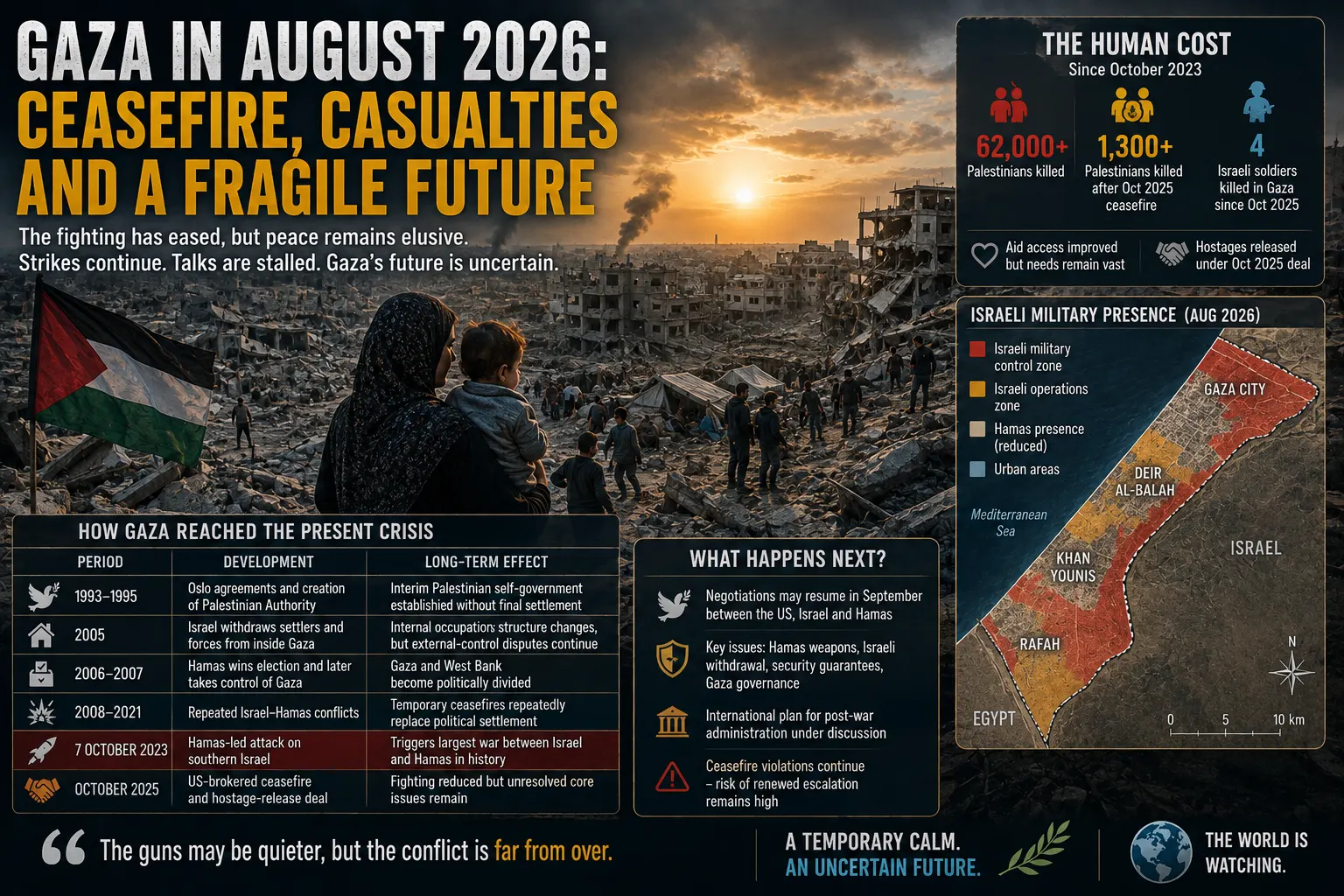
The fragility was visible again on 31 August 2026. Palestinian health officials said Israeli strikes killed at least five people in Gaza City, while the Israeli military said one of the attacks targeted Hamas militants. Similar incidents have continued despite the US-brokered ceasefire agreed in October 2025. Gaza health authorities reported more than 1,300 Palestinian deaths between the announcement of that ceasefire and late August 2026, while Israel has reported four soldiers killed in Gaza during the same period.
The present situation is therefore better understood as an incomplete transition than as either continuing full-scale war or settled peace. The hostage crisis has been resolved, humanitarian access improved substantially after the 2025 agreement and the framework for a new Palestinian administration has been developed. But the political and security arrangements necessary to transform the ceasefire into a durable settlement have not been implemented. The longer those questions remain unresolved, the greater the possibility that individual attacks, disputed ceasefire violations or political decisions outside Gaza could reverse the progress that has been made.
The Conflict That Exploded in 2023 Had Been Building for Decades
The immediate war began on 7 October 2023, but the political structure behind it developed over a much longer period. The Oslo process of the 1990s produced mutual recognition between Israel and the Palestine Liberation Organization and created the Palestinian Authority as an interim governing institution. It was intended to lead towards negotiations on the most difficult permanent-status questions, including borders, Israeli settlements, Jerusalem, security and Palestinian refugees. Those negotiations never produced a comprehensive settlement.
Israel withdrew its permanent military presence and evacuated its settlements from inside the Gaza Strip in 2005 under its unilateral disengagement plan, while continuing to control important aspects of Gaza’s external access, airspace and maritime environment. The following year Hamas won the Palestinian legislative election, defeating the Fatah movement that dominated the Palestinian Authority. A violent rupture between the two movements followed, and in 2007 Hamas took control of Gaza while the Palestinian Authority remained dominant in parts of the occupied West Bank.
The political split had profound consequences. Palestinians no longer had a single effective government administering both main Palestinian territories, while Israel and Egypt imposed tight restrictions around Gaza after the Hamas takeover. Israel described its restrictions as necessary to prevent weapons and materials with military uses reaching Hamas and other armed groups. The United Nations and humanitarian organisations repeatedly documented the economic and humanitarian consequences of restrictions on people, trade and essential infrastructure.
Gaza subsequently experienced repeated rounds of conflict involving Palestinian rocket fire towards Israel and Israeli air and ground operations. Major confrontations in 2008-09, 2012, 2014 and 2021 caused recurring casualties and infrastructure destruction without resolving the underlying political dispute. Ceasefires repeatedly stopped particular rounds of fighting, but they did not create a permanent security structure or political settlement.
How Gaza Reached the Present Crisis
| Period | Development | Long-Term Effect |
|---|---|---|
| 1993–1995 | Oslo agreements and creation of Palestinian Authority | Interim Palestinian self-government established without final settlement |
| 2005 | Israel withdraws settlers and permanent forces from inside Gaza | Internal occupation structure changes, but external-control disputes continue |
| 2006–2007 | Hamas wins election and later takes control of Gaza | Gaza and West Bank become politically divided |
| 2008–2021 | Repeated Israel-Hamas conflicts | Temporary ceasefires repeatedly replace political settlement |
| 7 October 2023 | Hamas-led attack on southern Israel | Triggers unprecedented Israeli military campaign in Gaza |
| October 2025 | US-backed ceasefire begins | Large-scale combat falls and hostage releases are completed |
| 2026 | Negotiations focus on disarmament, withdrawal and post-war governance | Political transition remains incomplete |
Sources: United Nations, UN Security Council, Reuters and official reports relating to the Gaza ceasefire framework.
7 October Changed the Scale of the Conflict
The Hamas-led attack on southern Israel on 7 October 2023 killed about 1,200 people and resulted in 251 Israelis and foreign nationals being taken hostage to Gaza, according to Israeli and subsequent international records. Most of those killed were civilians. Armed groups attacked communities, military positions and a music festival, producing the deadliest single day in Israel’s history.
Israel responded with an extensive military campaign intended to dismantle Hamas’s military and governing capabilities and return the hostages. Air strikes were followed by large-scale ground operations that moved through northern Gaza, Gaza City, Khan Younis, Rafah and other areas. Hamas and other armed organisations continued fighting from a dense urban environment containing tunnels, underground facilities and weapons positions.
The human and physical consequences became extraordinary. By August 2026, Gaza health authorities were reporting more than 73,000 Palestinian deaths since October 2023. Figures produced during an active conflict cannot always be independently verified in real time, and Hamas does not publish a comprehensive breakdown of its fighters killed. The United Nations and major international news organisations nevertheless use Gaza health-authority figures as an important source while identifying where the numbers originate.
The destruction also extended far beyond military positions. Housing, roads, electricity infrastructure, water systems, hospitals, schools, businesses and agricultural land were damaged on a scale far greater than in previous Gaza conflicts. The effect was not merely a temporary interruption of normal life. It substantially reduced Gaza’s capacity to function as an economy and society even if all military activity were to stop immediately.
The October 2025 Agreement Changed the War Without Resolving It
The ceasefire that emerged in October 2025 created the most substantial reduction in combat since the war began. It was incorporated into a broader US-backed Comprehensive Plan to End the Gaza Conflict and subsequently endorsed by United Nations Security Council Resolution 2803. Egypt, Qatar, Türkiye and the United States have played central roles as mediators and guarantors.
One of the agreement’s clearest achievements was the resolution of the hostage crisis. According to the May 2026 report submitted to the Security Council by the Board of Peace, 168 of the 251 people abducted on 7 October were ultimately returned alive. The final living hostage returned to Israel on 13 October 2025, and the remains of the final deceased hostage were returned on 26 January 2026. Israel also released Palestinian prisoners and detainees under the negotiated arrangements.
That removed an issue that had dominated Israeli society and complicated virtually every earlier ceasefire negotiation. It did not, however, resolve the security question that replaced it. Israel continues to demand that Hamas and other armed groups surrender their military capabilities. Hamas has accepted elements of a phased roadmap involving the storage and decommissioning of weapons, but disagreements remain over what weapons are covered, how verification would work and when Israel must withdraw.
The distinction is fundamental. Israel argues that withdrawing before Hamas is fully disarmed could permit the organisation to rebuild its military infrastructure. Hamas argues that surrendering its weapons before Israeli troops withdraw and attacks cease would remove its principal leverage without guaranteeing implementation of the rest of the agreement. Both positions produce the same practical problem: each side wants the other’s irreversible concession first.
The core dispute is now about sequencing. The current roadmap attempts to connect verified demilitarisation of individual areas with corresponding Israeli withdrawals. Israel has argued for disarmament before withdrawal, while Hamas has supported a more explicitly phased process in which the two happen together. Until that sequence is agreed and independently verified, the wider transition cannot move reliably forward.
Israel Still Controls Most of Gaza
The ceasefire did not return Gaza immediately to the territorial situation that existed before October 2023. Reuters reported in August 2026 that Israeli forces controlled roughly two-thirds of the Gaza Strip, following an expansion from positions established under the original ceasefire arrangements. Most of Gaza’s population was concentrated in the remaining area, largely along the coast, often in temporary shelters or damaged buildings.
United Nations reporting presents a similarly severe picture. OCHA said in August that nearly the entire population of about 2.1 million people remained concentrated in less than half of Gaza. Its latest shelter assessment estimated that approximately 1.98 million people required shelter assistance or essential non-food items and that 58 per cent of the population faced critical or catastrophic shelter needs.
The military geography makes the political negotiations unusually difficult. Withdrawal is not an abstract diplomatic promise: each kilometre transferred changes responsibility for security, policing, aid distribution and movement. If Israeli troops leave an area, another authority must be able to prevent renewed armed activity while simultaneously providing civilians with normal administration. Without that replacement structure, withdrawal can be seen by Israel as creating a security vacuum and by Palestinians as incomplete if Israeli operations can resume at any time.
Hamas Has Given Up Part of Government — but Not Yet Its Military Power
Hamas announced in July 2026 that it was dissolving its de facto governing structure in Gaza to facilitate a transition towards a technocratic Palestinian administration. The proposed institution, known as the National Committee for the Administration of Gaza, is intended to provide civilian government without Hamas exercising a formal governing role.
The move addresses one element of the international plan but does not settle the larger question of power. A government can administer schools, water networks and municipal services only if it also has sufficient authority to enforce laws. Israel argues that a civilian administration operating alongside an armed Hamas would remain subordinate to the organisation with the weapons. Hamas, meanwhile, has sought arrangements under which weapons would be stored, decommissioned or transferred according to an agreed process rather than surrendered unconditionally.
The US-backed roadmap attempts to bridge the two positions. It envisages verified decommissioning of weapons and military infrastructure, Palestinian civilian administration, newly trained Palestinian police and an International Stabilization Force operating in areas vacated by Israeli troops. Reconstruction would then expand progressively through sectors judged sufficiently demilitarised.
On paper, the architecture is more detailed than many previous ceasefire proposals. In practice, almost every component depends on the others. International forces are difficult to deploy without a clear mandate. A new Palestinian administration cannot establish legitimacy if it controls little territory. Israel is reluctant to withdraw without security guarantees. Hamas is reluctant to disarm without withdrawal. Reconstruction donors are reluctant to spend tens of billions of dollars where another war could destroy the investment.
A New July Roadmap Has Produced Movement but No Breakthrough
President Donald Trump announced a new 15-point roadmap at the end of July 2026 intended to move the 2025 agreement into its next phase. The proposal links Israeli withdrawal to verified disarmament sector by sector, establishes a role for an International Stabilization Force and places civilian administration under the new Palestinian technocratic structure.
Hamas accepted the roadmap’s basic phased framework, although it has disputed interpretations requiring all weapons to be surrendered before corresponding Israeli withdrawals. Israeli Prime Minister Benjamin Netanyahu said in August that Israel did not accept the document in its existing form and insisted that Israeli forces would not withdraw until Hamas was completely disarmed.
Further talks involving US representatives, Israeli officials and Hamas representatives did not produce a breakthrough in mid-August. Working groups were nevertheless established to discuss demilitarisation and urgent public-health issues. That is evidence that diplomacy remains active, but it is not evidence that a final agreement is close.
Israeli domestic politics is another factor. A national election is scheduled for 27 October 2026, and Netanyahu faces competing pressures from voters, security concerns, the United States and coalition partners opposed to concessions in Gaza. Major political decisions involving withdrawal are therefore intertwined with an election campaign. That does not determine Israel’s policy by itself, but it complicates the timing of negotiations.
The Ceasefire Has Saved Lives — but It Has Not Stopped the Killing
The difference between current conditions and the height of the war is substantial. Large-scale ground battles and continuous intensive bombardment have been reduced, aid flows improved and the food-security situation initially recovered from some of its worst levels. But Israeli air strikes, gunfire and other military incidents continue, while armed activity and perceived threats from Palestinian groups periodically generate Israeli responses.
OCHA reported that 47 Palestinians were killed and 176 injured between 12 and 26 August alone, based on Gaza Ministry of Health figures. That brought the reported total since the October 2025 ceasefire announcement to 1,303 deaths and 4,336 injuries by 26 August. Subsequent strikes pushed the death toll higher before the end of the month.
Israel says its post-ceasefire strikes are aimed at militants or immediate threats to Israeli forces and communities. Hamas accuses Israel of repeatedly violating the agreement. These competing claims illustrate why a ceasefire-monitoring mechanism matters: if every incident is interpreted exclusively by one of the belligerents, disputed violations can accumulate until each side concludes that the agreement no longer constrains the other.
The continuation of relatively small-scale incidents also creates an escalation risk disproportionate to their immediate size. A strike killing a senior militant, an attack causing significant Israeli military casualties or a perceived attempt to rearm could trigger retaliation and counter-retaliation. The transition therefore remains vulnerable even without a deliberate decision by either side to restart full-scale war.
Gaza in 2026: What Has Improved and What Has Not
| Area | Progress | Remaining Problem |
|---|---|---|
| Hostages | All living and deceased hostages returned | Issue resolved, but trauma and accountability remain |
| Large-scale combat | Sharply reduced since October 2025 | Strikes and ceasefire violations continue |
| Humanitarian aid | Access improved after ceasefire | Restrictions, shortages and funding gaps persist |
| Israeli forces | Framework exists for phased withdrawal | Israel still controls roughly two-thirds of Gaza |
| Hamas weapons | Phased decommissioning framework discussed | No completed disarmament agreement |
| Governance | Technocratic Palestinian administration proposed | Authority inside Gaza remains incomplete |
| Reconstruction | International plans and funding mechanisms exist | Large-scale rebuilding has barely begun |
Sources: UN Security Council Resolution 2803, Board of Peace report, OCHA and Reuters reporting through 31 August 2026.
The Humanitarian Emergency Has Changed Form Rather Than Disappeared
Food availability improved significantly after the October 2025 ceasefire allowed humanitarian assistance to expand. The Integrated Food Security Phase Classification found that large-scale aid had produced measurable improvements. Yet the improvement rests heavily on continuing external assistance rather than a functioning local economy.
Between mid-April and the end of June 2026, more than 1.2 million people — 59 per cent of Gaza’s population — were assessed as facing Crisis-level food insecurity or worse, including 212,000 in Emergency conditions. For July to December, the IPC projected more than 1.4 million people, or 67 per cent of the population, could face Crisis conditions or worse if current vulnerabilities persisted.
Child malnutrition has improved from earlier emergency levels, demonstrating that humanitarian intervention can have a measurable effect when access expands. Yet the IPC projected that tens of thousands of young children could still require treatment for acute malnutrition through 2027. The underlying reason is structural: households have lost incomes, agricultural production has been damaged and much of the normal commercial economy has disappeared.
Water presents another persistent danger. OCHA reported that 90 per cent of Gaza’s population was experiencing moderate-to-high water insecurity in early July 2026. Damaged infrastructure, limited fuel and electricity, overcrowding and restrictions affecting repairs create health risks even where sufficient food is available.
Rebuilding Gaza Is Now a $71 Billion Problem
The scale of physical destruction makes reconstruction inseparable from politics. A final Rapid Damage and Needs Assessment released by the European Union, United Nations and World Bank in April 2026 estimated that Gaza would require approximately $71.4 billion for recovery and reconstruction over the following decade. About $26.3 billion would be needed within the first 18 months for essential services, infrastructure and economic recovery.
The assessment estimated physical infrastructure damage at $35.2 billion and wider economic and social losses at $22.7 billion. More than 371,000 housing units had been damaged or destroyed, more than half of hospitals were non-functional and almost all schools had suffered damage. Gaza’s economy was estimated to have contracted by 84 per cent.
Those figures demonstrate why reconstruction cannot consist simply of replacing individual buildings. Electricity grids, water and sewage networks, roads, hospitals, schools, agricultural land, communications and commercial businesses have to recover simultaneously. Debris containing unexploded ordnance must be removed before many sites can be safely rebuilt. Ownership and property claims will also need to be resolved where neighbourhoods have been almost completely destroyed.
Funding represents only one obstacle. The Board of Peace reported in May that about $17 billion had been pledged towards reconstruction, substantially below total estimated needs, with disbursement lagging behind commitments. Some governments and institutions have also preferred established multilateral mechanisms over new structures, reflecting concerns about governance, transparency and political oversight.
The Economic Scale of Gaza’s Reconstruction
| Measure | Estimate | Reference |
|---|---|---|
| Recovery and reconstruction | $71.4bn | Ten-year requirement |
| First 18 months | $26.3bn | Priority recovery |
| Physical damage | $35.2bn | Infrastructure and assets |
| Economic and social losses | $22.7bn | Estimated wider losses |
| Housing units damaged or destroyed | More than 371,000 | Final damage assessment |
| Economic contraction | 84% | Gaza economy |
Source: Final Gaza Rapid Damage and Needs Assessment, European Union, United Nations and World Bank, April 2026.
Reconstruction Cannot Succeed Without Government
A territory requiring more than $70 billion of investment needs institutions capable of signing contracts, registering property, collecting revenue, regulating businesses, operating courts and policing communities. This is why the debate about Gaza’s future administration is not a secondary political argument. It determines whether reconstruction is practically possible.
The internationally backed framework envisages a technocratic Palestinian administration initially governing Gaza, with a longer-term objective of restoring a reformed Palestinian Authority to responsibility across Palestinian territory. The United Nations, European Union and World Bank have argued that reconstruction should ultimately support legitimate Palestinian governance rather than create a permanently separate political system for Gaza.
There is logic to that objective. One of the structural weaknesses created after 2007 was the division between Hamas-controlled Gaza and a Fatah-dominated Palestinian Authority in the West Bank. Any long-term settlement that preserves separate political entities would risk institutionalising the fragmentation that helped prevent a coherent peace process for almost two decades.
But reunification under the Palestinian Authority is not straightforward. The Authority itself faces serious questions over democratic legitimacy, institutional reform, public confidence and finances. Palestinian presidential elections have not been held since 2005 and legislative elections since 2006. Rebuilding legitimate institutions would therefore involve more than changing administrators in Gaza.
The Palestinian Authority Is Financially Weaker at the Moment It Is Supposed to Become Stronger
The contradiction is particularly visible in the West Bank. The international strategy depends heavily on eventually creating a Palestinian administration capable of governing Gaza and the West Bank, yet the existing Palestinian Authority is experiencing a severe fiscal crisis.
The United Nations Special Coordinator told the Security Council on 26 August that Israel was continuing to withhold approximately $6 billion in Palestinian clearance revenues. These revenues are taxes and customs receipts collected by Israel on behalf of the Palestinian Authority under existing economic arrangements and are central to the PA’s ability to pay salaries and maintain public services.
Uncertainty over banking links between Israeli and Palestinian financial institutions creates an additional risk because most Palestinian external trade depends on transactions connected to Israel. A severe PA financial crisis could reduce its ability to pay public employees, operate health and education services and maintain security forces. That would directly undermine the same institution that much of the international community expects eventually to assume greater responsibility.
This illustrates a broader problem with the peace process. Gaza cannot be treated as an isolated reconstruction project. The viability of any political settlement depends on what happens simultaneously in the West Bank, East Jerusalem and the Palestinian governing institutions.
The West Bank May Now Be the Biggest Structural Threat to a Two-State Settlement
While attention has focused on Gaza, the geography of a potential Palestinian state has continued changing in the occupied West Bank. Israeli settlements have expanded, settler violence has increased and Israeli military operations have intensified in several areas. Israel argues that its security operations are necessary to prevent attacks and disputes characterisations of the territory and settlement policies advanced by many international bodies.
In August 2026, the Israeli government moved forward with construction tenders for 1,234 housing units in the E1 settlement project east of Jerusalem, part of a wider plan for more than 3,400 homes. The project has been controversial for decades because of its position between East Jerusalem and the large Israeli settlement of Ma’ale Adumim.
Britain, France, Germany, Italy and other governments warned that construction in E1 would damage the territorial continuity required for a viable Palestinian state by creating a wedge across part of the West Bank. Israeli proponents of the project reject the premise that Israel should relinquish the area and emphasise Israel’s historical and security claims.
The legal international position is clearer than the political one. The International Court of Justice concluded in its July 2024 advisory opinion that Israel’s continued presence in the Occupied Palestinian Territory was unlawful and said settlement activity should cease. United Nations Security Council Resolution 2334 had previously stated that Israeli settlements in territory occupied since 1967 had no legal validity. Israel has strongly disputed important aspects of international legal and political assessments concerning the occupation and maintains that final territorial questions should be determined through negotiations.
For diplomacy, however, the practical question is geographical. A two-state solution requires a Palestinian state that is sufficiently contiguous and economically functional to govern itself. Settlement expansion, Palestinian population centres, Israeli security corridors and restricted movement become increasingly difficult to reconcile as physical development continues.
Security for Israel Cannot Be Treated as an Afterthought
A lasting settlement also requires confronting the fundamental Israeli security argument rather than assuming that political recognition alone can end the conflict. The attacks of 7 October profoundly changed Israeli public perceptions of the risks posed by armed organisations operating near population centres. Any proposal requiring a substantial Israeli withdrawal from Gaza or the West Bank will therefore be judged in Israel partly on whether it could enable another large-scale attack.
That is why demilitarisation, border monitoring, early-warning systems and external security guarantees have become central to post-war proposals. An International Stabilization Force could theoretically help bridge the gap between Israeli withdrawal and effective Palestinian security institutions. But participating countries will require clear rules on when force can be used, who commands operations, how militants are disarmed and how confrontation with Israeli forces is avoided.
A purely military solution faces its own limitations. Israel has inflicted immense damage on Hamas’s military infrastructure and leadership, but years of operations have not demonstrated that military force alone can create a legitimate alternative government accepted by Gaza’s population. Removing an armed organisation is different from constructing the political institutions that replace it.
The security requirement is therefore reciprocal. Israelis need credible protection against rocket attacks, raids and armed groups. Palestinians need credible protection against renewed large-scale military operations, indefinite displacement and the continued absence of political sovereignty. A system perceived as protecting only one population is unlikely to be politically sustainable.
Hamas’s Future Is About More Than Whether It Holds Government Offices
The future role of Hamas remains one of the most difficult political questions. The United States, Israel and several other governments designate Hamas as a terrorist organisation and insist it must have no military or governing role in post-war Gaza. The current peace framework therefore requires both civilian transition and the removal of its independent military capabilities.
Hamas has already indicated willingness to step away from formal administration and has accepted elements of weapons decommissioning. That represents movement from its position as the exclusive governing authority in Gaza before the war. But accepting technocratic administration is not equivalent to abandoning political influence, organisational networks or armed capability.
A durable settlement would therefore require clarity about what happens to thousands of members and supporters after demobilisation. International plans discuss weapons buy-back programmes, conditional amnesty and reintegration for individuals who comply with the new order. Similar processes have been used after conflicts elsewhere, although Gaza’s political conditions are distinctive and success cannot be assumed.
Excluding armed organisations from coercive power may be necessary for a unified state, but eliminating their social constituency by decree is much more difficult. Long-term stability would depend partly on whether Palestinians can pursue political objectives through legitimate institutions rather than competing armed organisations.
Palestinian Political Legitimacy Will Eventually Require Elections
One of the less visible obstacles to a long-term solution is the democratic vacuum created by two decades without national Palestinian elections. The Palestinian Authority has continued to function in parts of the West Bank, while Hamas governed Gaza after winning the 2006 legislative vote and defeating Fatah forces in 2007. Neither arrangement now rests on a recent national electoral mandate.
A technocratic administration may be useful during an emergency transition because Gaza requires immediate professional management rather than another struggle for control. But technocracy cannot indefinitely replace political legitimacy. At some point, Palestinians would need a credible mechanism for determining who represents them and who is authorised to negotiate permanent arrangements.
Elections themselves would not automatically solve the conflict. They would require agreed rules, security, freedom of political participation and some mechanism for dealing with parties maintaining armed wings. But without eventual democratic renewal, any government negotiating on borders, Jerusalem, refugees and security could face questions about whether it has the authority to accept irreversible compromises.
The Two-State Formula Still Dominates Diplomacy — Despite Growing Doubts About Its Practicality
Most major international diplomatic initiatives still point towards two states: Israel and an independent Palestinian state based broadly on the territories occupied in 1967, with negotiated adjustments and an agreed arrangement for Jerusalem. The United Nations, European Union and numerous Arab and Western governments continue to support that framework.
The attraction is straightforward. Two states attempt to reconcile two national movements seeking political self-determination in the same territory. Israel would retain national sovereignty and security, while Palestinians would obtain a recognised state rather than indefinite military occupation or fragmented autonomy.
The difficulty is that the physical and political conditions required for two states have deteriorated over time. Israeli settlements and associated infrastructure divide parts of the West Bank. Gaza and the West Bank have been politically separated since 2007. Trust between Israelis and Palestinians has been profoundly damaged by repeated violence, the 7 October attacks, the Gaza war and violence in the West Bank.
The alternative models are not necessarily easier. A single state would have to reconcile competing national identities, political rights, security institutions and demographic concerns inside one sovereign system. Permanent Israeli security control combined with limited Palestinian autonomy would not satisfy Palestinian demands for self-determination and would remain subject to intense international legal and political challenge. Confederation proposals solve some territorial problems but require an even higher level of cooperation than currently exists.
Regional Diplomacy Could Create an Incentive That Gaza Alone Cannot
The wider Middle East provides one potential source of political leverage. Israel established formal relations with the United Arab Emirates, Bahrain, Morocco and Sudan through the Abraham Accords process beginning in 2020. Before October 2023, a possible agreement between Israel and Saudi Arabia was widely considered the next major step in regional normalisation.
That process was disrupted by the Gaza war. Saudi Arabia now says recognition of Israel requires an irreversible path towards Palestinian statehood. In August 2026, the Trump administration linked a proposed US-Saudi civilian nuclear agreement to Saudi participation in the Abraham Accords, bringing the Palestinian question back into a much larger regional negotiation.
This potentially creates incentives unavailable in a purely bilateral Israeli-Palestinian process. Israel could gain deeper integration with major Arab economies and greater regional cooperation. Palestinians could gain Arab political and financial backing for reconstruction and state-building. Saudi Arabia and Gulf governments could gain regional stability and stronger economic relationships with both Israel and the United States.
But regional normalisation cannot substitute for Palestinian consent. A settlement negotiated primarily between outside powers without legitimate Palestinian participation would struggle to produce durable political acceptance. The same applies to Israeli security: regional governments can offer guarantees and incentives but cannot simply impose Israeli public confidence in a new security arrangement.
What a Durable Settlement Would Actually Require
A lasting solution is unlikely to emerge from one dramatic diplomatic conference. The current crisis contains several distinct problems that must be solved in a sequence capable of reinforcing rather than undermining each other.
First, the ceasefire would need to become substantially more reliable, with agreed rules for military responses and independent monitoring of violations. Second, Hamas and other armed organisations would need to surrender independent military capabilities under a verifiable arrangement while Israeli forces withdraw according to an agreed schedule. Third, a Palestinian administration with sufficient authority, financing and public legitimacy would have to replace both military rule and factional government.
Fourth, reconstruction would need to begin on a scale large enough to give civilians a visible stake in continued peace. People living indefinitely in tents among destroyed neighbourhoods have little reason to believe a political transition is succeeding. Housing, employment, schools, hospitals, water and normal commercial activity are therefore security issues as much as humanitarian ones.
Fifth, Gaza would need to be politically reconnected with the West Bank rather than rebuilt as an isolated coastal entity. That requires viable Palestinian institutions and movement arrangements, while settlement expansion and territorial fragmentation in the West Bank would have to be addressed as part of negotiations over a final border.
Finally, Israelis and Palestinians would need political leadership able to persuade their own populations that compromise is safer than indefinite conflict. International pressure can create incentives and impose costs, but an agreement involving borders, sovereignty and security ultimately has to survive domestic politics on both sides.
A sustainable settlement therefore requires six elements to move together: a durable ceasefire, verified demilitarisation, Israeli withdrawal, legitimate Palestinian governance, large-scale reconstruction and a credible political horizon connecting Gaza with the West Bank and the unresolved permanent-status questions.
What Could Still Cause the Ceasefire to Collapse
The most immediate danger is military miscalculation. A major Hamas or other militant attack on Israeli forces or communities could produce a much larger Israeli response. A high-casualty Israeli strike in Gaza could similarly increase pressure on armed groups to retaliate. The fact that significant casualties have continued during the ceasefire means this risk is not theoretical.
A second danger is failure of the disarmament negotiations. If the United States and mediators conclude that Hamas is unwilling to implement the roadmap, Israel could argue that renewed military action is necessary. Conversely, Hamas could abandon the process if it concludes that surrendering weapons will not produce Israeli withdrawal.
The third danger lies outside Gaza. Rapid deterioration in the West Bank, severe settler violence, further settlement expansion or a collapse of the Palestinian Authority could undermine the political assumptions behind the Gaza transition. A peace plan cannot plausibly create Palestinian governance in Gaza while Palestinian institutions elsewhere are disintegrating.
Regional escalation is another risk. Israel’s conflicts and confrontations with Iran and other Iran-aligned groups have repeatedly interacted with Gaza. A major regional war could redirect military priorities, alter alliances and remove diplomatic attention from the slow process of Palestinian reconstruction.
Why the Current Moment Is Different From Earlier Ceasefires
Despite the dangers, there are reasons the present moment is not simply another repetition of earlier Gaza truces. The hostage crisis has been completed rather than postponed. The United Nations Security Council has endorsed a detailed international transition framework. A technocratic Palestinian administration has been designed, an international force has been planned and governments have begun committing reconstruction funding.
Hamas has also accepted the principle of relinquishing direct civilian administration and has entered negotiations over weapons decommissioning. Israel has accepted in principle that withdrawal forms part of the comprehensive settlement, even though it disputes when withdrawal should occur. These are meaningful changes from the political structure that existed before October 2023.
At the same time, the distance between a framework and implementation remains enormous. The international force is not yet functioning across Gaza. The technocratic administration does not exercise normal sovereignty. Hamas remains armed. Israeli forces remain deployed across most of the territory. Reconstruction is far behind need.
The current framework therefore represents an opportunity rather than an accomplished peace process. Its significance lies in the fact that institutions for a transition now exist on paper. Its vulnerability lies in the fact that many of them still depend on the same unresolved political decisions.
The Chances of a Long-Term Solution Are Real — but Narrow
A permanent political settlement is more conceivable in August 2026 than it was during the most intensive stages of the Gaza war because large-scale fighting has decreased, the hostages have been returned and the parties are negotiating within an internationally recognised framework. Those achievements should not be dismissed simply because the remaining problems are formidable.
But the central obstacles are more structural than procedural. Hamas’s military future, Israeli security requirements, Palestinian political legitimacy, the future of the Palestinian Authority, settlement expansion in the West Bank, borders, Jerusalem and Palestinian statehood cannot be resolved by humanitarian reconstruction alone. They require political decisions that successive Israeli and Palestinian leaders have been unable to conclude for decades.
The most realistic near-term outcome may therefore be neither comprehensive peace nor a return to the full-scale war of 2023-25. Gaza could remain in a prolonged intermediate condition in which violence stays below previous levels while demilitarisation, withdrawal, governance and reconstruction advance only gradually. Such an arrangement could save lives and create time for diplomacy, but it would remain unstable unless it ultimately connects to a wider Israeli-Palestinian settlement.
The alternative is that the transition itself becomes permanent: Gaza divided into zones of control, Palestinians living amid reconstruction sites and temporary shelters, Israeli forces retaining extensive security authority and no agreement on Palestinian sovereignty. That could suppress some military threats while reproducing many of the conditions that have repeatedly generated conflict.
Gaza Cannot Be Solved Only in Gaza
The central lesson of the period since the Oslo agreements is that temporary arrangements tend to become long-term structures when the most difficult political questions are postponed. Palestinian self-government remained interim. Gaza and the West Bank became politically divided. Ceasefires repeatedly stopped wars without settling the dispute that produced them.
The October 2025 ceasefire has nevertheless achieved something important. It has shown that large-scale fighting can be reduced, hostages and prisoners can be exchanged, humanitarian conditions can improve and even bitter adversaries can accept internationally mediated arrangements when the incentives are strong enough.
What it has not yet demonstrated is that the same diplomacy can resolve sovereignty and security. Gaza needs reconstruction, but reconstruction requires government. Government requires security. Security requires agreed control over weapons and territory. Palestinian political legitimacy ultimately requires Gaza and the West Bank to be treated as parts of the same national political future. And any durable Israeli withdrawal requires Israelis to believe that relinquishing military control will not recreate the danger that erupted on 7 October 2023.
That chain explains both the possibility and the fragility of the present moment. A viable route towards peace now exists in greater detail than during much of the war, but almost every stage depends on implementation of the stage before it. As of 31 August 2026, Gaza is therefore neither where it was during the worst of the war nor where its international peace plans say it should eventually be. It is caught between those two realities, and whether the ceasefire becomes the beginning of a political settlement or merely another interval between conflicts will depend on whether that gap can finally be closed.
Sources
Reuters — Israeli strikes in Gaza and current ceasefire situation, 31 August 2026
Reuters — Gaza roadmap, Hamas disarmament and Israeli withdrawal, August 2026
Reuters — US, Israeli and Hamas negotiations, August 2026
Reuters — Hamas dissolves its Gaza governing structure, July 2026
United Nations OCHA — Humanitarian Situation Report, 28 August 2026
United Nations OCHA — Humanitarian Situation Report, 14 August 2026
Integrated Food Security Phase Classification — Gaza food insecurity assessment, July 2026
Board of Peace — Report on implementation of Security Council Resolution 2803, May 2026
United Nations Security Council — Resolution 2803 on the Comprehensive Plan to End the Gaza Conflict
International Court of Justice — Advisory Opinion on the Occupied Palestinian Territory, July 2024
United Nations — History of the Question of Palestine and the Oslo peace process
Reuters — Saudi normalisation, Palestinian statehood and regional diplomacy, August 2026
Source & Transparency
This article is published by Ireland Newspaper for editorial and informational purposes.
Published: 31 August 2026 · Updated: 31 August 2026

Newsroom Ireland Newspaper
Ireland Newspaper editorial team prepares daily news coverage for readers in Ireland and abroad.