
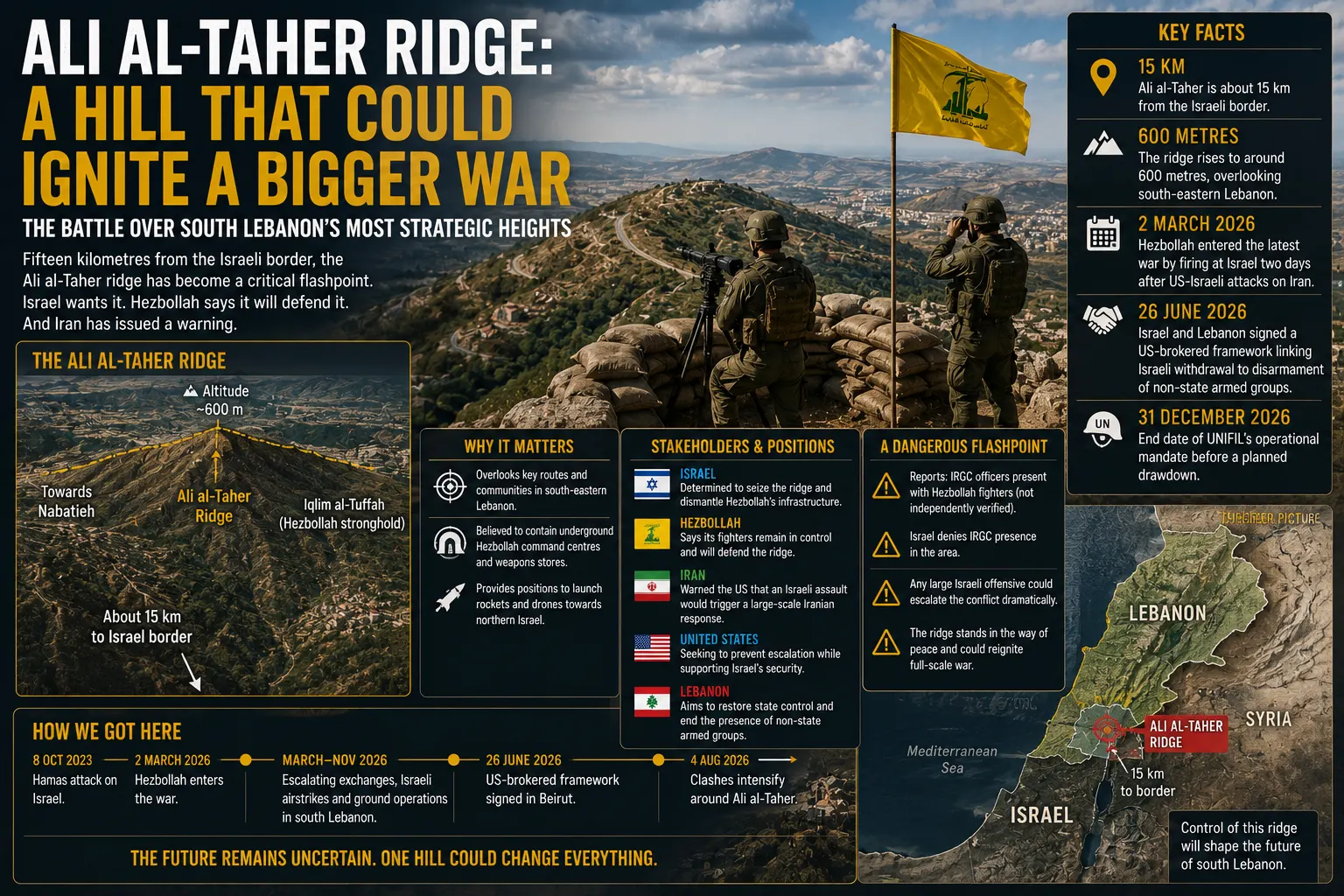
Fifteen kilometres from the Israeli border, a cluster of hills rising to roughly 600 metres has become one of the most dangerous pieces of ground in the Middle East. The Ali al-Taher ridge overlooks a broad section of south-eastern Lebanon, sits above routes towards Nabatieh and the Hezbollah stronghold of Iqlim al-Tuffah, and is believed by Lebanese security sources to contain an underground Hezbollah command complex and weapons stores. Israel has made the ridge one of its principal operational objectives. Hezbollah says it remains in control and warns that a large Israeli assault would mean a return to full-scale war.
The danger has increased because the contest is no longer exclusively between Israel and Hezbollah. Reuters reported on 3 September that Iran had warned the United States through intermediaries that a full Israeli offensive against Ali al-Taher would trigger a large-scale Iranian response. Three officials briefed on the message described the warning, with two saying more than a dozen members of Iran’s Islamic Revolutionary Guard Corps, including senior officers, were present with Hezbollah fighters. Neither the reported Iranian deployment nor the precise military situation inside the ridge has been independently verified, and an Israeli media report cited an Israeli military assessment that no IRGC personnel were there.
Washington has also disputed part of the account. A White House official told Reuters that the report concerning the Iranian message and American pressure on Israel was inaccurate. Israel, Iran and Oman have not publicly confirmed all of the details. What is not disputed is that Israeli forces are operating around the ridge, that Hezbollah says its fighters retain control of positions there, that Israeli forces have been trying to prevent Hezbollah from operating from underground infrastructure, and that the site has become a central obstacle in an already faltering attempt to end the latest Israel-Lebanon war.
Ali al-Taher matters because several unresolved conflicts have converged on the same hill. It is simultaneously a military strongpoint, a symbol of Hezbollah’s refusal to surrender its arsenal, a barrier to further Israeli withdrawal, a test of whether the Lebanese state can regain a monopoly over weapons and, potentially, a trigger capable of reconnecting Israel’s Lebanese front directly to Iran at a moment when Tehran and Washington are again exchanging fire.
About 15 km: distance between the Ali al-Taher ridge and the Israeli border.
About 600 metres: elevation of the ridge, giving it commanding views across south-eastern Lebanon.
2 March 2026: Hezbollah entered the latest regional war by firing at Israel two days after US-Israeli attacks on Iran.
26 June 2026: Israel and Lebanon signed a US-brokered framework linking phased Israeli withdrawal to verified disarmament of non-state armed groups.
31 December 2026: current end date of UNIFIL’s operational mandate before a planned drawdown.
Why a Relatively Small Ridge Has Such Large Military Value
Ali al-Taher is not important because of its physical size. Its value comes from elevation, position and what may exist underneath it. From the ridge, forces can observe approaches across a broad part of southern Lebanon and the terrain running towards northern Israel. Control of high ground has mattered in warfare for centuries because it improves surveillance, defensive positioning and the ability to monitor movement through valleys and roads below.
The ridge also connects areas closer to the Israeli frontier with Iqlim al-Tuffah farther north. That hilly region has long been associated with Hezbollah’s logistical and military presence. Nabatieh, one of southern Lebanon’s largest population centres, lies beyond the immediate battlefield and has repeatedly been struck during the current conflict.
Lebanese security sources have told Reuters that Hezbollah constructed underground command facilities and weapons stores inside Ali al-Taher. Analysts cited by the news agency said its elevation gave Hezbollah favourable conditions for launching shorter-range missiles and drones towards northern Israel. Hezbollah has acknowledged that it operates what it describes as a facility in the area but has not publicly disclosed its internal structure.
Israel therefore sees control of the ridge as more than the capture of another hill. If the suspected underground network can be neutralised, Israel would remove a military position overlooking territory already occupied farther south and weaken a potential route linking Hezbollah’s remaining southern positions with its deeper rear areas.
For Hezbollah, the same geography works in reverse. Losing Ali al-Taher would move Israeli military control or effective fire dominance significantly farther into Lebanon and weaken one of the remaining defensive barriers between Israeli-held territory and Hezbollah’s heartland farther north.
The Ridge Has Been Strategically Important Before
Ali al-Taher sits inside a landscape shaped by decades of conflict. Israel invaded Lebanon in 1978 and again on a much larger scale in 1982, initially targeting Palestinian armed organisations operating from Lebanese territory. The second invasion developed into a prolonged Israeli military presence in southern Lebanon.
Hezbollah emerged during that period, drawing ideological, organisational and military support from revolutionary Iran and the Islamic Revolutionary Guard Corps. It combined armed resistance to Israel with a political, religious and social organisation rooted particularly within Lebanon’s Shi’ite community.
Israel eventually withdrew from most of southern Lebanon in May 2000 after 22 years of occupation. Hezbollah presented that withdrawal as proof that armed resistance had succeeded, strengthening the organisation politically and militarily. Israel regarded Hezbollah’s continued armament after the withdrawal as an expanding security threat rather than a legitimate defensive necessity.
Those competing interpretations never disappeared. Hezbollah continued to describe its weapons as necessary to deter Israel and defend Lebanese territory. Its opponents inside Lebanon argued that an armed organisation outside the command of the state could independently decide matters of war and peace, weakening national sovereignty and exposing the country to conflicts the elected government had not authorised.
Ali al-Taher itself was held by Israel during the earlier occupation. Its return to the centre of military operations in 2026 is therefore part of a much longer struggle over who controls the high ground, movement corridors and security architecture of southern Lebanon.
The 2006 War Produced Rules That Were Never Fully Implemented
The most important diplomatic framework governing southern Lebanon remains United Nations Security Council Resolution 1701, adopted after the devastating Israel-Hezbollah war of 2006. The resolution called for a cessation of hostilities and envisaged an area between the Blue Line and the Litani River free of armed personnel, assets and weapons other than those belonging to the Lebanese state and UNIFIL.
Resolution 1701 also reaffirmed earlier calls for the disarmament of armed groups in Lebanon so that weapons and coercive authority would ultimately belong to the state alone. Israel, for its part, was expected to respect Lebanese sovereignty and withdraw its forces as Lebanese and UN forces deployed.
The arrangement reduced large-scale conflict for years but never resolved the central contradiction. Hezbollah retained and expanded a substantial military arsenal, including missiles, rockets, drones and underground infrastructure. Israel repeatedly argued that Hezbollah was building military capabilities in violation of Resolution 1701. Lebanon and the United Nations also documented Israeli violations of Lebanese airspace and unresolved disputes along the border.
The result was not peace but deterrence. Both sides possessed the ability to impose severe damage on the other, and for long periods the anticipated cost of another major war helped discourage one. That equilibrium began to break down after the Hamas attack on Israel on 7 October 2023 and the subsequent Gaza war.
The Gaza War Reopened the Northern Front
Hezbollah began firing towards Israel in October 2023, saying its operations were intended to support Palestinians and pressure Israel while the war in Gaza continued. Israel responded with airstrikes, artillery and targeted attacks. What began as relatively contained exchanges gradually intensified.
Communities on both sides of the frontier were evacuated. Israeli residents left towns and villages near Lebanon because of rocket, missile and drone attacks, while Lebanese civilians fled repeated Israeli strikes across the south. The ability of displaced Israelis to return safely became an increasingly important Israeli domestic objective.
By 2024 the conflict had escalated dramatically, culminating in intensive Israeli operations that killed much of Hezbollah’s senior leadership and inflicted extensive damage on its military infrastructure. A US- and French-backed cessation of hostilities took effect in November 2024, again relying heavily on the principles of Resolution 1701.
The agreement did not produce a durable political settlement. Israel continued to strike what it described as Hezbollah threats and retained forces at several positions inside Lebanon. Hezbollah remained armed. The Lebanese state increased efforts to deploy its army in the south but did not eliminate the organisation’s military capacity.
By early 2026, the Lebanese Armed Forces said the first phase of a government disarmament plan had made substantial progress in the sector south of the Litani. Yet the larger question — whether Hezbollah would surrender its arsenal throughout Lebanon — remained unresolved.
The Current War Began With Iran, Not Ali al-Taher
The immediate origins of the present conflict lie outside Lebanon. On 28 February 2026, the United States and Israel launched major attacks on Iran. Two days later, on 2 March, Hezbollah fired rockets and drones towards Israel, bringing Lebanon into the expanding regional war.
The Lebanese Government publicly rejected that decision. President Joseph Aoun and Prime Minister Nawaf Salam argued that the authority to decide war and peace belonged exclusively to the Lebanese state. At an emergency cabinet meeting on 2 March, the Government formally banned Hezbollah’s military and security activities, described them as outside the law and instructed the organisation to surrender its weapons to state authorities while limiting itself to political activity.
The decision marked an extraordinary deterioration in the relationship between Hezbollah and the Lebanese state. For decades, Lebanese governments had struggled to reconcile Hezbollah’s independent arsenal with a political system in which the organisation and its allies also participated. The regional war made that ambiguity much harder to sustain because Hezbollah had initiated attacks without government authorisation and Israel responded against Lebanese territory.
Israel launched extensive airstrikes and expanded ground operations. By mid-March, Israeli forces were pushing into new areas of southern Lebanon, establishing a much deeper security zone than the positions retained after the previous ceasefire. The humanitarian consequences were severe, with hundreds of thousands displaced within days and casualties rising rapidly.
By July, Reuters reported that more than 4,300 people had been killed in Lebanon since the March conflict began. Large areas of southern Lebanon had been damaged or emptied, creating a reconstruction burden on a country still struggling with the consequences of its long financial and banking crisis.
How the Latest Israel-Hezbollah Conflict Reached Ali al-Taher
| Date | Development | Why It Matters |
|---|---|---|
| 28 February | US and Israel attack Iran | Regional war begins |
| 2 March | Hezbollah attacks Israel | Lebanon becomes active front |
| 2 March | Lebanese cabinet bans Hezbollah military activity | State formally demands monopoly over arms |
| Spring 2026 | Israel expands ground operations | New security zone created |
| 19 June | New Lebanon ceasefire announced | Large-scale fighting temporarily eases |
| 26 June | Israel-Lebanon framework signed | Withdrawal tied to disarmament |
| July | First pilot withdrawal at Zawtar al-Gharbiyeh | Implementation begins, then stalls |
| September | Ali al-Taher remains contested | Potential trigger for renewed major war |
Source: Reuters, Lebanese Presidency, French Foreign Ministry and European External Action Service.
Israel’s Capture of Beaufort Changed the Geography of the War
As Israeli forces advanced during the spring, they captured several strategic elevations. One of the most symbolically and militarily important was Beaufort Castle, a medieval fortress overlooking southern Lebanon that had itself been fought over during earlier Israeli occupations.
Israel announced the seizure of the castle and its surrounding ridge at the end of May. The advance placed Israeli forces on a route leading towards Ali al-Taher and strengthened their position over the surrounding terrain. By June, the Israeli military was publicly describing Ali al-Taher as one of its primary operational focuses.
Israel subsequently incorporated the area into a self-declared security zone in southern Lebanon from which Lebanese civilians have largely been excluded. The exact boundaries and degree of Israeli control vary across the battlefield, but Ali al-Taher effectively marks the northern edge of territory over which Israeli forces have established significant military presence to its south.
That creates the fundamental strategic question. If Israel stops at the ridge, Hezbollah retains an important position immediately beyond the occupied zone. If Israel captures it, the effective military frontier moves farther north and the scope of Israeli control over Lebanese territory expands again.
What Is Believed to Be Under the Mountain
The underground infrastructure is one reason Israel appears unwilling simply to bypass the position. Hezbollah spent years building tunnels, bunkers, command spaces and concealed weapons positions across southern Lebanon. Such infrastructure allows fighters to survive aerial bombardment and emerge after surface positions appear to have been destroyed.
Reuters has reported, citing Lebanese security sources, that Ali al-Taher contains an underground command centre and weapons stores. Israel has repeatedly struck the ridge from the air and has conducted ground operations against tunnel access points.
The fighting has demonstrated the difficulty of clearing fortified subterranean positions. An Israeli military operation beneath the ridge in June resulted in one Israeli soldier being killed and 13 wounded, according to an Israeli military investigation reported by Israeli media. That episode helps explain why an apparently isolated underground complex can influence strategy at a much larger scale.
Storming tunnel systems can expose attacking troops to mines, ambushes, booby traps and close-range fire. Air power can destroy entrances or collapse sections without necessarily proving that a network has been completely neutralised. A defender can also maintain alternative exits and supply routes that are difficult to identify from the surface.
For Israel, a prolonged siege may therefore offer an alternative to a frontal assault. For Hezbollah, continuing to hold even part of the underground complex prevents Israel from claiming that the area has been fully cleared.
Israel Appears to Be Trying to Make the Position Unsustainable
The immediate battle has increasingly taken the form of isolation rather than a conventional assault. Israeli forces have sought to cut access to the ridge, prevent movement and stop supplies reaching fighters inside underground positions.
An Israeli military official said earlier in the summer that Hezbollah fighters had become trapped underground without adequate food or water. Reuters reported this week, citing a foreign official, that Israeli forces had been shooting down drones allegedly attempting to deliver supplies to the ridge.
Hezbollah disputes the suggestion that its fighters are completely isolated. A Lebanese source briefed by the organisation said access remains possible from the northern side. Hezbollah has also launched explosive drones towards Israeli troops operating near the ridge, according to the Israeli military.
The conflicting accounts cannot be independently reconciled because the area is inaccessible to ordinary observers and lies inside an active military zone. The existence of that uncertainty is itself strategically important. Israel cannot be certain that siege alone will remove the threat, while Hezbollah has an incentive to demonstrate that its fighters remain operational.
A drawn-out siege could therefore persist for weeks. It would allow Israel to maintain pressure without accepting the immediate casualties of a large assault, but it would also leave a continuing armed Hezbollah position beside Israel’s security zone.
Iran’s Reported Presence Changes the Calculation
Hezbollah has always been closely linked to Iran, but the reported presence of IRGC personnel at Ali al-Taher would give the confrontation a different character. Two officials briefed on Iran’s message told Reuters that more than a dozen Revolutionary Guard members, including at least two senior officers, were with Hezbollah personnel on the ridge.
This remains an attributed claim rather than independently established fact. Hezbollah has neither confirmed nor denied the presence of Iranian forces. Israeli newspaper Maariv, citing a military source, reported that Israel’s military assessment was that no IRGC personnel were inside the complex. Israel’s military declined to comment directly to Reuters.
The disagreement is important because an Israeli strike killing senior Iranian officers could create strong pressure on Tehran to retaliate directly. Iran has previously responded militarily when senior personnel or allied commanders were killed, although the scale and form of each response has varied.
Reuters reported that Iran conveyed a warning through Oman around mid-August that a full Israeli assault on Ali al-Taher would be met with a large-scale Iranian attack. One official said American pressure had subsequently caused Israel to postpone storming the ridge. The White House rejected the accuracy of that account, meaning the existence and effect of such pressure should not be treated as confirmed US policy.
Even with those uncertainties, Tehran’s interest in the ridge is easy to understand strategically. Hezbollah has for decades been one of Iran’s most important regional partners and a central element of Tehran’s deterrence against Israel. A decisive Israeli defeat of Hezbollah in southern Lebanon would weaken Iran’s ability to project power along Israel’s northern frontier.
Hezbollah Is More Than an Iranian Proxy
Describing Hezbollah only as an instrument of Iran can obscure the organisation’s Lebanese foundations. Iran has supplied substantial ideological, military and financial support since Hezbollah’s creation, but the movement also possesses its own domestic constituency, political representation, social institutions and decision-making structures inside Lebanon.
Its armed wing developed partly in response to Israel’s occupation of southern Lebanon. That history remains central to Hezbollah’s claim that its weapons constitute a resistance force rather than a militia whose disarmament can simply be ordered from abroad.
Opponents of Hezbollah inside Lebanon reject that argument. They contend that Israel’s principal occupation ended in 2000 and that continued possession of an independent arsenal allows one political organisation to expose the entire country to war. That argument became more powerful after Hezbollah entered the Iran conflict on 2 March despite the Lebanese Government’s efforts to keep the country outside it.
The dispute is therefore simultaneously geopolitical and domestic. Iran wants to preserve an allied armed force capable of threatening Israel. Israel wants that force dismantled. The Lebanese state wants sovereignty over its territory and weapons but must achieve that without provoking an internal confrontation that could destabilise an already fragile political system.
Lebanon’s Government Has Taken Its Strongest Position Against Hezbollah’s Arms
The Lebanese cabinet’s decision on 2 March went substantially further than the cautious language used by many previous governments. It declared Hezbollah’s security and military activities illegal, ordered the organisation to hand its weapons to the state and instructed the army and security agencies to prevent unauthorised missile and drone launches from Lebanese territory.
Prime Minister Nawaf Salam said the Government did not seek a confrontation with Hezbollah but could not accept an armed organisation independently launching the country into war. President Aoun similarly argued that those responsible for the attacks had acted without regard for the interests and safety of Lebanon.
That position built on an earlier state strategy to extend Lebanese Armed Forces control across the country. The army had already been working to consolidate authority south of the Litani after the previous Israel-Hezbollah ceasefire.
The state’s policy and its capacity are not the same thing. Disarming a heavily armed organisation with a substantial domestic political base is fundamentally different from closing an unauthorised checkpoint or confiscating a small weapons cache. If Hezbollah refuses voluntarily, the Government faces the possibility that coercive disarmament could produce violent clashes between Lebanese forces and Lebanese citizens.
Hezbollah has repeatedly warned against attempts to disarm it by force. That threat makes the sequencing of any peace agreement exceptionally difficult.
Israel and Hezbollah Are Locked in a Sequencing Trap
The central diplomatic problem can be expressed in two sentences. Israel says it will not withdraw fully from southern Lebanon until Hezbollah is disarmed. Hezbollah says it will not surrender its weapons while Israeli forces remain on Lebanese territory.
Both positions contain their own security logic. Israel argues that withdrawing first could allow Hezbollah to reoccupy vacated territory, rebuild positions and restore a direct threat to northern Israeli communities. Hezbollah argues that giving up its weapons first would leave Lebanon exposed while a hostile foreign army continues to occupy parts of the south.
The result is a classic sequencing deadlock. Each side demands the other perform the action that would make its own concession safer before it acts. Without an external verification mechanism trusted by both sides, neither wants to move first.
The US-brokered framework agreed by Israel and Lebanon on 26 June attempted to solve precisely this problem through phased implementation. Lebanese forces would enter designated pilot zones, verify the dismantling of non-state armed infrastructure and assume security responsibility. Israeli troops would then redeploy from those areas and reconstruction could begin.
In theory, the approach breaks one enormous national bargain into smaller steps that can be tested. In practice, the first pilot zone showed how difficult the process is.
The First Pilot Withdrawal Was Only a Partial Success
Zawtar al-Gharbiyeh, close to Ali al-Taher, became the first major test of the June agreement in July. After weeks of American-mediated negotiations, Israeli troops withdrew from the village and Lebanese forces entered.
The achievement was politically significant because it demonstrated that an Israeli withdrawal and Lebanese army deployment could occur without a major battle. It also created a model that negotiators hoped could be replicated across other occupied areas.
But the limitations were immediately apparent. Much of the village had been damaged, preventing many displaced residents from returning to normal life. Israeli troops remained nearby. Hezbollah was still armed. And the Ali al-Taher complex remained immediately adjacent to the area from which Israel had withdrawn.
The next step therefore became much harder than the first. Israel was unwilling to continue vacating territory without visible Hezbollah disarmament, while Hezbollah refused to make the concession Israel demanded. The pilot-zone process stalled.
Ali al-Taher consequently became more than a tactical obstacle. It is the place where the logic of the peace framework and the reality of the battlefield collide.
What the Three Main Actors Want at Ali al-Taher
| Actor | Core objective | Main concern |
|---|---|---|
| Israel | Remove Hezbollah military threat near security zone | Hezbollah rebuilds after withdrawal |
| Hezbollah | Retain ridge and armed deterrent | Disarmament while Israel occupies Lebanon |
| Lebanese state | Restore sovereignty and monopoly over arms | War with Israel or internal conflict |
| Iran | Preserve Hezbollah as strategic ally | Loss of regional deterrence against Israel |
Summary based on public positions and current diplomatic frameworks; individual tactical decisions may change.
The June Agreement Was More Ambitious Than a Simple Ceasefire
The framework signed by Israel and Lebanon on 26 June aimed not merely to stop shooting but to change the security structure that has produced repeated wars. It linked Israeli redeployment to Lebanese state control and the verified removal of non-state military forces and infrastructure.
The agreement also envisaged reconstruction and the eventual safe return of displaced Lebanese civilians as areas passed to the Lebanese Armed Forces. A trilateral military coordination mechanism was established to assist implementation and verification.
France and the European Union welcomed the agreement because its principles align closely with Resolution 1701: Israeli withdrawal, Lebanese sovereignty and a state monopoly over arms. The EU has already approved €100 million in additional assistance for the Lebanese Armed Forces, bringing support through the European Peace Facility to €182 million.
The weakness of the framework is that Hezbollah did not negotiate it as a formal party and has not agreed to surrender its arsenal. The Lebanese Government can commit the state to disarmament in principle without possessing a simple mechanism for compelling Hezbollah to comply.
Israel, meanwhile, retains the ability to decide that disarmament has not been sufficiently verified and therefore delay withdrawal. The framework consequently depends on trust between parties that have almost none.
The Wider US-Iran Agreement Has Also Become Fragile
Lebanon’s ceasefire architecture is tied to the larger conflict between Washington and Tehran. The Islamabad Memorandum of Understanding reached in June sought to halt US-Iran military operations, reopen the Strait of Hormuz and create a negotiating period for a broader settlement. The arrangement also addressed fighting in Lebanon.
Iran therefore views major Israeli territorial expansion in southern Lebanon as potentially incompatible with the regional understandings that accompanied the June diplomacy. Hezbollah’s media office has explicitly framed an attack on Ali al-Taher as a violation of those arrangements.
The problem is that the wider US-Iran process is itself deteriorating. Negotiations stalled over implementation, nuclear issues, sanctions and control of shipping through the Strait of Hormuz. American and Iranian forces have now exchanged their heaviest attacks since July, with new US strikes on Iranian military infrastructure followed by Iranian attacks on American facilities in the region.
That dramatically reduces the diplomatic insulation around Lebanon. When Washington and Tehran were actively trying to preserve a ceasefire, both had incentives to restrain their respective partners. When they are exchanging fire themselves, the capacity and willingness to contain an Israel-Hezbollah escalation becomes less certain.
Why Iran Cannot Easily Abandon Hezbollah
Hezbollah occupies a special place within Iran’s regional security architecture. Unlike a conventional alliance between two sovereign states, the relationship developed through decades of military assistance, training, financing and political cooperation. Hezbollah’s proximity to Israel gives Iran a means of imposing costs on its principal regional adversary far from Iranian territory.
This has historically contributed to deterrence. Israeli planners have had to consider not only direct Iranian missile capabilities but the possibility that conflict with Tehran could trigger a large rocket and missile campaign from Lebanon.
The events of 2024 and 2026 have weakened that model. Israeli operations killed senior Hezbollah leaders, destroyed infrastructure and occupied areas from which the organisation had previously threatened northern Israel. Lebanon’s own Government is now formally demanding Hezbollah’s disarmament. Iran itself has been subjected to direct US and Israeli attacks.
Losing Ali al-Taher would not by itself eliminate Hezbollah as a military organisation. But it could symbolise the further erosion of the southern Lebanese front that once gave Tehran substantial strategic leverage. That helps explain why an apparently small ridge can acquire disproportionate importance in Iranian calculations.
It also creates escalation risk. The more symbolic and strategic value Tehran attaches to the position, the harder it becomes for Iran to tolerate its loss without appearing to abandon an ally during an active regional war.
Why Israel May Not Want to Leave the Ridge Unresolved
Israel faces its own strategic pressures. Residents of northern communities have lived for years with the possibility of rockets, drones and cross-border infiltration. Israeli governments have increasingly argued that the pre-2023 model of relying primarily on deterrence is no longer sufficient.
The military objective has therefore shifted towards creating physical distance between Hezbollah’s combat infrastructure and Israeli communities. Israeli forces have destroyed positions near the border, occupied commanding terrain and established a broader security zone.
From that perspective, leaving a functioning underground Hezbollah installation immediately beyond Israeli-controlled territory appears inconsistent with the objective of preventing the group from rebuilding. Ali al-Taher’s elevated position and potential missile and drone role make it particularly problematic.
The counterargument is that capturing the ridge would deepen Israel’s presence inside another sovereign state and could recreate elements of the long occupation that ended in 2000. A larger buffer zone may improve tactical security while creating strategic problems by strengthening Hezbollah’s argument that armed resistance remains necessary.
That tension is familiar from earlier phases of the conflict. Territorial depth can reduce immediate exposure but can also generate a long-term insurgency against the force occupying that territory.
Israel’s October Election Adds Political Sensitivity Without Determining the Outcome
Israel is scheduled to hold a national election on 27 October. Military decisions taken in the weeks before a vote inevitably acquire political meaning, particularly when national security dominates public debate.
Analysts interviewed by Reuters have argued that capturing Ali al-Taher could be presented domestically as an important military achievement because the area has long been regarded as a Hezbollah stronghold. That does not establish that electoral considerations will cause an assault, and military commanders also have to weigh casualties and strategic consequences.
Indeed, the same political calendar may favour caution. A costly ground operation with substantial Israeli losses immediately before an election would create its own political risks. A prolonged siege allows Israel to maintain pressure while avoiding some of the hazards of storming a fortified underground complex.
The election therefore affects the environment in which decisions are made but should not be treated as a proven cause of whatever military action occurs next.
Hezbollah Also Faces a Domestic Political Constraint
Hezbollah’s strategic decisions are being made in a Lebanon that has paid an enormous price for repeated wars. Thousands have been killed since March, entire communities have again been displaced and reconstruction needs are substantial. The country continues to struggle with the after-effects of the banking collapse that began in 2019.
For many Lebanese citizens, the central question is why an organisation outside the state should retain the power to initiate attacks capable of bringing nationwide retaliation. That argument became particularly acute because the Lebanese cabinet explicitly opposed participation in the Iran war.
Hezbollah cannot ignore the opposite pressure within its own constituency. Surrendering its weapons while Israeli forces occupy substantial Lebanese territory would be portrayed by supporters as capitulation. Families displaced from the south may simultaneously want the fighting to end and resist an arrangement perceived to leave Israeli troops permanently on Lebanese land.
The organisation therefore faces competing pressures: preserve its identity and deterrent capability, avoid appearing to abandon territory, protect its political standing and prevent further devastation of the communities from which much of its support comes.
This Is Why Disarmament Cannot Be Reduced to Collecting Weapons
From outside Lebanon, the policy prescription can appear straightforward: the Lebanese army disarms Hezbollah, Israel withdraws and the state controls the border. On paper, that is close to the architecture envisaged by Resolution 1701 and the June framework.
Implementing it requires solving a much more difficult political problem. Hezbollah possesses weapons precisely because it does not fully trust the Lebanese state or international guarantees to deter Israel. Israel does not trust the Lebanese state to prevent Hezbollah from rebuilding. Lebanese institutions cannot guarantee either side’s security without substantial external assistance.
A durable disarmament process therefore requires more than military raids on arms depots. It requires security guarantees, border arrangements, verification, economic reconstruction, political consent and a Lebanese army capable of exercising effective authority throughout the country.
Without those elements, coercive disarmament could replace one conflict with another. Lebanon’s leaders have repeatedly warned that an internal armed confrontation would be disastrous for a country whose political system is built around a delicate sectarian balance and memories of civil war remain powerful.
The Lebanese Army Has Become Central to Every Diplomatic Plan
The Lebanese Armed Forces are therefore expected to perform a difficult dual role. They must replace Israeli forces as territory is vacated while simultaneously dismantling Hezbollah military infrastructure and preventing renewed attacks on Israel.
That requires personnel, intelligence, mobility, equipment, logistics and political backing. It also requires the army to remain broadly accepted across Lebanon’s communities rather than becoming viewed as an armed instrument of one faction against another.
The European Union is preparing to increase its involvement. More than ten EU member states have indicated willingness to participate in a mission designed to advise and train the Lebanese Armed Forces. Current planning envisages the mission launching in mid-October, with personnel deployments beginning later in 2026 or early 2027.
The purpose is not formally to replace UNIFIL with another international combat force. The objective is to strengthen Lebanese institutions so that the state can eventually perform functions currently supported by international peacekeepers.
UNIFIL Is Approaching the End of Its Mission
The timing creates another source of pressure. The United Nations Interim Force in Lebanon has operated in the south since 1978 and was substantially strengthened after the 2006 war. Its mandate includes supporting the Lebanese Armed Forces and helping establish an area between the Blue Line and Litani River without unauthorised armed personnel and weapons.
The Security Council decided in 2025 to extend the mission for a final period until 31 December 2026. An orderly drawdown and withdrawal is then intended to take place through 2027.
UNIFIL has never possessed the authority or capacity to solve Lebanon’s political conflict by force. It has nevertheless provided patrols, liaison mechanisms, observation, communication between hostile militaries and an international presence in areas where direct contact between Israel and Lebanon is otherwise extremely limited.
Its departure will remove part of that stabilising architecture unless new mechanisms are ready. That makes the current efforts to strengthen the Lebanese army and establish alternative international support more urgent.
Twenty years after Resolution 1701 was adopted, its core problem remains unresolved: southern Lebanon was supposed to be free of unauthorised armed forces while Israeli troops were supposed to be outside Lebanese territory. In 2026, both conditions are again at the centre of the conflict.
A Full Assault Could Trigger Several Escalation Chains at Once
The most dangerous feature of Ali al-Taher is not necessarily the number of fighters inside it. It is the number of actors whose credibility has become connected to what happens next.
If Israel launches a large ground assault, Hezbollah has said it would treat the operation as a return to full-scale war. That could mean increased rocket, missile and drone attacks on northern Israel and potentially targets farther south, depending on the capabilities the organisation retains after months of fighting.
Israel could respond with a wider air campaign against Hezbollah infrastructure across southern Lebanon, the Bekaa Valley and Beirut’s southern suburbs. Israel has previously struck all of those areas when it said military targets were present.
If Iranian personnel were killed and Tehran implemented the warning reported by Reuters, Iran could launch missiles or drones directly at Israel. That would connect the Lebanese battlefield to the already unstable Iran front.
The United States would then face another decision over whether and how to defend Israel or attack Iranian capabilities, even as American and Iranian forces are already engaged in renewed exchanges elsewhere in the region. A battle over one Lebanese ridge could therefore generate escalation across several countries without any actor necessarily having planned a regional war at the outset.
The Strait of Hormuz Makes the Consequences Global
The Israel-Hezbollah conflict does not directly determine global oil supply, but Iran’s involvement links it to a conflict that already does. Fighting between the United States and Iran has disrupted shipping through the Strait of Hormuz, one of the world’s most important energy chokepoints.
Brent crude has been trading around the mid-$90s per barrel during the latest escalation. Tanker traffic through Hormuz remains well below normal levels on some days, while markets react rapidly to every sign that military operations could intensify.
An Israeli assault on Ali al-Taher followed by direct Iranian retaliation would therefore have economic implications well beyond Lebanon and Israel. Markets would have to price the possibility that Tehran and Washington might intensify their confrontation again, potentially threatening oil and liquefied-natural-gas flows.
This does not mean an attack on the ridge would automatically produce another oil-price surge. Energy-market outcomes would depend on the scale of Iran’s response and whether Hormuz shipping was affected. The connection nevertheless demonstrates how tightly linked the region’s previously separate fronts have become.
A Limited Israeli Operation Is Possible but Difficult to Contain
One scenario would involve Israel attempting a tightly defined operation against tunnel entrances and positions without seeking permanent control of the entire ridge. The objective would be to destroy specific infrastructure while reducing the appearance of territorial expansion.
Such an operation might remain limited if Hezbollah responded proportionately and Iran chose not to intervene. But underground warfare makes clean boundaries difficult. Israeli troops could become pinned down or suffer casualties, encouraging reinforcement and additional strikes. Hezbollah might interpret any substantial ground penetration as the large-scale offensive it has already warned against.
Once rockets begin landing on Israeli communities, pressure for broader retaliation would grow. A supposedly limited operation could therefore expand through battlefield dynamics rather than a deliberate political decision to begin another major war.
A Slow Siege May Be the Least Escalatory Military Option
A second scenario is essentially the strategy already visible: isolate the ridge, block supplies, strike fighters who emerge and wait for conditions underground to deteriorate. Israel could hope that Hezbollah eventually evacuates, surrenders or loses the ability to use the facility effectively.
The advantage for Israel is reduced exposure of ground forces. It also postpones the politically explosive decision to storm a location Iran has reportedly identified as a red line.
The weakness is time. Hezbollah can use continued control of the ridge as evidence that Israel has failed to eliminate it. If supply routes remain open from the north, a siege could continue indefinitely. Repeated drone exchanges and local strikes would preserve a constant possibility of accidental escalation.
The siege also prevents the wider peace process from moving easily forward. Israel is unlikely to continue significant withdrawals while a major Hezbollah position remains active beside its forces.
A Negotiated Evacuation Would Require Guarantees Neither Side Currently Trusts
A third possibility would be a mediated arrangement under which Hezbollah personnel leave Ali al-Taher, weapons and military infrastructure are transferred or dismantled, Lebanese forces take control and Israel commits not to advance farther north.
Such a deal would fit the architecture of the pilot-zone programme. It could also allow reconstruction and civilian return to expand around the area without requiring a costly battle.
The obstacle is credibility. Hezbollah would want confidence that relinquishing the ridge leads to an Israeli withdrawal rather than making the next Israeli advance easier. Israel would want proof that weapons had genuinely been removed and that Hezbollah could not simply rebuild after its troops departed.
External verification by the United States, European states, the Lebanese Armed Forces or international organisations could narrow that trust gap but would not eliminate it. Recent failures of ceasefires and framework agreements have made each side more sceptical of promises whose implementation depends on future behaviour.
The Worst Scenario Would Be a Direct Israel-Iran Escalation Through Lebanon
The most dangerous scenario begins with an Israeli assault, continues with a major Hezbollah response and then draws in Iran directly. At that point Ali al-Taher would cease to be the centre of the conflict. It would merely be the trigger.
Iran could choose missile or drone attacks on Israel, strikes against US-associated facilities elsewhere in the region or indirect pressure through other allied groups. Israel could respond against Iranian targets, while the United States could become more deeply involved depending on attacks on its forces or its assessment of Israel’s security.
Lebanon would probably suffer the most immediate physical consequences. Hezbollah launch sites and command infrastructure are embedded across areas that also contain towns and civilian populations. Israel has demonstrated during the current war that it is willing to strike far beyond the immediate border zone when it identifies Hezbollah targets.
Another full-scale campaign could displace hundreds of thousands again just as some communities are attempting to return and rebuild. Lebanon’s weak fiscal position would make reconstruction even harder, while further destruction of roads, housing, businesses and public infrastructure would deepen an already severe economic crisis.
Four Plausible Paths From the Ali al-Taher Standoff
| Scenario | Immediate result | Escalation risk |
|---|---|---|
| Continued siege | Israel isolates ridge without storming it | Persistent but comparatively contained |
| Limited operation | Selected tunnels or positions attacked | High if Hezbollah expands retaliation |
| Negotiated evacuation | Lebanese forces take control | Lower, but requires trusted guarantees |
| Full Israeli assault | Battle for control of ridge | Very high, including possible Iranian response |
These are analytical scenarios based on current military positions and public statements, not predictions of future events.
The Civilian Population Has the Least Control Over the Outcome
Military analysis of high ground, tunnels and deterrence can obscure who ultimately bears much of the cost. Southern Lebanon contains towns, villages, farms and families whose lives have repeatedly been interrupted by the same strategic geography.
Large areas have been evacuated, damaged or destroyed during the 2026 war. Some people returning after Israeli withdrawals have found homes uninhabitable and basic infrastructure badly damaged. Reconstruction is therefore not simply a future economic programme but a prerequisite for normal civilian life.
The June framework deliberately links reconstruction to verified security arrangements. International donors are more likely to finance rebuilding where they believe another war will not immediately destroy what they fund. That creates an understandable financial logic but also leaves civilians dependent on a political settlement they cannot themselves negotiate.
Northern Israeli communities face a comparable security dilemma. Residents are unlikely to regard a diplomatic agreement as sufficient if Hezbollah retains weapons capable of reaching their homes. Their pressure on the Israeli Government therefore reinforces demands for enforceable security rather than another temporary ceasefire.
The human problem on both sides is that complete security for one population cannot be achieved simply by moving the military threat closer to the other population. A durable solution requires institutions and agreements capable of reducing the threat itself.
Iran Has Less Room for Manoeuvre Than It Once Did
Tehran’s ability to support Hezbollah is also constrained by the wider war. Iran has suffered direct US and Israeli attacks, tighter sanctions and disruption to its oil exports. Its economy is under severe pressure, while renewed confrontation around Hormuz creates additional risks to revenue and regional relationships.
That could encourage restraint because another large Israeli-Iranian exchange would impose costs Tehran may prefer to avoid. Equally, visible abandonment of Hezbollah at a strategically important moment could weaken Iranian credibility among its remaining regional partners.
Those competing incentives make Iran difficult to predict. Economic pressure does not necessarily produce military restraint, particularly if leaders conclude that deterrence is being eroded and that failing to respond would invite further attacks.
This is why the reported warning over Ali al-Taher deserves attention even though its details remain disputed. Its strategic meaning is more important than whether every element of the account is ultimately confirmed: Iran has a strong interest in preventing Hezbollah’s remaining military position in southern Lebanon from collapsing completely.
Israel Also Has to Decide Where a Security Zone Ends
Buffer zones have an inherent problem. If the threat remains just beyond the buffer, the argument for expanding the zone can reproduce itself. A position ten kilometres from the border is seized because it threatens the frontier; the next commanding hill then becomes the new potential threat.
Ali al-Taher illustrates this problem. Israel’s forces have already pushed north of areas once considered sufficient for border security. Capturing the ridge could create greater tactical depth, but Hezbollah positions farther north would still exist. Unless the political problem of armed groups in Lebanon is resolved, geography alone cannot provide unlimited security.
This was one lesson of Israel’s earlier occupation from 1978 to 2000. Holding territory provided a security belt but also generated continuous conflict with Hezbollah, which used the occupation itself to justify resistance.
That does not mean the situations are identical. Hezbollah today possesses different capabilities, Israel’s security assumptions have changed after the attacks of recent years and the Lebanese state has taken a stronger position against non-state weapons. But the historical parallel explains why Washington and European governments have opposed the idea of permanent Israeli occupation while supporting measures to prevent Hezbollah from returning to border positions.
The Durable Solution Requires Three Things to Happen Together
Any sustainable settlement needs three processes to reinforce rather than block one another. Israel has to withdraw from Lebanese territory. Hezbollah’s independent military infrastructure has to be dismantled. The Lebanese state has to become capable of exercising credible security authority where both previously operated.
Doing only one of the three leaves the conflict structurally intact. Israeli withdrawal without Hezbollah disarmament recreates Israel’s fear that the organisation will return to the border. Hezbollah disarmament without Israeli withdrawal makes the process politically much harder to legitimise inside Lebanon. Withdrawal and disarmament without a capable Lebanese army leave a security vacuum.
That is why the June framework, Resolution 1701 and current European support for the Lebanese Armed Forces all converge on essentially the same end state despite emerging from different diplomatic moments.
The unresolved issue is sequencing. Ali al-Taher has become dangerous precisely because the international community has not yet found a sequence that Israel, Hezbollah and the Lebanese state can all accept and enforce.
What to Watch in the Coming Weeks
The first indicator will be Israeli force movements around the ridge. A substantial accumulation of engineering equipment, armour, infantry or intensified airstrikes could indicate preparation for a more direct operation, although military deployments can also be intended to increase pressure without launching an assault.
The second will be Hezbollah’s ability to sustain the position. Continued drone launches or other activity from the area would undermine claims that the complex has been effectively neutralised. Conversely, a reduction in operations could indicate increasing effectiveness of the siege without necessarily proving that the site has been abandoned.
The third will be Iranian signalling. Public statements from Tehran, messages transmitted through Oman or other mediators and any movement in US-Iran negotiations could determine whether an Israeli operation remains a Lebanese confrontation or becomes a direct regional trigger.
The fourth will be the stalled pilot-zone process. If Israel and Lebanon can establish another area in which Israeli forces withdraw as the Lebanese army removes non-state military infrastructure, Ali al-Taher may eventually be incorporated into a negotiated sequence. If that process remains frozen, military pressure will continue to fill the diplomatic vacuum.
Finally, the approaching Israeli election and the planned October launch of the EU advisory mission for Lebanon will create additional political milestones. Neither guarantees a change in policy, but both affect the strategic environment in which the standoff is being managed.
The Ridge Is a Trigger, Not the Underlying Cause
It would be misleading to describe Ali al-Taher itself as the cause of a possible new Israel-Hezbollah war. The ridge is important because decades of unresolved disputes have accumulated around it: the legacy of Israeli occupation, Hezbollah’s independent arsenal, Iranian strategic support, Israeli security fears, incomplete implementation of Resolution 1701 and the weakness of Lebanese state authority.
The 2026 regional war added another layer. Hezbollah chose to attack Israel after the US-Israeli assault on Iran despite the Lebanese Government’s opposition. Israel responded by occupying substantial Lebanese territory. Iran and the United States then attempted to negotiate a regional ceasefire whose provisions have not produced a stable settlement.
Ali al-Taher now concentrates those contradictions geographically. Hezbollah cannot easily surrender a celebrated defensive stronghold while Israeli troops remain in Lebanon. Israel cannot easily leave a fortified Hezbollah position overlooking its forces and northern communities. The Lebanese Government cannot easily disarm Hezbollah by force without risking internal conflict. Iran cannot easily watch a key ally lose another strategic position without considering the implications for its own deterrence.
That is why the next battle, if it comes, could be much larger than the ground being contested. A frontal Israeli assault might remain a local military operation. It might also provoke Hezbollah into abandoning the restraint of the current ceasefire, draw direct Iranian retaliation and connect Lebanon once again to the wider confrontation stretching from Israel to Iran and the Strait of Hormuz.
The alternative is a settlement in which the significance of the ridge gradually disappears because Lebanese institutions replace both Hezbollah fighters and Israeli troops. Twenty years after Resolution 1701 attempted to create precisely such an order, that remains the objective around which almost every diplomatic proposal is built. The immediate question is whether diplomacy can reach Ali al-Taher before the armies do.
Sources
Reuters — Iran Warns US Against Israeli Attack on South Lebanon Ridge Held by Hezbollah
Reuters — Ali al-Taher Ridge Emerges as Flashpoint in Israel-Hezbollah War
Reuters — First Test of US-Backed Pilot Zones in South Lebanon Lays Bare Difficulties
Reuters — What Is in the Deal Between Israel and Lebanon?
Reuters — Israel Ties Lebanon Withdrawal to Hezbollah Disarmament
Reuters — Israel and Hezbollah Agree to June Ceasefire
Reuters — The Long History of Warfare on the Israel-Lebanon Border
Reuters — EU Countries Prepare Support Mission for Lebanon
United Nations Security Council — Resolution 1701 and the Security Framework for Southern Lebanon
United Nations Interim Force in Lebanon — UNIFIL Mandate and Final Extension
French Ministry for Europe and Foreign Affairs — Framework Agreement Between Lebanon and Israel
European External Action Service — EU Statement on the Israel-Lebanon Framework Agreement
Council of the European Union — €100 Million Assistance Measure for the Lebanese Armed Forces
Source & Transparency
This article is published by Ireland Newspaper for editorial and informational purposes.
Published: 3 September 2026 · Updated: 3 September 2026

Newsroom Ireland Newspaper
Ireland Newspaper editorial team prepares daily news coverage for readers in Ireland and abroad.