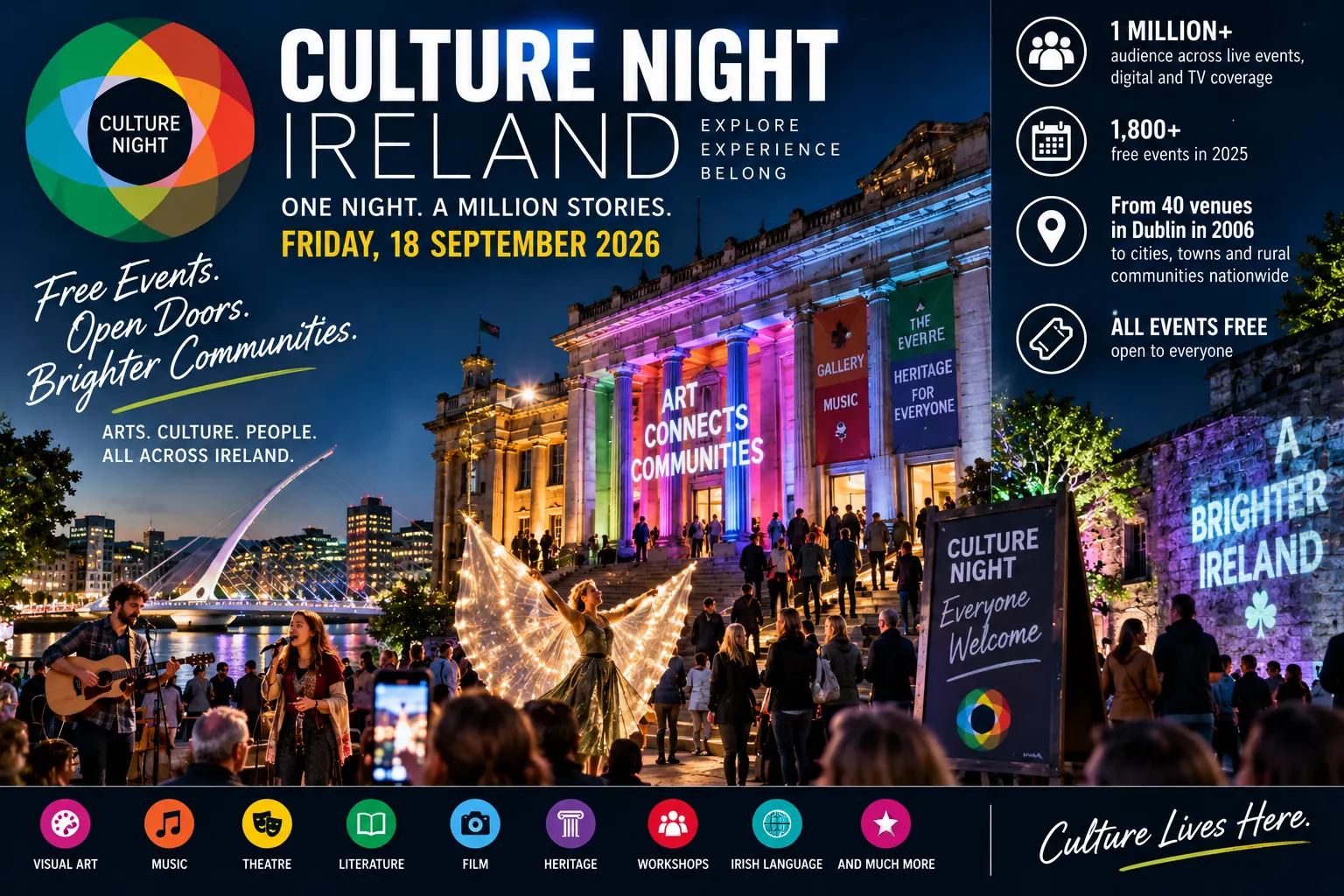
Twenty years ago, the idea was remarkably simple: persuade cultural venues to stay open late, remove the admission charge and invite people to explore places they might otherwise walk past. The first Culture Night in 2006 involved just 40 venues in Dublin. On Friday, 18 September 2026, its 21st edition will unfold through cities, towns, villages and rural communities across Ireland, encompassing music, theatre, dance, visual art, literature, film, heritage, workshops, Irish-language events, nightlife and activities in spaces not usually thought of as cultural venues.
The scale of the transformation is considerable. The Arts Council says Culture Night now reaches an audience of more than one million when live events, digital participation and television coverage are considered together. In 2023, 1,205,834 engagements were recorded around a programme of approximately 1,700 events. More than 1,800 free events ultimately took place during the 2025 edition, according to the organisers’ subsequent assessment. What began as a local initiative has become one of the most visible dates in Ireland’s cultural calendar.
Yet the numbers alone do not explain why it grew. Culture Night succeeded because it changed several conditions surrounding cultural participation at once. It removed ticket prices, extended opening hours, concentrated thousands of experiences into a single highly visible evening, encouraged people to move between venues, placed cultural activity into streets and unconventional spaces, and created a sense that entering a gallery, studio, theatre or heritage building required neither specialist knowledge nor a prior commitment to return.
That combination helps explain why the State continues to support an evening during which audiences largely pay nothing. Culture Night is not principally a subsidy for a free night out. Its broader public-policy purpose is to reduce barriers to cultural participation, introduce audiences to artists and venues, animate local places and create pathways towards engagement during the remaining 364 days of the year. The difficult question is how much of that ambition survives after Friday night becomes Saturday morning.
Culture Night 2026
- The 21st edition takes place on Friday, 18 September 2026.
- The first Culture Night in 2006 involved 40 participating Dublin venues.
- By 2007, 87 cultural institutions were participating across Dublin.
- More than 1,800 free events took place during the 2025 edition.
- The latest Arts Council review describes Culture Night as attracting an audience of more than one million across live, digital and television activity.
- All official Culture Night events are free to the public.
The Original Idea Was About Opening Doors
Culture Night emerged from Temple Bar Cultural Trust and Dublin City Council at a time when a significant concentration of cultural institutions existed in central Dublin but many people had little reason to enter them. Museums, galleries, studios and arts organisations might have been publicly visible, yet cultural participation could still carry financial, practical and psychological barriers. A venue can be physically open and nevertheless feel closed to somebody who does not know what happens inside, what it costs or whether they will feel comfortable there.
The 2006 experiment attempted to change that atmosphere. Forty venues opened free and late, turning cultural institutions from individual destinations into part of a shared evening. The attraction was not simply that admission cost nothing. Visitors could wander, sample several experiences and make decisions spontaneously. The event therefore lowered what might be called the risk of cultural discovery: if an unfamiliar exhibition, performance or building did not appeal, the visitor had lost neither a substantial ticket price nor an entire evening.
Growth followed quickly. In 2007 Culture Night expanded across Dublin, with 87 cultural institutions participating. Cork, Galway, Limerick and Waterford joined in 2008. By 2009, ten participating locations included Tralee, Roscommon, Mayo, Wexford, Sligo and Belfast. In 2010 the network had expanded to 20 locations in the Republic, reaching places including Tory Island and Inis Meáin, Gaeltacht communities and, north of the border, both Belfast and Derry.
This expansion was more important than simply increasing the event count. It changed Culture Night from a Dublin cultural-marketing initiative into a model that local authorities and cultural organisations could adapt to their own places. A successful national event did not require every county to reproduce Temple Bar. It required the opposite: local programming capable of reflecting the artists, traditions, institutions, communities and buildings already present there.
How Culture Night Expanded
| Year | Development |
|---|---|
| 2006 | 40 venues in Dublin |
| 2007 | 87 Dublin cultural institutions |
| 2008 | Cork, Galway, Limerick and Waterford join |
| 2009 | Ten participating locations |
| 2010 | 20 locations across the Republic, plus Belfast and Derry |
| 2015 | About 1,500 events |
| 2016 | Approximately 3,000 events across 40 towns, cities and regions |
| 2019 | Responsibility transferred to the Arts Council |
| 2026 | 21st edition delivered nationwide |
Sources: Culture Night and the Arts Council.
Local Authorities Turned a Dublin Idea Into National Infrastructure
The organisational model was central to Culture Night’s growth. Rather than attempting to programme every event from a national office, delivery developed through local authorities, arts offices, cultural organisations, individual venues, community groups and artists. National coordination provides a common date, identity and communications structure; local knowledge determines much of what audiences actually encounter.
This arrangement makes Culture Night unusually scalable. A national institution in Dublin can open its collection after hours while a library in a regional town hosts performances, a rural heritage centre provides tours, a community organisation stages an intercultural event and an independent artist runs a workshop. Their scale, audiences and artistic forms may be entirely different, yet they can all exist within the same national programme.
The Arts Council’s latest review describes the event’s development from an urban-focused initiative into a genuinely national programme reaching towns, villages and rural areas. That distinction matters because cultural participation in Ireland is geographically uneven. A national event concentrated overwhelmingly in the largest cities would produce impressive attendance figures without necessarily widening access in the places where cultural infrastructure is thinner.
Local authorities also provide continuity. Culture Night takes place for only one evening, but county and city arts offices work throughout the year with many of the organisations involved. The event can therefore draw on relationships, venues and artistic networks that already exist rather than constructing a temporary festival organisation from scratch each September.
2019 Marked a Change in Who Was Responsible for the Event
A significant institutional shift came in 2019 when central government transferred responsibility for Culture Night to the Arts Council. The change placed the event within the organisation responsible for developing and funding the arts nationally while retaining the partnership with local authorities and cultural organisations.
The timing proved consequential. One year later the Covid-19 pandemic disrupted the very characteristic on which Culture Night had been built: people physically moving through shared cultural spaces. The 2020 edition became a hybrid of digital and in-person experiences, while RTÉ expanded broadcast programming across television, radio and online services.
Digital and broadcast participation did not replace the live event once restrictions ended, but it permanently widened the ways Culture Night could be experienced. Someone unable to travel, enter a crowded building or attend at a particular time could encounter parts of the programme from home. The 2026 event again includes an RTÉ presence across television, radio and online platforms.
This broader reach also requires care when interpreting attendance statistics. An audience figure that combines physical attendance, online interaction and television audiences is not equivalent to counting individual people walking through venue doors. The figure of more than one million demonstrates substantial public reach, but it should not be read automatically as more than one million distinct in-person Culture Night visitors.
Free Admission Removes One Barrier — Not Every Barrier
The principle that Culture Night events should be free has remained remarkably consistent throughout its development. The logic is easy to understand: ticket prices can discourage experimentation. People may be willing to spend €20, €40 or considerably more on an artist or performance they already know, while being much less willing to pay for something unfamiliar. Removing the price allows curiosity to replace purchasing risk.
Recent national research helps explain why this matters. The Arts Council’s Arts Insight 2025 survey found that almost two-thirds of adults would like to participate more in creative activity, with time and cost among the principal practical constraints. At the same time, the research found continuing socioeconomic and geographical inequalities in arts attendance. Highly engaged cultural audiences account for a large proportion of attendance, meaning strong overall participation can coexist with groups who engage much less frequently.
Culture Night is therefore aimed partly at people who already value the arts and partly at those who normally do not enter cultural spaces. These are not the same audience-development problem. Regular theatre-goers may use the evening to try a new venue or artform; somebody with little previous engagement may need the event to overcome uncertainty about whether a cultural space is meant for them at all.
Free admission cannot solve every obstacle. Transport still costs money. Rural residents may live far from participating venues. Parents may need childcare. A building may not be fully accessible. Popular events can require advance booking and reach capacity quickly. Some people work on Friday evenings, while others may feel that particular cultural institutions remain socially unfamiliar even when the ticket price is zero.
This is why the success of Culture Night should not be evaluated simply by asking whether a free event attracts a crowd. The stronger test is whether it reaches people who would otherwise participate less, whether they feel welcome and whether the experience gives them a realistic route back.
Who Actually Takes Part Is More Complicated Than the Slogan Suggests
The phrase used for Culture Night is deliberately expansive: One Night For All. The programme includes family events, heritage, traditional and contemporary music, visual art, dance, literature, film, crafts, performances, community activities, Irish-language culture and events created by communities representing Ireland’s increasing cultural diversity. Events can take place in museums and national institutions but also in libraries, public buildings, studios, streets, community spaces, pubs and other less formal locations.
That variety matters because cultural participation is not simply determined by income. Age, education, location, confidence, disability, cultural background, transport and previous exposure to the arts can all influence whether somebody attends. Arts Insight research has repeatedly shown that the Irish population cannot be treated as a uniform cultural audience.
The 2025 national Arts Insight findings are particularly interesting because young adults showed strong arts engagement and creative participation after earlier post-pandemic research had identified concerns about declining sentiment among younger people. Yet the same national evidence continues to identify inequality of participation. Culture Night’s large headline audience therefore should not be interpreted as proof that every demographic or community is reached equally.
The programme has responded by broadening both its locations and its definition of cultural activity. A visitor who feels little connection with conventional theatre or gallery programming may nevertheless be interested in street performance, hip-hop, fashion, architecture, craft, traditional music, storytelling, food heritage, community history or club culture. Broadening the entry points can make the event more inclusive without requiring every participant to share the same definition of art.
The Festival Atmosphere Is Part of the Policy
One of Culture Night’s less obvious strengths is concentration. Ireland has cultural events throughout the year, many of them free. What Culture Night adds is simultaneous visibility. When numerous venues remain open, streets are active and people move between events, individual organisations become part of something larger than their own programme.
This creates a festival atmosphere that changes behaviour. A person might rarely plan an evening around visiting several galleries but happily enter one while walking between a concert, a workshop and a heritage building. The distinction is important for audience development because discovery becomes social. Friends and families can try something unfamiliar together rather than making a formal commitment to a single institution.
The clustering effect is particularly visible in town and city centres. Culture Night can extend activity beyond normal retail hours, bring pedestrians into public spaces and create additional demand for cafés, restaurants, bars and transport. Participating businesses can themselves become venues, further blurring the boundary between a cultural institution and the wider town.
These effects are real in principle but difficult to quantify nationally. Culture Night does not publish a comprehensive annual measure of additional retail, hospitality or tourism spending attributable exclusively to the event. Claims about a precise national economic impact would therefore be stronger than the available evidence allows. A busy evening can support local commercial activity, but the amount varies considerably between Dublin city centre, a regional town, a suburban community and a rural event.
Culture Night Late Is Turning the Event Into a Night-Time Economy Experiment
The relationship between cultural activity and local economies has become more explicit through Culture Night Late. The programme developed from recommendations on Ireland’s night-time economy and extends selected events later into the evening, using music, performance, film, visual art, spoken word, dance, club culture and unconventional venues to test what a broader after-dark cultural offer can look like.
For 2026, more than €260,000 is supporting Culture Night Late events, funded through the Department of Culture, Communications and Sport’s Night-Time Economy initiative with additional Arts Council support. Dedicated activity includes Ireland’s nine night-time economy pilot locations: Buncrana, Longford, Sligo, Drogheda, Kilkenny, Galway, Limerick, Cork and Dublin.
The objective is wider than making Culture Night last a few additional hours. Irish night-time policy has long been concerned with diversifying evening activity beyond alcohol-led entertainment and using cultural venues, public buildings and public space later into the night. Culture Night provides a low-risk environment in which towns and cities can test those possibilities with unusually large public interest.
For artists and venues, later programming can introduce work to audiences that do not normally attend traditional evening performances. For local businesses, more people remaining in town centres later can increase demand. For public authorities, however, a successful late-night programme also exposes the infrastructure required to sustain it: late transport, public safety, licensing, toilets, lighting, accessibility and coordination all become part of cultural policy.
Free for the Audience Should Not Mean Unpaid for the Artist
There is an inherent tension in a free national cultural event. If audiences are not buying tickets, somebody else has to finance the creative work, production, staffing, technical requirements and venue costs. Treating free admission as meaning free labour would transfer the cost of public access directly onto artists.
Culture Night participation criteria therefore require organisers to follow the Arts Council’s Paying the Artist policy. Artists and cultural practitioners engaged professionally are expected to be paid unless they are participating voluntarily or as part of an appropriate community context. The principle is important because a national event intended to celebrate Ireland’s creative sector could otherwise damage the livelihoods of the people whose work attracts the audience.
That does not remove all financial pressure. Cultural organisations can face additional staffing, security, production and building costs when extending opening hours and presenting special events. Smaller organisations have less capacity to absorb those expenses than national institutions or large publicly funded venues. Participation can therefore be valuable for audience development while still presenting a genuine resource challenge.
Previous Arts Council research into Culture Night identified this tension and found that local authorities were already supplementing national funding with their own resources. The long-term sustainability of the event consequently depends not only on public enthusiasm but on whether artists, local authorities and participating organisations have sufficient funding and organisational capacity to continue delivering it.
For an Emerging Artist, One Busy Night Can Matter
Culture Night offers artists something public funding alone cannot guarantee: concentrated exposure. A performer, visual artist, craft worker, writer or community arts group can encounter people who did not deliberately seek them out. An independent venue can appear alongside nationally recognised institutions within the same programme and communications campaign.
The value is difficult to express as immediate income because audiences are not buying admission. The potential return lies instead in visibility, audience discovery, new professional relationships and future attendance. A person who hears a musician for the first time may follow their later work; somebody entering an independent gallery may return for another exhibition; a family attending a workshop may discover a local arts organisation they had not previously known existed.
Those outcomes are plausible, and venue-level research over the history of Culture Night has found substantial numbers of first-time visitors to participating locations. But exposure is not automatically converted into income or a sustainable career. An artist performing once to a large free audience does not necessarily gain paying audiences afterwards. The quality of follow-up therefore matters almost as much as the event itself.
For Venues, the Most Valuable Visitor May Be the Person Who Has Never Entered Before
The same principle applies to museums, galleries, theatres, libraries and arts centres. Regular audiences are valuable, but Culture Night’s strategic purpose is strongest when it reaches people who are not already customers or habitual visitors. An organisation that simply gives its existing audience a free version of what they normally buy has produced enjoyment, but limited audience development.
The format encourages institutions to behave differently. Buildings remain open later, special tours are offered, artists interact directly with audiences and programming often becomes more informal. Some spaces that can appear quiet or ceremonial during ordinary opening hours become crowded, noisy and social.
This can change perceptions of a venue. Cultural participation includes a psychological threshold: people are more likely to return somewhere once they understand where the entrance is, what the building feels like and how people behave inside it. Culture Night reduces that uncertainty.
But there is an obvious limitation. A venue that is approachable only on Culture Night has solved very little. If ticket prices, opening hours, transport, communication or social perceptions immediately return to being barriers the following week, the bridge from free discovery to regular participation may be weak.
The Local Impact Is Different Outside the Major Cities
Culture Night’s move into villages and rural communities changed its social function. In central Dublin, the challenge is often helping people navigate an abundance of cultural institutions. In a smaller town or rural area, the event may instead create a rare concentration of activity or bring professional and community work together in places with a much thinner permanent cultural infrastructure.
Libraries are particularly significant because they provide public buildings across the country that already carry a low barrier to entry. Heritage centres, community halls, local museums, studios and outdoor spaces can perform a similar role. Their participation means Culture Night does not depend entirely on purpose-built theatres or large arts centres.
The local approach also creates opportunities to foreground forms of culture that may receive less national media exposure. Irish-language activity, traditional skills, local history, minority cultures, amateur creativity and work developed through community organisations can appear alongside professionally produced contemporary arts. In that sense, the event does not merely distribute national culture geographically; it allows local places to define part of the programme themselves.
The economic effect can also be proportionally different. Several hundred additional people moving through a small town centre can be more visible to local cafés and hospitality businesses than the same number in central Dublin. Conversely, limited public transport and smaller venue capacity can restrict participation. A nationwide programme therefore does not create identical outcomes nationwide.
Culture Night Has Also Changed With Ireland
The Ireland in which Culture Night began in 2006 was demographically different from Ireland in 2026. Population growth and migration have made the country more diverse, while younger generations encounter culture through an increasingly fragmented mix of physical venues, streaming platforms, social media, gaming, design, nightlife and participatory creative activity.
A national cultural event cannot respond to that change simply by placing more traditional exhibitions on the programme. The range of participating artforms and organisations has consequently widened. Intercultural storytelling, African music and dance, contemporary club culture, fashion, digital art, workshops and community-based events sit alongside orchestral music, heritage tours, literature, theatre and visual art.
This is more than a programming decision. It touches on the question of who feels represented by publicly supported culture. If Culture Night is intended to convey that culture belongs to everyone, the programme has to reflect contemporary Ireland as well as its inherited artistic traditions.
Representation alone, however, does not guarantee participation. Communications channels differ substantially by age. Arts Insight 2025 found that older audiences remain more closely connected to television and radio, while younger audiences increasingly receive information online through very different platforms. A single national advertising campaign will therefore struggle to reach every potential audience equally well.
More Than One Million Is an Impressive Number — but It Is Not the Only Number That Matters
Large events naturally emphasise scale. Culture Night has strong numbers to report: hundreds of thousands of people have engaged in individual years, more than one million engagements have been recorded when different channels are combined, and the programme now reaches every part of the country.
For public policy, however, participation quality matters alongside quantity. A person who already attends arts events every week is different from somebody entering a cultural venue for the first time. Five thousand visitors concentrated in one city-centre institution do not produce the same geographical access as smaller audiences distributed through dozens of communities. Watching a television broadcast is valuable cultural engagement but different from participating in a local workshop.
The latest review of Culture Night for the period to 2030 therefore matters because it shifts attention towards the future purpose of the event, not simply its annual size. The Arts Council’s challenge is to retain the qualities that made Culture Night popular — accessibility, discovery, celebration and local participation — while becoming more precise about whom it reaches and what happens afterwards.
What Culture Night Removes — and What Can Still Keep People Away
| Barrier | What Culture Night changes | What may remain |
|---|---|---|
| Ticket price | Official events are free | Travel, food and childcare costs |
| Unfamiliarity | Informal discovery is encouraged | Some venues may still feel unfamiliar |
| Opening hours | Venues open later | One evening cannot suit everyone |
| Geography | Nationwide local programming | Transport and uneven infrastructure |
| Information | National programme and promotion | Different groups use different media |
Analysis based on Arts Council Culture Night and Arts Insight research.
Can One Free Evening Really Create a Long-Term Cultural Audience?
This is the central question behind Culture Night’s success, and the evidence requires a more cautious answer than the attendance figures might suggest. There is good evidence that the format encourages discovery. Over the years, participating venues have reported high levels of first-time visitors, and Culture Night research has repeatedly identified new audiences and new experiences as core strengths of the programme.
It is much harder to prove that one evening directly changes cultural behaviour for years afterwards. Somebody may enjoy a free concert without ever buying a concert ticket. A first visit to a gallery may remain the only visit. Families who attend because the evening is free may face the same cost or scheduling barriers when normal programming resumes.
This does not make the intervention unsuccessful. Audience development often begins by removing the first obstacle rather than solving every subsequent one. A person cannot become a repeat visitor to a venue they have never entered, and Culture Night creates millions of opportunities for such first encounters across its history.
The strongest long-term model therefore treats Culture Night as an entrance rather than a destination. Venues can collect newsletter registrations where appropriate, advertise upcoming affordable events, promote regular free opening hours, offer follow-on workshops and make clear how visitors can return. Local authorities can use the night to identify demand for programmes that should exist more regularly.
Without that follow-up, Culture Night risks becoming an annual cultural exception: one evening when doors are open, prices disappear and institutions present themselves differently, followed by a return to normal barriers. With effective follow-up, it can operate as the largest audience-development campaign in the Irish cultural sector.
There Is a Tension Between Popularity and Discovery
Success itself creates another challenge. The better known Culture Night becomes, the easier it is for the event to attract people who already understand how to navigate cultural programmes. Popular performances can fill rapidly, and advance booking may be required. Experienced cultural audiences are often better equipped to discover limited-capacity events and secure places quickly.
That can work against the ambition of reaching people with less previous engagement. A completely open event can produce queues and uncertainty; a booked event provides order but may favour people who monitor programme announcements. Organisers therefore have to balance spontaneity with capacity management.
Public-space events, drop-in activities and programming spread across a town can help because they preserve the possibility of accidental discovery. A visitor does not need to plan every part of the evening. This quality of wandering was present in the original Dublin concept and remains one of the features that distinguishes Culture Night from a conventional ticketed festival.
The Future May Be Less About Making Culture Night Bigger
After two decades of expansion, there is a reasonable question about whether event numbers should remain the principal measure of progress. Culture Night has already achieved national scale. Simply adding another hundred events may produce less public value than improving access, geographical balance, artist remuneration, transport, disability inclusion or follow-up engagement around the programme already being delivered.
The latest Arts Council review, intended to inform the period from 2026 to 2030, arrives at an appropriate point. Culture Night no longer needs to prove that the public is interested. Its nationwide reach and audience scale have established that. The next stage is to determine whether participation becomes broader, deeper and more sustainable.
That may involve stronger data on who attends, distinguishing repeat participants from first-time visitors and separating physical attendance from digital and broadcast reach. It may also require more systematic follow-up research months after the event rather than relying mainly on immediate satisfaction surveys. The question is not simply whether somebody enjoyed Culture Night but whether anything in their cultural behaviour subsequently changed.
Regional data will also matter. A national total can conceal communities with very high participation and others with limited programming. If public investment is intended to broaden cultural access, the distribution of opportunities is as important as the overall audience.
The State Is Buying Access, Visibility and Public Space — Not Just Entertainment
The rationale for public investment becomes clearer when Culture Night is viewed in this wider way. Government support allows admission to remain free while artists can still be paid. Local-authority involvement distributes cultural activity geographically. National promotion gives smaller organisations visibility they could not purchase independently. Late-night investment tests how culture can contribute to more active towns and cities after conventional opening hours.
There is also a civic dimension that is difficult to measure financially. Museums, libraries, historic buildings, galleries and public spaces are part of the physical fabric of communities, yet many residents may rarely enter them. Culture Night temporarily changes the relationship between those buildings and the public by emphasising invitation rather than transaction.
That can strengthen a sense of local ownership. A cultural institution supported by public money has a stronger social argument when people from different backgrounds can see themselves using it. Culture Night provides an unusually visible opportunity for institutions to demonstrate that public purpose.
This is why the event’s value should not be assessed solely by comparing government expenditure with ticket income that would otherwise have been collected. The intended return includes participation, discovery, support for artists, local activity, cultural visibility and the use of public spaces. Some of those benefits are economic; others are social and civic.
18 September Will Be the Easy Part
Culture Night 2026 is likely to look very different from the 2006 experiment that started with 40 Dublin venues. The National Concert Hall will host the National Symphony Orchestra Ireland, libraries and heritage locations will open late, community organisations will present local work, and Culture Night Late will extend activity in towns and cities well beyond conventional cultural hours. Broadcast programming will take part of the event into homes that never reach a venue.
Its transformation into a national occasion is therefore no longer in doubt. The more interesting question concerns what Culture Night has become a gateway to. Ireland does not lack evidence of public interest in creativity: the Arts Council’s latest national research finds substantial appetite for greater participation. The persistent problem is converting that interest into accessible opportunities across different incomes, places and stages of life.
A free evening can remove cost, uncertainty and habit for a few hours. It can introduce an artist, reveal a building, animate a town centre or persuade someone that an artform they had dismissed is worth another look. Those are meaningful effects, but they become durable only if the cultural system beyond Culture Night remains capable of welcoming that person back.
The achievement of the past two decades is that an initiative involving 40 venues became a shared national date. The challenge for the next decade is subtler. Culture Night no longer has to convince Ireland to turn up for one evening in September. It has to help ensure that more of the people who turn up discover a reason — and a practical way — to return.
Sources
Culture Night — About and History of Culture Night
Arts Council — Culture Night 2026 Returns Friday 18 September
Arts Council — Culture Night 2026 Open Call and Future Review
Culture Night — Informing the Future of Culture Night 2026–2030
Arts Council — Culture Night Flagship Programme
Arts Council — Culture Night Late 2026 Funding and Programme
Arts Council and Ipsos — Arts Insight 2025: The National Arts Engagement Survey
Culture Night — Event and Venue Participation Criteria
Dublin City Council Arts Office — Culture Night Dublin
Department of Culture, Communications and Sport — Night-Time Economy Taskforce
Source & Transparency
This article is published by Ireland Newspaper for editorial and informational purposes.
Published: 4 September 2026 · Updated: 4 September 2026

Newsroom Ireland Newspaper
Ireland Newspaper editorial team prepares daily news coverage for readers in Ireland and abroad.