Ireland’s Political Landscape in 2026: What the Main Parties Stand For
Ireland’s political system is no longer dominated by two parties in the way it once was. Fianna Fáil and Fine Gael remain central to government, Sinn Féin leads the main opposition bloc, while the Social Democrats, Labour, Independent Ireland, Aontú, People Before Profit–Solidarity, the Greens, 100% Redress and a substantial group of independents give voters an unusually broad range of political choices.
Ireland’s political landscape can be difficult to understand from outside the country.
There is no simple Irish equivalent of the familiar two-party contests found in Britain or the United States.
Economic policy does not always divide parties neatly into left and right.
Positions on Irish unity, neutrality, agriculture, housing, immigration and social policy can cut across conventional ideological categories.
And because Ireland uses proportional representation with the Single Transferable Vote, voters rank candidates rather than simply placing one cross beside one party. Transfers between candidates can decide the final seats, while independents continue to play a much larger role than in most European national parliaments.
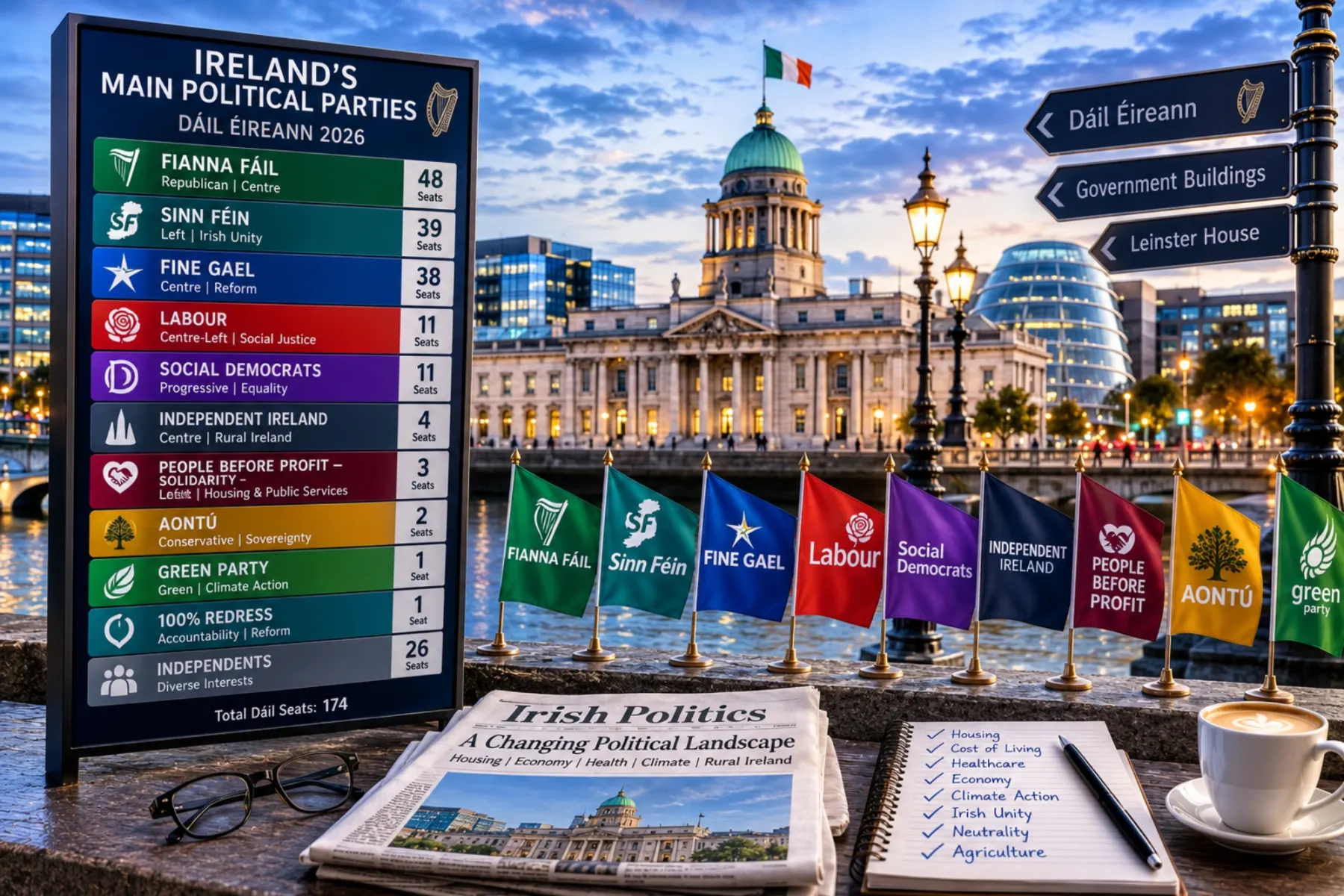
The most recent general election took place on 29 November 2024 and elected the 174 members of the 34th Dáil across 43 constituencies. Fianna Fáil emerged as the largest party with 48 seats, followed by Sinn Féin with 39 and Fine Gael with 38. Labour and the Social Democrats each won 11 seats, Independent Ireland four, People Before Profit–Solidarity three, Aontú two, the Green Party one and the 100% Redress Party one, alongside a substantial independent bloc.
The composition subsequently changed slightly. Two by-elections were held on 22 May 2026 after vacancies arose in Dublin Central and Galway West. Fine Gael won Galway West while the Social Democrats captured Dublin Central, meaning the Social Democrats increased their parliamentary strength while Fine Gael effectively replaced the seat it had lost in Dublin with the former independent seat in Galway.
Ireland’s current government was formed in January 2025 around Fianna Fáil and Fine Gael, with support and participation from independent TDs following negotiations involving the Regional Independent Group. The parties agreed the Programme for Government entitled Securing Ireland’s Future.
But government and opposition do not tell the whole story.
The modern Irish party system is increasingly fragmented, and the differences between the parties are becoming easier to understand when viewed through the questions they answer differently:
How much should the State build directly?
How much tax should people and companies pay?
How quickly should Ireland move on climate policy?
How should migration be managed?
How large should the public health and childcare systems become?
What role should private providers have?
How strongly should Ireland maintain military neutrality?
And how actively should the State prepare for possible Irish reunification?
Those questions explain far more about contemporary Irish politics than the traditional labels alone.
Why Fianna Fáil and Fine Gael Still Dominate the Centre
For most of the history of the Irish State, politics revolved around Fianna Fáil and Fine Gael.
Their origins lie partly in the political divisions that emerged after independence and the Civil War rather than in a conventional twentieth-century European contest between socialism and conservatism.
That history produced an unusual political system.
Both parties developed broad electoral coalitions.
Both have represented farmers, employees, business owners, professionals and middle-income households.
Both support Ireland’s membership of the European Union.
Both broadly support foreign direct investment and the country’s open economic model.
Both support substantial public expenditure on health, housing, education and infrastructure while placing importance on maintaining sustainable public finances.
Their differences are real, but they are often differences of emphasis rather than completely opposing visions of the State.
The decision by Fianna Fáil and Fine Gael to govern together from 2020, and again following the 2024 election, made that overlap more visible than ever before.
Fianna Fáil — Public Services, Housing, Families and a Broad Republican Tradition
Fianna Fáil remains the largest parliamentary party in the current Dáil.
Its 2024 election platform, Moving Forward. Together, placed housing, healthcare, the cost of living, education, economic stability and public services at the centre of its programme.
The party describes itself through a republican tradition, but in contemporary economic policy it occupies a broad centre ground rather than advocating a revolutionary restructuring of the economy.
Housing
Fianna Fáil supports substantially increasing overall housing construction while expanding social and affordable housing and maintaining assistance for first-time buyers.
Its approach relies on a mixture of private-sector construction, local-authority and approved-housing-body delivery, State investment and purchaser supports.
The party has repeatedly identified housing as one of the defining challenges facing Ireland and argues that higher overall supply has to remain central to resolving affordability pressures.
Health
Healthcare is another major Fianna Fáil priority.
Its election programme proposed significant additional health investment, more beds and healthcare professionals, expansion of primary care and additional GPs.
The party also proposed widening access to free GP care for children and continuing investment in cancer services, women’s health and diagnostics.
Childcare and families
Fianna Fáil has emphasised reducing childcare costs while expanding available places and supporting childcare workers.
Its 2024 programme proposed moving towards childcare fees of approximately €200 per month for families while also increasing social-protection supports and pensions.
Economy and taxation
The party supports Ireland’s existing open economic model, including foreign direct investment and strong links with the European Union, but combines this with public investment and targeted tax reductions.
It also favours retaining substantial fiscal reserves as protection against future economic shocks.
Agriculture and rural Ireland
Fianna Fáil traditionally maintains a significant rural and agricultural support base.
Its policies generally favour maintaining viable family farming, defending important agricultural interests within the European Union and providing investment in rural services and infrastructure.
Irish unity
Fianna Fáil has historically defined itself as a republican party and supports eventual Irish unity through democratic and peaceful means.
Its approach is generally more gradual and institutionally cautious than Sinn Féin’s, placing particular emphasis on the Good Friday Agreement, North-South cooperation and building consent.
Overall, Fianna Fáil’s offer to voters can be described as combining social investment and public services with economic continuity, home ownership, rural interests and a strong republican identity.
Fine Gael — Enterprise, Tax Reductions, Law and Order and Infrastructure
Fine Gael governs alongside Fianna Fáil but has a recognisably different emphasis.
Its latest general-election manifesto was built around four broad themes: children and families, housing and communities, a firmer approach to migration and criminal justice, and protecting the economy.
Fine Gael generally places somewhat greater emphasis than Fianna Fáil on enterprise, individual taxation, public-finance discipline, policing and economic competitiveness.
Housing
The party’s 2024 programme proposed facilitating 300,000 additional homes by 2030, backed by large-scale public infrastructure investment.
It supports social and affordable housing but also strongly emphasises increasing private housing supply and helping first-time purchasers.
Fine Gael proposed continued first-time-buyer support and an increase in the rent tax credit.
Taxation
One of Fine Gael’s clearest distinguishing themes is the idea that employees should retain more of their earnings.
Its manifesto proposed changes designed to prevent an average-income worker entering the higher income-tax rate and also proposed increasing inheritance-tax thresholds.
The underlying philosophy is that economic growth should fund better services while allowing reductions in the tax burden where public finances permit.
Business
Fine Gael strongly supports foreign direct investment while also arguing for greater assistance to Irish-owned companies trying to expand.
Its programme included targeted support for retail and hospitality businesses and measures aimed at helping indigenous companies scale internationally.
Crime and policing
Fine Gael traditionally places particularly strong emphasis on law and order.
Its 2024 manifesto proposed recruiting 6,000 additional Gardaí, expanding body-worn cameras and giving policing authorities additional tools to address crime and anti-social behaviour.
Immigration
The party advocates what it describes as a fair but firmer migration system.
That includes faster processing, stronger enforcement of immigration decisions and a system that distinguishes between legal migration, international protection and people without permission to remain.
Infrastructure and transport
Fine Gael proposed a dedicated infrastructure focus in government, arguing that planning and delivery delays are restricting housing, transport, energy and economic development.
Its programme also supports major road investment alongside public transport and retains the nationwide reduction in public-transport fares.
Agriculture
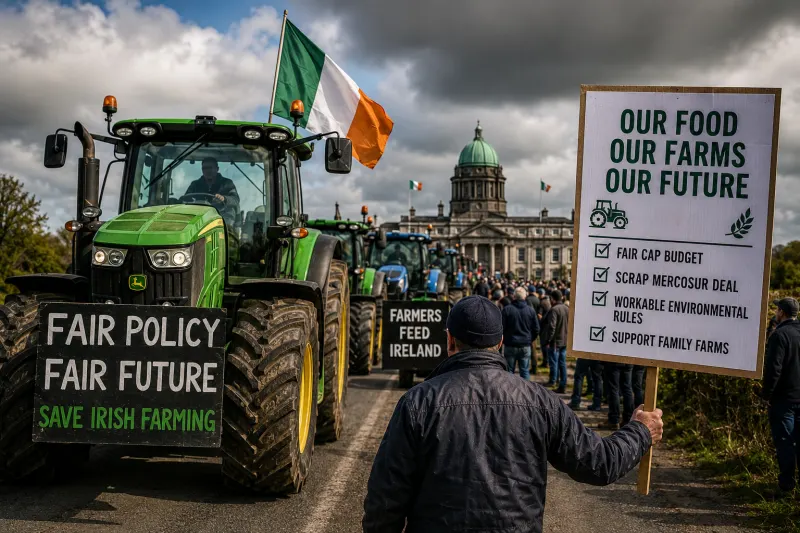
Fine Gael supports retaining Ireland’s nitrates derogation and has placed considerable emphasis on agricultural succession and the economic sustainability of family farming.
Fine Gael’s political proposition is therefore one of economic stability, enterprise, lower personal taxation where affordable, strong policing, housing supply and large-scale infrastructure delivery.
Sinn Féin — Housing, Public Services, Economic Redistribution and Irish Unity
Sinn Féin is the largest opposition party in the Dáil and remains one of the three dominant forces in Irish national politics.
Its economic programme is substantially more interventionist than that of Fianna Fáil or Fine Gael.
The party places housing, health, childcare and the cost of living at the centre of its agenda while combining these with its long-standing republican objective of a united Ireland.
Housing
Housing is arguably Sinn Féin’s strongest domestic policy theme.
The party proposes a far larger direct role for the State in housing construction and supports substantial programmes of social and affordable housing.
Its budget proposals have included delivering 300,000 homes over a government term, restricting rent increases and increasing State construction of affordable housing.
The distinction from the government parties is therefore not that Sinn Féin rejects private housing development.
It is that the party places considerably greater weight on direct State delivery and stronger market intervention.
Healthcare
Sinn Féin supports moving towards a comprehensive publicly funded healthcare system based on the principles of Sláintecare.
Its programme includes expanding hospital and community capacity, increasing recruitment, improving mental-health provision and reducing direct charges faced by patients.
Childcare
The party’s best-known childcare proposal is a maximum cost of €10 per day per child.
It also advocates extending parental support so that families have greater ability to care for children during the first year of life.
Tax and cost of living
Sinn Féin generally argues for greater tax reductions for low- and middle-income workers combined with increased taxation in selected areas of wealth and higher income.
Its programme has included reducing the Universal Social Charge burden on workers while directing more State resources towards housing and public services.
Workers’ rights
The party supports stronger collective bargaining, trade-union rights and employment protections.
Neutrality
Sinn Féin strongly supports maintaining Ireland’s military neutrality and has opposed proposals it considers likely to weaken existing neutrality protections.
Irish unity
This is the defining constitutional difference between Sinn Féin and most other large parties.
Sinn Féin wants the Irish Government actively to prepare for reunification.
It has proposed a Citizens’ Assembly, a government Minister responsible for reunification planning and referendums on Irish unity during this decade.
The party’s position is that reunification should be planned economically and institutionally before any referendum rather than discussed only after one is called.
Sinn Féin therefore offers voters a combination of economic intervention, expanded public provision and a much more active strategy towards constitutional change.
The Social Democrats — Public Services Before Large Tax Cuts
The Social Democrats have become one of the most significant smaller parties in Irish politics.
They won 11 seats in the 2024 general election and added another when Daniel Ennis won the Dublin Central by-election in May 2026.
Their programme is built around a distinctly social-democratic argument: Ireland has significant financial resources, but too little of that wealth is translated into affordable housing and high-quality universal public services.
Housing
The party proposes substantially expanding State-led housing.
Its 2024 manifesto set targets including 50,000 affordable-purchase homes, 25,000 affordable-rental homes and 70,000 social homes over the lifetime of a government.
It also supports stronger protections for tenants, restrictions on no-fault evictions and measures against illegal short-term letting.
Healthcare
The Social Democrats strongly support full implementation of Sláintecare and a more universal public-health system.
Their policies include greater primary-care capacity, salaried GP options and substantially increased mental-health expenditure.
Childcare
The party supports moving towards a publicly provided childcare model rather than relying predominantly on subsidies to private operators.
Disability
Disability policy is unusually prominent within the party’s programme.
Its 2024 election conditions included having a senior Minister for Disability, increasing disability-service funding and introducing a specific cost-of-disability payment.
Tax and spending
The Social Democrats generally argue against large reductions in Ireland’s overall tax base where those reductions would restrict investment in public services.
Their more recent budget proposals emphasise housing, healthcare, childcare, education and infrastructure rather than broad-based tax cuts.
Climate
The party advocates substantial investment in renewable electricity, particularly offshore wind, alongside public transport, retrofitting and green technology.
The Social Democrats therefore compete for many of the same voters as Labour and Sinn Féin but place particularly strong emphasis on universal public services, disability provision and evidence-based State investment.
Labour — Housing, Workers’ Rights and a Traditional Social-Democratic Model
Labour is one of Ireland’s oldest political parties.
Although no longer one of the two or three dominant national forces, it remains an established parliamentary party and won 11 seats in the 2024 general election.
Its programme combines public housing, workers’ rights, childcare, universal services and climate action.
Housing
Labour describes housing as a civil and workers’ rights issue.
Its election programme proposed an average of at least 50,000 new homes annually, supported by a State construction company and stronger national coordination of housing delivery.
This approach places greater emphasis on direct State participation in construction than the policies of Fianna Fáil and Fine Gael.
Workers
Labour remains closely associated with trade-union and employment-rights politics.
It supports stronger collective bargaining, improved employment conditions and measures intended to increase incomes and economic security for workers.
Healthcare
The party supports universal healthcare and proposed extending free GP care to all children.
Childcare
Labour advocates a much stronger public childcare system, with government and local authorities playing a larger role in providing early-years services.
Climate
Its climate programme combines decarbonisation with measures intended to reduce household expenditure.
The party supports large-scale home retrofitting, cheaper and more reliable public transport, and expansion of wind and solar energy.
Labour’s overall economic philosophy therefore remains recognisably European social democratic: a market economy combined with stronger public services, public investment and labour protections.
Green Party — Climate, Transport, Energy and Sustainable Communities
The Green Party suffered major electoral losses in 2024 after participating in government with Fianna Fáil and Fine Gael.
It retained one Dáil seat.
Its parliamentary size is therefore much smaller than during the previous government, but the party retains a clear and distinctive policy identity.
Climate action remains its defining priority.
Transport
The Greens support a major shift towards public transport, walking and cycling.
Their election programme proposed a €10 billion transport plan and continued reductions in the cost of public transport.
Energy
The party supports accelerated renewable-energy development, energy-efficiency improvements and reducing Ireland’s dependence on fossil fuels.
Housing
Green housing policy combines additional supply with energy efficiency, compact development, public transport and the idea that new homes should be accompanied by functioning communities rather than isolated housing estates.
Cost of living
The party increasingly presents climate policy partly through household economics: warmer homes with lower energy requirements, cheaper transport and reduced exposure to volatile fossil-fuel prices.
Nature and biodiversity
The Greens place more emphasis than most other parties on biodiversity restoration, water quality, habitat protection and land-use policy.
Social policy
Despite the environmental name, the party also supports expanded childcare, social housing and public-service investment.
The Green Party’s political challenge is therefore different from that of the larger parties.
Its distinctive argument is that housing, transport, energy and climate should not be treated as separate policy areas but as parts of the same long-term planning problem.
People Before Profit–Solidarity — Public Ownership and a Much Larger Economic Role for the State
People Before Profit–Solidarity represents the most clearly anti-capitalist parliamentary current in the Dáil.
Its platform calls for a substantially larger role for public ownership, extensive redistribution of wealth and major expansion of services provided free at the point of use.
Housing
The grouping advocates large-scale public and affordable housing, stronger rent controls and bringing vacant properties into use.
Tax
It proposes substantially higher taxation of wealth and high incomes to finance public services.
Healthcare and education
Its programme calls for public health and education services provided without direct charges to users.
Energy
People Before Profit supports bringing the energy system into public ownership while moving rapidly towards renewable electricity.
Transport
It advocates free, frequent public transport across the country.
Workers
The party places trade-union power, higher wages and workers’ rights at the centre of its economic programme.
Foreign policy and neutrality
People Before Profit strongly supports Irish neutrality, opposes military alignment and takes prominent positions on international human-rights questions, including support for Palestinian rights.
Its programme therefore represents a much deeper restructuring of Ireland’s existing economic model than those proposed by Labour, the Social Democrats or Sinn Féin.
Aontú — Economic Populism, Irish Unity and Social Conservatism
Aontú occupies a distinctive position in Irish politics because it combines policies that do not fit neatly onto one left-right line.
The party defines its principles around Life, Unity and Economic Justice.
Economically, many of its positions emphasise housing, public services, rural communities and the cost of living.
On several social and cultural questions, however, the party is considerably more conservative than most other parties represented in the Dáil.
Housing
Aontú advocates increasing housing supply, bringing vacant properties back into use and increasing State investment in housing.
Cost of living
The party gives significant attention to household costs and opposes taxes or charges that it believes place excessive burdens on families.
Healthcare
It argues for reducing hospital waiting lists, improving healthcare capacity and addressing regional inequality in services.
Agriculture
Aontú places strong emphasis on farmers and rural Ireland.
Its agricultural proposals have included fertiliser support and opposition to measures it believes would unnecessarily reduce Ireland’s cattle herd.
Immigration
Aontú supports a more restrictive and enforcement-focused immigration system.
Its current political campaigning places considerable emphasis on faster decisions, enforcement of return orders and closer control of immigration administration.
Social policy
Aontú’s strongest distinction from almost all other parliamentary parties is its socially conservative position on abortion.
This forms an important part of the party’s concept of the protection of life.
Irish unity
Aontú is an all-Ireland republican party and supports Irish reunification.
Its unusual political combination is therefore economically interventionist in several areas, strongly republican on the constitutional question and socially conservative on issues where most of Ireland’s larger parties have moved in a more socially liberal direction.
Independent Ireland — Rural Interests, Immigration, Planning and ‘Common Sense’ Politics
Independent Ireland is one of the newest significant parties in the Dáil.
It won four seats in the 2024 general election and also secured representation in the European Parliament.
The party presents itself as an alternative to both the traditional establishment parties and the larger left-wing opposition parties.
Its programme places particular weight on rural Ireland, agriculture, fisheries, immigration, taxation and government accountability.
Agriculture and rural Ireland
This is one of Independent Ireland’s clearest priorities.
The party argues that national policy is too heavily centred on Dublin and that farmers, fishers and rural communities need greater influence over decisions.
Housing and planning
Independent Ireland supports planning reform, accelerated housing delivery and measures including modular housing where appropriate.
It argues that bureaucracy and slow infrastructure delivery contribute substantially to housing shortages.
Immigration
The party advocates tighter management of immigration and international protection, with greater consideration given to the capacity of housing and local public services.
Cost of government
Independent Ireland places strong emphasis on government expenditure and argues that money should be redirected from waste or unnecessary administration towards health, housing and household cost pressures.
Climate
The party does not reject environmental protection but is strongly critical of climate measures it believes disproportionately affect agriculture and rural communities.
Neutrality
Independent Ireland supports the traditional concept of Irish military neutrality.
Politically, the party is attempting to occupy a space based on rural representation, economic pragmatism, immigration control and scepticism towards what it considers excessive central bureaucracy.
100% Redress — A Regional Movement That Reached the National Parliament
The 100% Redress Party emerged from one of Ireland’s most serious regional housing problems: homes damaged by defective concrete blocks, particularly in Donegal.
The party won a Dáil seat in Donegal in the 2024 general election, with Charles Ward representing it in the 34th Dáil.
Its central demand remains straightforward.
Homeowners whose properties have been damaged by defective concrete products should receive full end-to-end compensation sufficient to remediate or rebuild their homes.
The party’s election programme placed the defective-block issue at the centre of its political identity while also developing positions on housing, health, business and regional development.
Its success demonstrates something particularly Irish about the electoral system.
A regional issue can develop into an organised political movement, win substantial local support and ultimately gain representation in the national parliament.
Independents — Not a Party, but a Major Political Force
Any overview of Irish politics that discusses only political parties misses a crucial part of the system.
Independent politicians remain unusually important.
They do not share one manifesto.
Some are economically conservative.
Others are socially liberal.
Some focus overwhelmingly on local infrastructure.
Others campaign on rural affairs, disability, housing, neutrality or healthcare.
Several independents participated in negotiations to support the government formed in 2025.
This influence reflects Ireland’s electoral structure.
PR-STV elections take place in multi-seat constituencies.
Voters frequently choose individual candidates partly on their record of constituency work rather than solely on national party programmes.
That creates political space for well-established local candidates to win Dáil seats without belonging to any party.
Independent politics is therefore not a temporary anomaly in Ireland.
It is a structural feature of the system.
The Irish Left Is Large — but Fragmented
One of the most important features of the current party landscape is the number of parties broadly competing for voters who want a stronger State role in housing and public services.
Sinn Féin.
Labour.
The Social Democrats.
People Before Profit–Solidarity.
The Green Party on many social and economic questions.
They agree on several broad ideas.
Ireland needs substantially more social and affordable housing.
Healthcare needs additional investment and reform.
Childcare costs are too high.
Workers and families require stronger economic security.
But they differ significantly in method.
Sinn Féin combines economic intervention with republican constitutional politics.
The Social Democrats emphasise high-quality universal public services and State capacity.
Labour brings a traditional labour-movement and social-democratic approach.
People Before Profit advocates much greater public ownership and redistribution.
The Greens place climate and sustainability at the centre of economic planning.
Those differences make the idea of a single homogeneous Irish left misleading.
There is considerable overlap.
There is also considerable competition.
Fianna Fáil and Fine Gael Are Similar — but Not Identical
The same caution applies when discussing the two government parties.
Fianna Fáil and Fine Gael now govern together, and their economic programmes overlap substantially.
Both support private enterprise.
Both support EU membership.
Both support foreign investment.
Both want higher housing construction.
Both support substantial investment in public services.
But differences remain.
Fine Gael tends to place greater rhetorical and policy emphasis on lower personal taxation, law and order, business competitiveness and fiscal discipline.
Fianna Fáil traditionally presents itself through a broader republican and community-oriented tradition and tends to place somewhat greater emphasis on public-service expansion and regional and rural interests.
Those differences are less dramatic than the divide between centre-right and socialist parties in many European countries.
They nevertheless matter when budgets and policies are negotiated.
Housing Is the Issue Almost Every Party Claims as a Priority
One of the most remarkable characteristics of Irish politics in 2026 is how little disagreement exists over whether housing is a major problem.
The disagreement concerns the solution.
Fianna Fáil and Fine Gael emphasise increasing total supply through a mixture of public and private construction while retaining supports for purchasers.
Sinn Féin wants substantially greater direct State construction and stronger controls in the rental market.
Labour proposes a State construction company.
The Social Democrats favour large-scale public affordable housing and stronger tenant protections.
People Before Profit wants an even larger public-housing sector and much tighter intervention in private property markets.
Aontú emphasises vacancy, State construction and cost.
Independent Ireland places particular focus on planning reform and faster delivery.
The Greens emphasise sustainable housing integrated with transport and energy infrastructure.
The political argument is therefore no longer whether Ireland should build more.
It is who should build, who should own, how much the State should intervene and how the homes should be financed.
Immigration Has Become a Much More Important Political Divide
Immigration has moved rapidly up Ireland’s political agenda.
Ireland’s strong economy, population growth, labour demand and international-protection pressures have turned a subject that once occupied relatively little space in general elections into a significant dividing line.
Fine Gael advocates a fair but firmer system.
Fianna Fáil supports controlled migration with more efficient administration.
Sinn Féin argues for faster and better-resourced processing while combining migration management with opposition to racism.
Aontú and Independent Ireland favour significantly stronger enforcement and place more emphasis on the capacity of communities, housing and services.
Labour, the Social Democrats, Greens and People Before Profit generally place greater emphasis on rights, integration and humanitarian responsibilities, although none argues for an immigration system without rules.
Future elections are likely to make these differences increasingly visible.
Climate Policy Is Moving from a Scientific Question to an Economic One
There is also broad parliamentary acceptance that climate change requires action.
The political divide increasingly concerns how quickly action should happen, how much it should cost and who should carry the burden.
The Greens advocate the strongest and most comprehensive acceleration of decarbonisation.
Labour and the Social Democrats support ambitious climate investment combined with social protections.
Sinn Féin supports climate targets but emphasises a just transition and affordability.
Fianna Fáil and Fine Gael support the national climate framework while placing considerable emphasis on economic competitiveness and agricultural viability.
Independent Ireland and Aontú are more critical of climate policies that they believe impose disproportionate costs on farmers, motorists and rural communities.
People Before Profit supports rapid decarbonisation but proposes achieving it through extensive public ownership rather than primarily through market incentives.
This makes climate policy one of the clearest examples of a subject where parties can agree on the problem but disagree fundamentally on the economic mechanism.
Irish Neutrality Could Become a Bigger Political Question
Ireland’s traditional policy of military neutrality also cuts across the normal party spectrum.
Sinn Féin, Labour, People Before Profit, Aontú and Independent Ireland all place significant importance on maintaining neutrality, although their wider foreign-policy positions differ.
Fianna Fáil and Fine Gael also state support for Ireland’s non-membership of military alliances but have generally favoured deeper European security cooperation and reform of some mechanisms governing overseas Defence Forces deployments.
The debate is becoming more important because European security has changed significantly since Russia’s invasion of Ukraine.
Ireland will therefore have to continue answering a difficult question:
How can a militarily non-aligned country participate in European security while preserving the form of neutrality its population expects?
There is no single parliamentary answer.
Irish Unity Is Supported in Principle by Much of Politics — but the Timetable Divides Them
Another unusual feature of the Irish political system is that support for eventual reunification is not confined to Sinn Féin.
Fianna Fáil has a republican tradition.
Aontú openly supports unity.
Labour and other parties support the Good Friday Agreement and the democratic mechanisms it provides for constitutional change.
Fine Gael supports closer North-South relations and the constitutional framework established by the Agreement.
The major divide is therefore not simply unity versus partition.
It is urgency.
Sinn Féin wants active preparation and referendums within this decade.
Other parties generally argue that the conditions for a referendum, including sustained consent in Northern Ireland, need to develop first.
The constitutional debate could therefore become much more prominent if opinion in Northern Ireland shifts.
Ireland Has More Political Choice Than the Dáil Alone Suggests
The parties described here are those currently represented in Dáil Éireann.
They are not the complete legal register of political parties in Ireland.
The Electoral Commission maintains the official Register of Political Parties, which also contains parties entitled to contest various elections even though they currently have no TDs. The register can change as parties are created, reorganised or removed.
This distinction matters.
A party can exist nationally without winning a Dáil seat.
It can win local-council representation.
It can contest European elections.
And Ireland’s proportional electoral system occasionally allows movements that begin at local level to become national parliamentary forces relatively quickly.
Independent Ireland and 100% Redress are recent examples of how the party system can evolve.
Ireland Is No Longer a Two-Party Political System
The most important development in Irish politics is therefore not the rise or fall of one individual party.
It is structural.
Fianna Fáil and Fine Gael remain extremely important.
Together they continue to possess the largest bloc of parliamentary seats and form the core of the current Government.
But the electorate has become more fragmented.
Sinn Féin has established itself as a major national alternative.
The Social Democrats have expanded.
Labour remains an established parliamentary force.
Newer parties such as Independent Ireland and Aontú have created political space outside the traditional blocs.
People Before Profit maintains a radical-left presence.
The Green Party retains a distinctive environmental voice despite its electoral losses.
100% Redress demonstrates the power of regional political mobilisation.
And independents remain capable of influencing government formation.
Ireland’s voting system reinforces this diversity because voters can support one candidate while transferring subsequent preferences to candidates from completely different parties.
That makes Irish politics less binary than the politics of many comparable countries.
For Voters, the Differences Are Becoming Clearer
The Irish party landscape can appear confusing because almost every party promises more housing, better healthcare and lower living costs.
Those broad objectives are not where the real differences lie.
The differences appear when the next question is asked.
Should housing primarily be delivered by private builders with State support, or should the State itself become a much larger developer?
Should Ireland reduce income taxes or preserve more revenue for universal public services?
Should rent controls become stronger?
Should childcare ultimately become a public service?
Should energy infrastructure be publicly owned?
How strict should immigration enforcement become?
How quickly should agricultural emissions fall?
How much should neutrality constrain European security cooperation?
How soon should the Government actively prepare for an Irish unity referendum?
Those are genuine policy choices.
And the answers vary substantially between the parties.
Fianna Fáil offers a broad republican-centrist approach centred on public services, housing delivery and economic continuity.
Fine Gael places greater weight on enterprise, taxation, security, infrastructure and competitiveness.
Sinn Féin combines a much larger State role in housing and services with an active programme for Irish reunification.
The Social Democrats prioritise universal public services, public housing, childcare and disability provision.
Labour represents a traditional social-democratic emphasis on workers, housing and public services.
The Greens place climate, transport, renewable energy and sustainable development at the centre of policy.
People Before Profit–Solidarity proposes a much more fundamental redistribution of wealth and expansion of public ownership.
Aontú combines economic intervention and Irish republicanism with socially conservative policies and a restrictive approach to immigration.
Independent Ireland emphasises rural communities, agriculture, immigration control, planning reform and government accountability.
100% Redress emerged primarily to represent households affected by defective concrete blocks.
And independents offer voters a political route focused much more heavily on individual representatives and constituency priorities than on a national party programme.
The Next Election Will Be About More Than Which Party Comes First
Under Ireland’s political system, winning the most seats does not automatically mean governing alone.
With 174 TDs and an increasingly fragmented electorate, single-party majority government has become extremely difficult.
Future governments are therefore likely to continue requiring coalitions, confidence agreements or independent support.
That makes transfers, relationships between parties and their willingness to govern together almost as important as their individual vote shares.
Ireland’s political landscape in 2026 is consequently more competitive, more fragmented and arguably more ideologically diverse than it was for much of the State’s history.
The old Fianna Fáil–Fine Gael rivalry has not disappeared.
It has been joined by a second political argument about how large the State should become, how public services should be financed, how migration should be managed, how quickly Ireland should transform its energy system and what kind of country a possible future united Ireland would be.
For voters, that creates complexity.
It also creates choice.
The defining question in modern Irish politics is increasingly no longer simply which party a voter identifies with.
It is which combination of economic management, public services, social policy, national identity and long-term vision they believe Ireland should pursue next.
Source & Transparency
This article is published by Ireland Newspaper for editorial and informational purposes.
Published: 10 August 2026 · Updated: 10 August 2026

Newsroom Ireland Newspaper
Ireland Newspaper editorial team prepares daily news coverage for readers in Ireland and abroad.