An explosive-laden drone discovered beside a Ukrainian cargo aircraft at Leipzig/Halle Airport has moved from a German criminal and intelligence investigation to the centre of European diplomacy. Germany now formally attributes the attempted 4 August attack to Russia, while Moscow categorically denies responsibility. Within hours of Berlin announcing its conclusion, EU foreign ministers gathering in County Wicklow were discussing sanctions, diplomatic measures and how Europe should respond when suspected hybrid operations move from cyberattacks and disinformation towards potentially lethal physical sabotage.
Ireland has become directly involved in that response. The Department of Foreign Affairs and Trade has ordered Russia’s ambassador in Dublin to attend a meeting with senior officials, while the European Union has separately summoned Russia’s most senior diplomatic representative in Brussels. Foreign Affairs Minister Helen McEntee has characterised the Leipzig incident as part of a broader attempt to divide European countries and weaken their support for Ukraine.
The timing gives the episode particular importance for Dublin. Ireland holds the Presidency of the Council of the European Union until the end of December and this week hosted EU defence and foreign ministers in Wicklow. The Presidency does not give Ireland unilateral authority over EU foreign policy or sanctions, and the Foreign Affairs Council itself is chaired by the EU High Representative rather than the rotating presidency. It does, however, give Ireland a substantial role in preparing negotiations, building consensus and moving agreed priorities through the Council machinery during one of the most difficult European security periods since the Cold War.
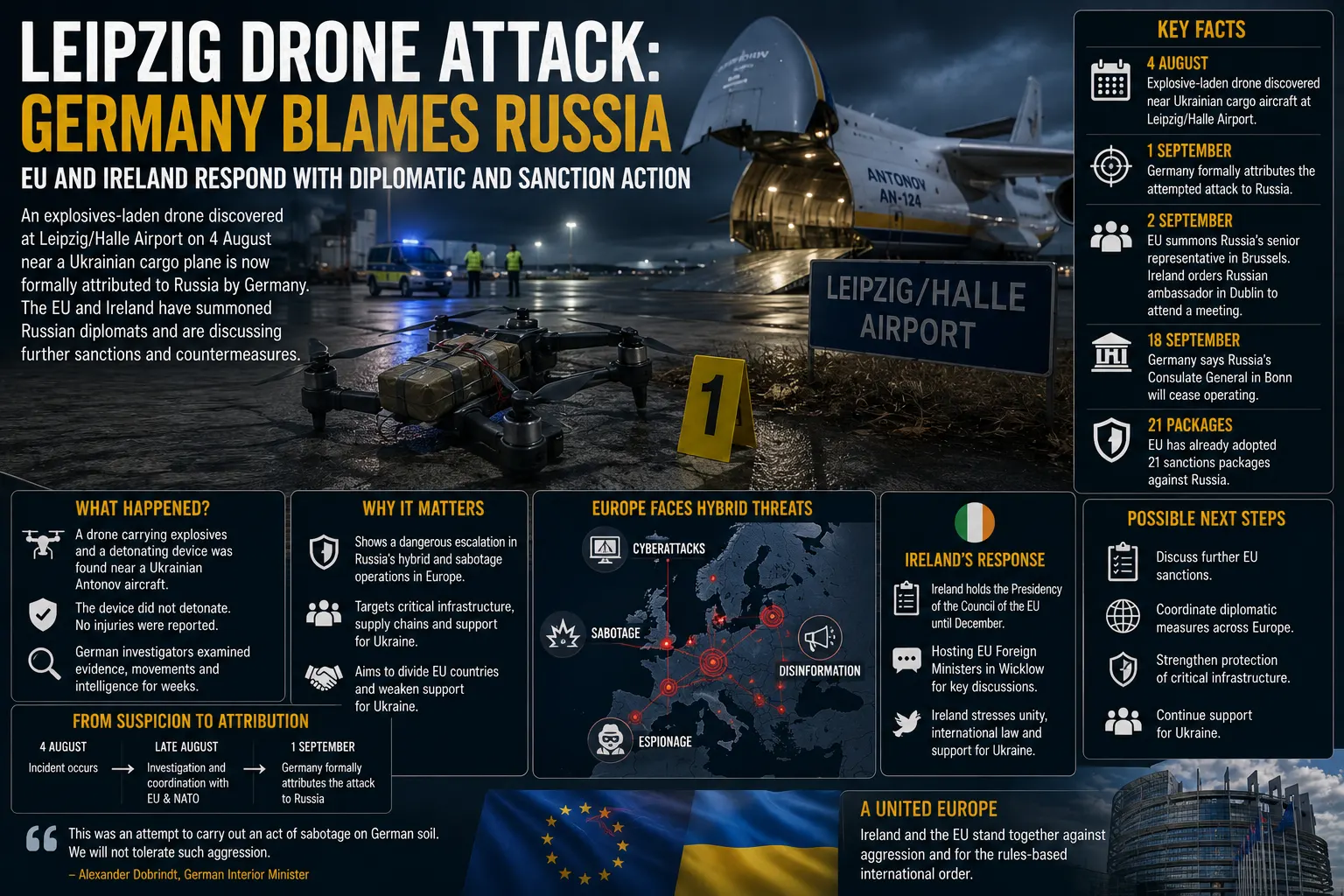
4 August: an explosives-equipped drone was discovered at Leipzig/Halle Airport near a Ukrainian Antonov cargo aircraft.
1 September: the German Government formally attributed responsibility for the attempted attack to Russia.
2 September: the EU summoned Russia’s senior representative in Brussels and Ireland ordered the Russian ambassador in Dublin to attend a meeting.
18 September: Germany says Russia’s Consulate General in Bonn will cease operating.
21 sanctions packages: the EU had already adopted its latest major economic package against Russia in July before the Leipzig attribution.
What Happened at Leipzig/Halle Airport
The incident took place on 4 August at Leipzig/Halle, one of Germany’s most important cargo airports. Workers discovered a drone carrying explosives and a detonating device near a Ukrainian Antonov aircraft. The device did not cause the intended explosion, and no loss of life was reported, but its location immediately raised the seriousness of the investigation.
Leipzig/Halle is not an ordinary regional airport. It is a major European freight centre, supports military logistics and hosts large Antonov An-124 cargo aircraft operated by the Ukrainian company Antonov Airlines. Such aircraft are used to transport unusually heavy and oversized cargo, including equipment connected with support for Ukraine.
German investigators spent several weeks examining the device, movements of suspected participants and intelligence information before the Federal Government made a public attribution. On 1 September, Interior Minister Alexander Dobrindt said police investigations, the pattern of the offence and intelligence findings collectively established German authorities’ assessment that the operation had been carried out on behalf of Russian state agencies.
That is a formal political and intelligence attribution by Germany, not a judicial conviction following a public criminal trial. Some underlying intelligence will by its nature remain classified, while investigations into individuals involved continue. Russia rejects Berlin’s conclusion entirely and says the accusation has been fabricated.
The Difference Between Suspicion and Attribution Matters
For almost a month, German officials were deliberately cautious about publicly naming a state sponsor. Chancellor Friedrich Merz said at the end of August that the investigation was being completed and that Germany was coordinating its response with EU and NATO partners. At that stage Berlin had described the event as a possible hybrid attack but had not formally identified Russia as responsible.
That changed on 1 September. The German Government said the available investigative and intelligence picture justified attribution to Russia. Foreign Minister Johann Wadephul placed the incident within what Germany describes as a longer pattern of destabilisation, sabotage, threats and hostile activity directed at European countries.
Public attribution is itself a significant step in international relations because it commits a government to a factual judgement about another state’s conduct. European governments have increasingly developed procedures for coordinating such judgements because hybrid operations are frequently designed to obscure who ordered them. Attackers may use intermediaries, criminal networks, foreign nationals or commercially available equipment rather than uniformed military personnel.
That ambiguity is one of the defining characteristics of hybrid activity. The target may suspect immediately which state benefits from an operation, but suspicion is not sufficient for responsible policy. Attribution requires evidence strong enough for governments to accept the diplomatic, economic and potentially security consequences of publicly naming another state.
Russia Denies the Allegation and the Diplomatic Dispute Is Escalating
Moscow has rejected Germany’s conclusion as baseless and politically motivated. Russia summoned Germany’s chargé d’affaires in Moscow on 2 September to protest what its Foreign Ministry described as anti-Russian measures and allegations. President Vladimir Putin has also criticised Berlin’s response and denied Russian responsibility.
Germany has announced several measures of its own. The Russian Consulate General in Bonn is to close from 18 September, personnel attached to it are required to leave the country, and Berlin has terminated the agreement governing the operation of the Russian House cultural institution in the German capital. German authorities are also tightening entry controls involving Russian nationals and seeking further EU-level listings against individuals connected with hybrid activity.
The dispute widened again on Thursday when Russia announced that branches of Germany’s Goethe-Institut in Moscow, St Petersburg and Yekaterinburg would be closed. That response transforms what began as a security investigation at an airport into another deterioration in the already severely weakened diplomatic and cultural relationship between Germany and Russia.
The sequence demonstrates one danger surrounding hybrid incidents. Even when governments deliberately avoid a military response, attribution can trigger escalating diplomatic measures, sanctions and retaliatory restrictions. Both sides can therefore increase pressure substantially without crossing into conventional armed confrontation.
How the Leipzig Dispute Escalated
| Date | Development | Status |
|---|---|---|
| 4 August | Explosive drone found at Leipzig/Halle | German investigation begins |
| 1 September | Germany attributes attack to Russia | Russia denies allegation |
| 2 September | EU and Ireland summon Russian representatives | Diplomatic response |
| 2 September | EU ministers discuss further sanctions | No new package agreed at informal meeting |
| 3 September | Russia announces Goethe-Institut closures | Retaliatory measure |
Source: German Federal Government, German Federal Foreign Office, European External Action Service, RTÉ and Reuters.
Why the EU Meeting in Wicklow Suddenly Became More Important
The attribution came immediately before EU foreign ministers met at Druids Glen in County Wicklow for their informal Gymnich meeting. The gathering had already been expected to focus heavily on Ukraine, European security and the Middle East. Leipzig moved rapidly to the top of the agenda.
EU High Representative Kaja Kallas said before the talks that the incident had the hallmarks of state-sponsored terrorism and that ministers needed to examine what additional measures could be taken. That description represents the political assessment of the EU’s senior foreign-policy official; it should not be confused with a separate judicial determination under criminal terrorism law.
Kallas also said further sanctions work linked to Russia’s military complex was already under way. German Foreign Minister Wadephul used the Wicklow gathering to press for additional EU listings, tighter restrictions involving Russian nationals and further action against the so-called shadow fleet used to move Russian energy exports around existing restrictions.
The meeting was informal, which matters procedurally. Gymnich meetings allow ministers to speak strategically and test possible compromises but do not normally adopt binding legal decisions. Any new EU sanctions must pass through formal Council procedures before taking effect.
Ireland Is Influential During the Presidency, but It Cannot Decide Sanctions Alone
Ireland’s Council Presidency gives it an important but sometimes misunderstood role. For six months, Irish ministers and officials chair many Council formations and working groups, organise agendas, seek compromises between member states and represent the Council in negotiations with other EU institutions. That creates substantial influence over the pace and organisation of European business.
Foreign and security policy is different in one important respect. The Foreign Affairs Council is chaired by Kaja Kallas as High Representative rather than by the Irish presidency. The Wicklow meeting was therefore hosted by Ireland and prepared in close cooperation with Kallas, while Ireland helped shape the discussion rather than acting as the EU’s foreign-policy executive.
Sanctions also remain a collective decision. EU sanctions regimes are adopted through the Council, and the central decisions require unanimity among member states. Ireland can build consensus, draft compromises and encourage progress, but it cannot independently impose an EU sanctions package or force another member state to accept one.
This makes diplomatic skill particularly important. Measures that appear straightforward politically can become difficult when 27 governments have different economic exposures, security priorities and domestic political pressures. The presidency’s value often lies precisely in finding language and legal arrangements that every government can accept.
Europe Is Not Starting From Zero on Russian Sanctions
The EU has already constructed an extensive sanctions system since Russia’s full-scale invasion of Ukraine in February 2022. The measures cover finance, energy, trade, technology, military goods, transport, individuals, companies and vessels. Separate regimes also target cyberattacks and destabilising hybrid activity.
The 21st major sanctions package was adopted on 23 July 2026. It added 48 individuals and 170 entities, expanded restrictions on Russian financial institutions and crypto services, tightened controls involving liquefied-natural-gas tankers and extended measures aimed at the shadow fleet. Another 41 vessels were brought under port-access and services restrictions.
That breadth creates a problem for policymakers considering a 22nd package or additional targeted measures: each successive round has to identify meaningful economic or operational pressure that has not already been imposed. Sanctions must also be enforceable. A prohibition that can easily be circumvented through companies, banks, ports or vessels in third countries may look significant on paper while having limited practical effect.
The current debate therefore appears likely to focus heavily on enforcement, additional individual and corporate listings, military supply chains, the shadow fleet and actors directly associated with hybrid operations. Germany has explicitly said it will propose new listings linked to such attacks.
Measures Already Available to the EU
| Instrument | Current use | Possible next step |
|---|---|---|
| Individual sanctions | Asset freezes and travel bans | New hybrid-attack listings |
| Energy measures | Oil and shadow-fleet restrictions | Tighter enforcement and more vessels |
| Financial sanctions | Bank and transaction restrictions | Additional institutions and intermediaries |
| Technology controls | Dual-use export restrictions | Wider military supply-chain controls |
| Diplomatic measures | National restrictions and expulsions | Further coordinated action possible |
Source: Council of the European Union and statements by EU and German officials.
Hybrid Warfare Is Designed to Create Exactly This Political Problem
The expression “hybrid threat” covers activity that combines different instruments of state power while attempting to remain below, or blur, the threshold of conventional military conflict. The EU includes sabotage, cyberattacks, interference with critical infrastructure, manipulation of information and attempts to undermine elections among the methods involved.
The concept is useful precisely because an adversary need not send tanks across a border to create strategic damage. A cyberattack can disrupt a hospital. Sabotage can interrupt electricity or transport. Interference campaigns can weaken trust in democratic institutions. A small explosive device at an airport can force governments to divert substantial security resources while creating fear disproportionate to the physical size of the weapon.
The ambiguity creates a dilemma for the target. Respond too weakly and further operations may appear low-cost. Respond too aggressively and an attacker may succeed in generating escalation between states. The European response has therefore generally combined criminal investigation, intelligence cooperation, infrastructure protection, sanctions and diplomatic measures rather than treating every hostile act as a conventional military attack.
The Leipzig incident is more serious because the alleged operation involved explosives at a functioning civilian airport. If Germany’s attribution is correct, the activity moved beyond espionage, online interference or covert influence into an operation capable of causing deaths and serious damage on EU territory.
Leipzig Is Not Being Viewed in Isolation
European officials are assessing the episode against a wider pattern. The Council of the EU has repeatedly accused Russia and actors linked to it of conducting cyberattacks, disinformation, infrastructure disruption and other destabilising activity across Europe. Sanctions specifically addressing Russian hybrid activity were created in 2024 and have subsequently been expanded.
Germany itself is simultaneously investigating separate suspected sabotage incidents affecting electricity infrastructure. Authorities have stressed that those investigations remain at an earlier stage and that foreign involvement has not been established in every case. It would therefore be wrong to treat every unexplained infrastructure failure as a Russian operation.
That caution is essential because hybrid warfare can generate a second-order risk: once governments expect covert hostile action, unrelated crimes, technical failures or domestic extremism may initially appear to fit the same pattern. Effective counter-hybrid policy therefore requires stronger attribution standards, not weaker ones.
European governments are nevertheless increasingly planning on the assumption that sabotage and infrastructure interference will remain part of the security environment even if the war in Ukraine eventually becomes less intense. The focus is moving from emergency reaction towards permanent resilience.
For Ireland, Geographic Distance Is No Longer a Security Shield
Ireland is more than 1,500 kilometres from Leipzig and is militarily neutral, but neither fact removes the relevance of hybrid threats. Irish Government policy now explicitly recognises that the State’s highly connected economy creates vulnerabilities that cannot be protected simply through geographic isolation.
Major subsea telecommunications cables pass through or close to Irish waters and carry enormous quantities of internet and financial data between Europe and North America. Gas infrastructure, electricity interconnectors and expanding offshore renewable-energy systems add further critical assets in Ireland’s maritime domain.
The Government’s first National Maritime Security Strategy, launched in February, identified the protection of critical maritime infrastructure as a central national-security objective. Ministers have also sought additional legal powers for the Naval Service, specifically mentioning the need to respond to risks associated with vessels linked to Russia’s shadow fleet.
Ireland and the United Kingdom have meanwhile agreed a framework for cooperation on subsea infrastructure, including information sharing and coordinated responses to major cable incidents. The wider policy direction is clear: Ireland increasingly treats resilience of civilian infrastructure as a security function even while retaining military neutrality.
Neutrality Does Not Mean Remaining Outside the EU Security Response
Ireland is not a member of NATO and the Government continues to describe the State as militarily neutral. That position limits certain forms of collective military participation, but it does not make Ireland neutral on Russia’s invasion of Ukraine or on hostile activity directed at EU member states.
Ireland has supported EU sanctions, humanitarian assistance, non-lethal and other forms of support for Ukraine, and measures intended to strengthen European resilience. The Irish Presidency programme explicitly identifies security as one of its three central themes alongside competitiveness and values.
Micheál Martin told the European Parliament in July that Ireland would work towards tighter sanctions on Russia and stronger European resilience in areas including hybrid, maritime and cyber security. McEntee similarly said before the Presidency began that Russia’s aggression and hybrid activity had fundamentally altered Europe’s threat environment.
The Leipzig episode therefore does not force Ireland to choose suddenly between neutrality and European engagement. It illustrates the type of threat that Irish security policy has increasingly been designed around: activity that can target a neutral state’s civilian infrastructure without resembling a conventional invasion.
Ireland’s EU Presidency runs from 1 July to 31 December 2026, placing Irish ministers and officials at the centre of efforts to build agreement on sanctions, resilience and European security during the current escalation.
The Shadow Fleet Is Becoming a Security Issue as Well as a Sanctions Issue
Russia’s so-called shadow fleet consists of tankers and associated commercial structures used to transport oil outside conventional Western shipping and insurance networks. European sanctions increasingly target the vessels, companies, service providers and ports involved because energy exports remain an important source of Russian state revenue.
For coastal European states, the issue now extends beyond economics. Older vessels with opaque ownership and insurance structures can create maritime-safety concerns, while governments are increasingly alert to suspicious activity near subsea infrastructure. It is important not to assume that every shadow-fleet vessel is engaged in sabotage; the categories describe sanctions and ownership risks rather than proof of hostile activity by each ship.
Ireland’s location on the western edge of Europe makes the maritime dimension particularly relevant. Transatlantic data cables and European energy links cross areas that are difficult to monitor continuously. A strategy focused only on defending national territory above the waterline would consequently miss infrastructure essential to Ireland’s economy.
Germany’s proposal to increase pressure on the shadow fleet therefore aligns closely with an area Ireland has already placed high on its Presidency and national-security agenda.
Europe Must Decide Whether Sanctions Can Still Change Behaviour
After more than four years of war and more than 20 major sanctions packages, an unavoidable question is how much additional economic pressure the EU can generate. Russia has adapted parts of its economy, redirected energy exports towards Asian markets and developed increasingly complex methods of sanctions circumvention.
That does not mean sanctions have had no effect. They have restricted access to technologies, increased transaction and shipping costs, frozen assets, constrained portions of the financial system and forced Russia to construct more expensive alternative trade channels. The relevant policy question is whether additional measures can materially raise those costs without creating disproportionate damage for EU economies or pushing evasion still further into third countries.
Targeted measures against people or organisations directly associated with hybrid activity present a somewhat different objective. Their purpose is less about changing the entire Russian economy than identifying individuals, restricting access to European assets and territory, disrupting operational networks and signalling that covert activity has consequences.
That may make such listings attractive following Leipzig. They allow Europe to respond collectively without pretending that another broad trade embargo alone can prevent a future drone operation.
Unanimity Remains Both a Safeguard and a Constraint
EU foreign policy repeatedly encounters the same institutional difficulty: the Union wants to respond quickly to security crises, while decisions in sensitive areas often require agreement among all 27 governments. Sanctions are a prominent example.
The unanimity requirement protects national sovereignty because no member state can easily be compelled to accept a major foreign-policy measure against its will. But it can also allow one government to delay or narrow measures supported by the other 26. Negotiations can consequently take weeks even when there is broad political agreement on the underlying problem.
The question has become sufficiently contentious that a group of EU countries has renewed discussion about greater use of majority voting in foreign-policy decisions. Such reform is politically and legally complex and will not change the rules governing an immediate Leipzig response overnight.
For Ireland’s Presidency, the current system means that successful coordination is measured less by issuing dramatic declarations than by producing an agreement every capital can ultimately accept.
Germany Is Trying to Respond Without Turning a Hybrid Attack Into a Military Crisis
Berlin’s measures are notable for what they include and what they do not. Germany is closing a consulate, restricting Russian diplomatic and cultural activity, seeking sanctions, tightening security and continuing military assistance to Ukraine. It has not treated the Leipzig incident as the beginning of a direct armed conflict with Russia.
That reflects the logic of proportionality in hybrid defence. A state needs to impose meaningful consequences while avoiding an automatic escalation ladder in which a covert attack leads directly to military retaliation between nuclear-armed powers.
German officials have described their measures as strong but proportionate and explicitly said they were designed not to escalate the situation unnecessarily. Russia’s subsequent cultural and diplomatic retaliation shows that even this calibrated approach can still deepen confrontation.
The effectiveness of the strategy will be difficult to measure. If no similar incident occurs, governments may claim deterrence worked, but proving why an adversary chose not to act is inherently difficult. If further incidents emerge, pressure will increase for stronger responses.
Infrastructure Protection May Matter More Than Punishment Alone
Sanctions dominate political attention because they offer a visible collective response, but preventing future attacks requires a different set of measures. Airports, ports, power networks, telecommunications systems and subsea cables need better surveillance, faster information sharing and physical resilience.
The Leipzig device illustrates the accessibility problem created by inexpensive drone technology. Commercial platforms can be modified to carry dangerous payloads, while small objects are far harder to detect than conventional aircraft. Protecting every airport, energy facility and transport hub continuously against every small drone is technically and financially difficult.
European governments are therefore expanding counter-drone authorities and detection systems while reconsidering which agencies are permitted to disable hostile unmanned aircraft. Germany is reforming federal police powers in response to the broader drone threat.
For Ireland, comparable resilience questions apply to airports and other infrastructure but also to domains where the State’s geography is distinctive. Maritime surveillance, cybersecurity and protection of subsea communications may be more important to national resilience than acquiring the same capabilities as a large continental military power.
The Ukraine War Remains the Strategic Context
European officials view alleged hybrid activity as inseparable from Russia’s continuing war against Ukraine. The EU’s assessment is that operations against supporting countries are intended partly to raise the domestic political cost of assisting Kyiv and to generate fear, disagreement or fatigue among European populations.
McEntee framed Leipzig in precisely those terms, saying attempts to divide the EU and weaken support for Ukraine would fail. NATO Secretary General Mark Rutte has similarly argued that increased malign activity and airspace incidents should not deter allies from assisting Ukraine.
Russia rejects the Western description of its activities and presents EU and NATO policy as hostile escalation against Russian interests. Moscow argues that Western weapons, financial support and sanctions make European countries participants in a confrontation being prolonged by their support for Kyiv.
The opposing narratives leave little shared diplomatic ground. That increases the significance of attribution and evidence because virtually every security incident now occurs inside an information conflict in which each side accuses the other of manipulation.
Fresh Russian Retaliation Shows How Quickly the Crisis Can Broaden
The announced closure of Goethe-Institut branches in Russia on 3 September is a reminder that consequences can spread into areas unrelated to the original operational target. Cultural exchange, consular services and diplomatic staffing have become instruments within the dispute even though none caused the incident at Leipzig.
Germany’s own closure of the Russian Consulate General in Bonn will also affect ordinary Russian citizens who previously used it for consular services. Such second-order effects are common in diplomatic retaliation. Governments attempt to impose a cost on the opposing state, but the practical inconvenience can also be experienced by people with no involvement in the underlying dispute.
That is one reason European governments are debating targeted measures alongside broader restrictions. A sanction focused on an individual believed to have organised hostile activity is more precise than an action that affects every traveller, student or cultural organisation associated with a country.
Precision, however, depends on evidence. Hybrid networks deliberately use intermediaries and opaque relationships, meaning officials must establish a defensible link before an individual or company can be sanctioned.
What Could Happen Next
The most immediate next step is likely to be further work on individual and corporate sanctions rather than a single dramatic new embargo. Germany has already said it will press for listings connected with hybrid activity and increased action against the shadow fleet. EU institutions are examining additional measures involving Russia’s military-industrial complex.
The Irish Presidency will help move those discussions through the Council’s working structures if formal proposals emerge. Any package will then require sufficient legal preparation and political agreement among member states before adoption.
A second track will involve security rather than economic sanctions. Germany is strengthening counter-drone and intelligence measures, while other European states will examine whether the Leipzig methods reveal vulnerabilities at their own airports and military logistics facilities. Information sharing between national intelligence and police services is likely to intensify.
A third possibility is further diplomatic retaliation between Russia and individual European countries. The closure of German and Russian cultural institutions demonstrates that this process has already begun. If additional governments expel diplomats or restrict Russian facilities, Moscow may respond symmetrically.
The greatest uncertainty concerns whether Leipzig was an isolated attempted operation or part of a broader operational campaign. That question can only be answered through continuing investigations and intelligence work, not political inference.
Four Possible Areas of the EU Response
| Area | Likely action | Main constraint |
|---|---|---|
| Sanctions | New individuals, entities and vessels | Unanimous EU agreement |
| Diplomacy | Summons, expulsions or restrictions | Russian retaliation |
| Infrastructure | Stronger drone and sabotage protection | Cost and technical complexity |
| Ukraine support | Air defence and continued assistance | Available equipment and funding |
These are plausible areas of action based on measures currently being discussed or already announced; they are not predictions that every measure will be adopted.
For Ireland, the Presidency Has Turned Security From an Abstract Priority Into a Live Test
Ireland selected security as a core theme of its Presidency months before the Leipzig attribution. The programme includes continued support for Ukraine, stronger sanctions, cyber resilience, maritime security and protection against hybrid threats. The events of this week have converted those priorities from programme language into immediate diplomatic work.
Hosting European foreign and defence ministers during the crisis also demonstrates a broader evolution in Ireland’s position. The State remains militarily neutral, but European security decisions increasingly affect Irish infrastructure, trade, digital connectivity and political stability directly. The old idea that an island on Europe’s western edge can remain physically distant from continental security problems has become much harder to sustain in an interconnected economy.
That does not require Ireland to adopt the security model of Germany, Poland or the Baltic states. Threat exposure is different. Ireland’s most consequential vulnerabilities include cyber systems, ports, aviation, energy interconnection and the subsea cables on which a large part of the digital economy depends.
The policy challenge is to build credible protection around those assets while preserving the foreign-policy principles Ireland considers important, including military neutrality, international law and multilateral cooperation.
The Central Question Is How Europe Deters the Next Attack
The failed Leipzig operation caused no reported casualties, but that fact can obscure its significance. An explosives-equipped drone was found at a civilian airport beside an aircraft associated with Ukrainian logistics. Germany has now taken the unusually serious step of attributing the operation to Russian state agencies. Russia emphatically denies it.
The European response therefore has to satisfy several objectives at once. Governments need to demonstrate that covert attacks carry consequences, protect infrastructure against repetition, maintain support for Ukraine and avoid allowing an incident designed to create instability to produce uncontrolled escalation.
Sanctions are one part of that response but cannot physically stop a drone. Diplomatic expulsions can disrupt intelligence networks but can also reduce channels of communication. Better defences can make an operation harder but cannot protect every potential target equally. Intelligence cooperation can expose networks while much of the evidence may never be suitable for public release.
Those trade-offs explain why the debate now taking place under Ireland’s EU Presidency is larger than the question of whether another Russian name should be added to a sanctions list. Europe is trying to establish the price that will be imposed for hostile activity conducted below the level of conventional war.
Leipzig may become an important precedent. If Germany’s attribution is accepted across the EU and additional measures follow, the Union will be signalling that an attempted covert attack on one member state is treated as a collective European security concern. For Ireland, hosting and helping organise that response brings an unfamiliar reality into sharp focus: European security is no longer something that begins only at the Union’s eastern border.
Sources
Reuters — Germany Says Russia Responsible for Leipzig Airport Drone Attack
Reuters — EU and Member States Respond After Leipzig Drone Attack
Reuters — Russia Announces Closure of Goethe-Institut Branches
German Federal Foreign Office — Statement by Foreign Minister Wadephul on the Leipzig Attack
German Federal Government — Questions and Answers on Drone Defence and Hybrid Threats
European External Action Service — Kaja Kallas Remarks at the Wicklow Gymnich Meeting
Irish Presidency of the Council of the EU — Informal Meeting of Foreign Affairs Ministers
RTÉ News — Ireland and EU Summon Russian Envoys Over Leipzig Hybrid Attack
Council of the European Union — 21st Package of Sanctions Against Russia
Council of the European Union — Sanctions in Response to Russia’s Hybrid Activities
Council of the European Union — How the EU Adopts and Reviews Sanctions
Government of Ireland — Security and Ukraine Priorities for Ireland’s EU Presidency
Government of Ireland — National Maritime Security Strategy 2026–2030
Source & Transparency
This article is published by Ireland Newspaper for editorial and informational purposes.
Published: 3 September 2026 · Updated: 3 September 2026

Newsroom Ireland Newspaper
Ireland Newspaper editorial team prepares daily news coverage for readers in Ireland and abroad.